Alaska is an energy powerhouse. With abundant natural gas, oil, and coal reserves, sufficient mineral wealth to produce 51 out of 54 critical minerals identified by the U.S. Geological Survey, and the pipeline infrastructure to bring crude oil from its energy-rich North Slope to North America’s northernmost ice-free port, the state has the capability to help meet the U.S. and the world’s energy needs for the foreseeable future. As IER President Tom Pyle explains, “the last frontier… can be the first frontier of a new era in American energy independence and economic growth.” Moreover, the state’s location holds strategic importance, giving the U.S. an arctic coastline and serving as a bridge to Asia and even Europe through the Northwest Passage.
Given the value Alaska brings to the U.S., one would assume that its inclusion in the union as a territory would have been celebrated as a momentous occasion. However, Alaska in 1867, the year it was purchased, differed profoundly from the Alaska of today, as did the geopolitical considerations.
Motivated by the fur trade, Russia’s claim to Alaska began in the 1770s and became formal in 1799, when the Tsar Paul I established the Russian-American Company and gave it economic and political control over the territory. Over time, Russia had difficulty controlling the territory, and it became unprofitable. At its peak, the colony had only 800 Russians, who had difficulty communicating with the rest of the empire due to the distance from its capital, St. Petersburg. After losing in the Crimean War and facing financial difficulties, Alaska became too expensive to keep, and Russia feared that Great Britain would take over in a future conflict.
At the same time, manifest destiny had taken hold of the U.S. and interest in the north Pacific grew; the U.S. defined its border with Great Britain in the Oregon Territory in 1846 along the 49th parallel and gained control over California in 1848 after the Treaty of Guadalupe Hidalgo ended the Mexican-American War. Negotiations between the U.S. and Russia started before the Civil War, but really took off when Edouard de Stoeckl, Russia’s minister to the U.S. and a popular diplomat in Washington, met with Tsar Alexander and his advisors, who determined that he would offer the U.S. the opportunity to buy Alaska for at least $5 million. Stoeckl met with U.S. Secretary of State William Seward in 1867, who declared that even though President Andrew Johnson was “not inclined” toward the purchase, the president was willing to accept Seward’s judgment. After negotiations that involved Seward bidding against himself, both sides agreed on $7.2 million (about $119 million in U.S. dollars today). Eventually, the U.S. Senate approved the purchase by a vote of thirty-seven to two. Tsar Alexander ratified it on May 3, 1867, and President Johnson signed it on May 28.
The U.S. had added a new territory twice the size of Texas for the price of roughly two cents an acre, but at a time when the U.S. already had vast tracts of undeveloped western land, some did not see Seward’s vision. The purchase was ridiculed as “Seward’s Folly,” “Seward’s Icebox,” and President Johnson’s “polar bear garden” by members of the press and Congress, viewing it as barren land with little value. Seward was allegedly complicit in an effort to bribe congressmen and journalists to support the purchase.
It was only a few decades before the value of Alaska was realized. In 1896, the discovery of gold near the Klondike River in Canada’s Yukon territory near the border with Alaska motivated 100,000 miners to travel to the region, many taking ships to Skagway and Dyea in Alaska before trekking north. In the summer of 1899, over 8,000 miners traveled east from Dawson City in Yukon to Cape Nome in Alaska, chasing rumors of a new gold strike. Anvil City, later renamed Nome, reached an estimated population of 20,000 by 1900.
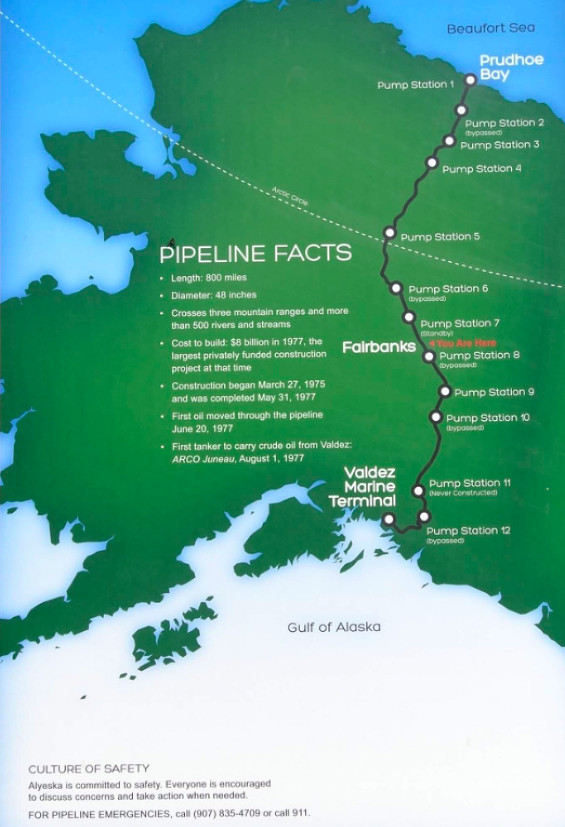
Just a couple of years later, the first commercial oil well in Alaska was completed at the remote settlement of Katalla by the Alaska Steam Coal & Petroleum Syndicate, which led to the territory’s first refinery. The 1957 discovery of oil north of Sterling at the Swanson River provided, according to Alaska’s first governor, William Egan, “the economic justification for statehood.” Despite these discoveries, Alaska remained relatively poor and dependent on federal subsidies. It was able to reverse its fortunes when, upon achieving statehood, the Alaska Statehood Act allowed the state to select 100 million acres of federal land to develop as it saw fit. The state chose the North Slope, a region with substantial oil reserves covered by permafrost. Oil was discovered in Prudhoe Bay in 1968, and began flowing in 1977, thanks to the construction of the 800-mile Trans-Alaska Pipeline to carry oil to Port Valdez in the Prince William Sound. Opponents waged a national campaign against the pipeline’s construction; however, it was eventually passed with the 1973 tie-breaking vote of Vice President Spiro Agnew in the U.S. Senate. The act included a provision banning further challenges under the National Environmental Policy Act. Since the pipeline was built, Prudhoe Bay has produced 17 billion barrels of oil.
Alaska has also been a boon for natural gas production. Discovered on the Kenai Peninsula in 1959 and in the Middle Ground Shoal in the Cook Inlet in 1963, natural gas in this region became the major fuel source for power generation for southcentral Alaskan communities. In 1969, ConocoPhillips began producing liquefied natural gas (LNG) for export to Japan from the Kenai LNG Facility, the U.S.’s only LNG export facility until 2016. Today, natural gas encompasses 58.5% of energy and 55.7% of electricity consumption in Alaska, and the state ranks fifth in the U.S. in gross natural gas withdrawals.
As with any state, Alaska’s energy story has involved peaks and valleys of production and regulation. Although Prudhoe Bay is the largest conventional oil field in North America and four of the U.S.’s top ten conventional producing oil fields are on the North Slope, oil production dropped 75% in 2020 from its peak of more than two million barrels per day in 1988 due to the maturation of conventional fields and regulatory barriers preventing producers from accessing new ones in the National Petroleum Reserve Alaska and Arctic National Wildlife Refuge. Many of the groups that opposed the original pipeline back in 1973 continue their opposition to additional oil production in areas of Alaska. Even if poor policy decisions stand in the way at times, Alaska’s potential for energy production — it holds almost 3.4 billion barrels of crude oil reserves, 125 trillion cubic feet of natural gas reserves, and 2.8 billion tons of coal reserves, according to the Energy Information Administration — makes its inclusion in the U.S. valuable for the country as a whole. And many believe its energy potential is much greater, but has yet to be cataloged because of limited exploration.
Clearly, Seward’s “Folly” was anything but. The purchase of Alaska gave the U.S. a territory worth a fortune based on its location and natural resources alone. Of course, Seward could not have predicted the progress the U.S. would make in developing Alaska. However, his decision reflected a positive, pro-growth vision for the future in which American ingenuity could transform millions of acres of largely undeveloped land into resources for human benefit. For providing the opportunity for future Americans to develop Alaska into an energy powerhouse, the purchase of Alaska deserves recognition as an American energy moment.
_______
This article is part of Fueling America: 250 Years of Energy Innovation, a special project by the Institute for Energy Research highlighting America’s unique role as a global energy innovator. To read more related content please visit Fueling250.org.