

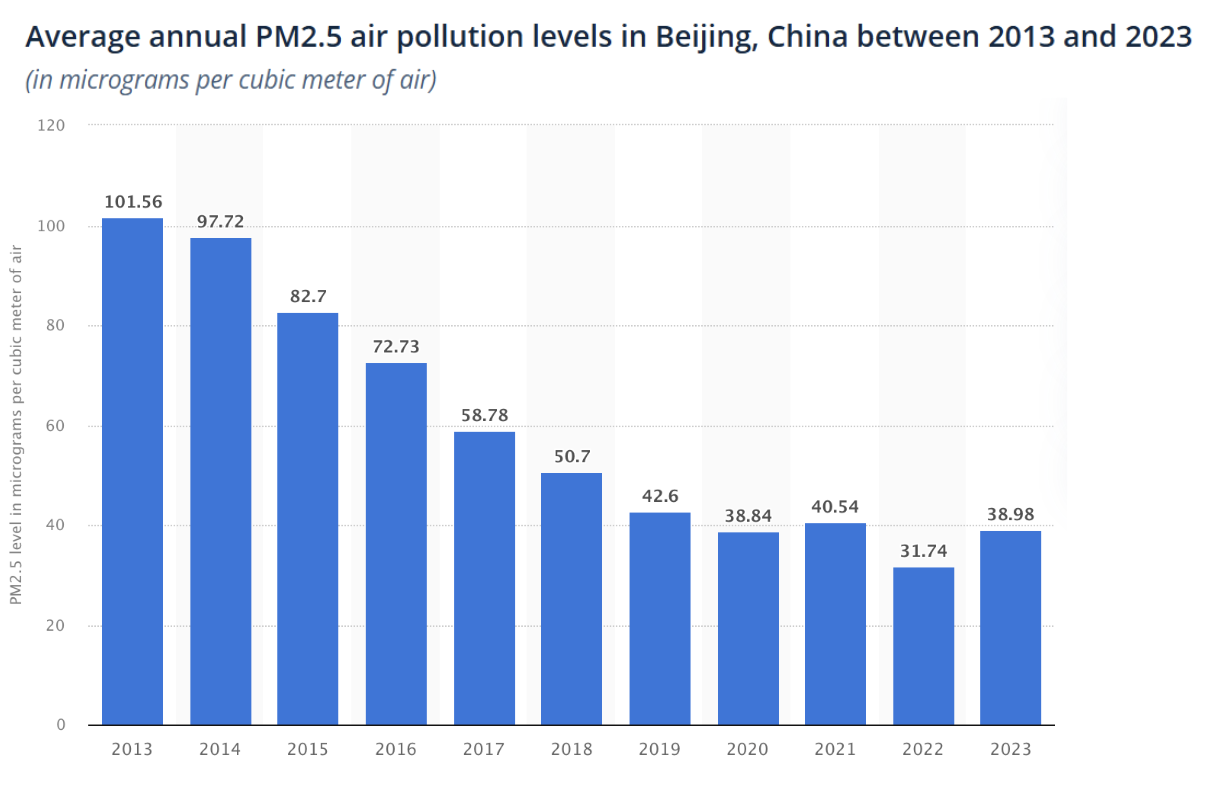
It is not carbon, but criteria pollutants, of which PM 2.5 is a contributor, that are polluting cities around the world. China is trying to reduce these real pollutants in its cities, which the graph below indicates is working, as Beijing’s air quality was good to moderate on 95.3% of days last year, up from 55.9% in 2013. But energy subsidies to incentivize the transition have ended or are being phased out, and energy costs have risen. As a result, some rural areas cannot afford heating during the winter months. The cost of heating a home over the winter in these rural areas of China is now more than some elderly couples’ pensions to the point that some villagers are secretly burning firewood, which also releases pollutants and greenhouse gases. Firewood, like coal, is banned for residential heating, but can be secured by those in rural areas.
According to Pekingnology, beginning around 2017, millions of rural homes in and around Beijing were ordered to dismantle small coal furnaces and switch to natural gas or electricity, with generous subsidies and strict enforcement to prevent households from reverting back to dispersed coal. Because such furnaces do not control combustion or pollutants effectively, the central government banned burning coal for residential heating in much of Hebei, a province of 74 million people that encircles China’s capital, in an effort to reduce air pollution in the capital. At first, local governments eased the transition by heavily subsidizing natural gas, which is three times more expensive than coal. But those subsidies are being phased out, and the residents cannot afford the cost of the alternate fuel.
Electric heat pumps are an option, but the upfront costs are above what homeowners can afford. The installation cost is more than $2,800, and the government does not offer any subsidies for them. While China gets over 50% of its central station electricity from coal, those coal generators are highly efficient with the latest environmental control technology for limiting criteria pollutants.
U.S. Success Story on Criteria Pollutants
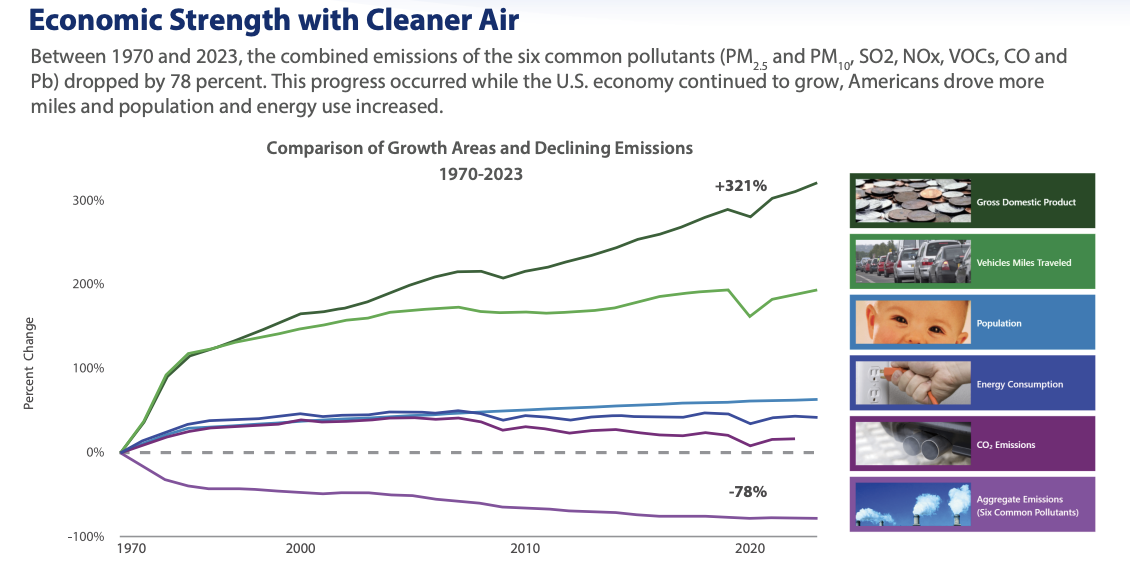
While many nations struggle to balance air quality improvements with affordable energy access — often facing trade-offs that leave vulnerable populations in the cold — the United States has reduced these pollutants without sacrificing energy affordability. Air quality in the United States was improving well before Congress enacted the Clean Air Act Amendments of 1970, which mandated reductions in so-called criteria pollutants. Since then, emissions of the six pollutants regulated under the law have fallen sharply, even as coal-fired power plants at times generated as much as 52% of U.S. electricity and still account for about 17% today. The criteria pollutants: carbon monoxide, lead, sulfur dioxide, nitrogen oxides, ground-level ozone, and particulate matter, are designated as such because the Environmental Protection Agency sets health-based limits for their allowable concentrations. From 1970 to 2023, combined emissions of these common pollutants, including fine and coarse particulates, sulfur dioxide, nitrogen oxides, volatile organic compounds, carbon monoxide, and lead, declined by 78%.
Analysis
Compared to the U.S., China is a relatively poorer country, as evidenced by the success of the U.S. in reducing the six criteria pollutants. As we discuss in U.S. Success Story on Criteria Pollutants, “One factor in improving air quality has been the pollution-control technologies used by coal-fired power plants. Today’s coal-fired electricity generating plants produce more power with less emissions of criteria pollutants than ever before. According to the National Energy Technology Laboratory (NETL), a new pulverized coal plant (operating at lower, ‘subcritical’ temperatures and pressures) reduces the emission of NOx by 83 percent, SO2 by 98 percent, and PM by 99.8 percent, as compared with a similar plant having no pollution controls. Air quality will continue to improve in the future because of improved technology.”
For inquiries, please contact wrampe@ierdc.org.

