

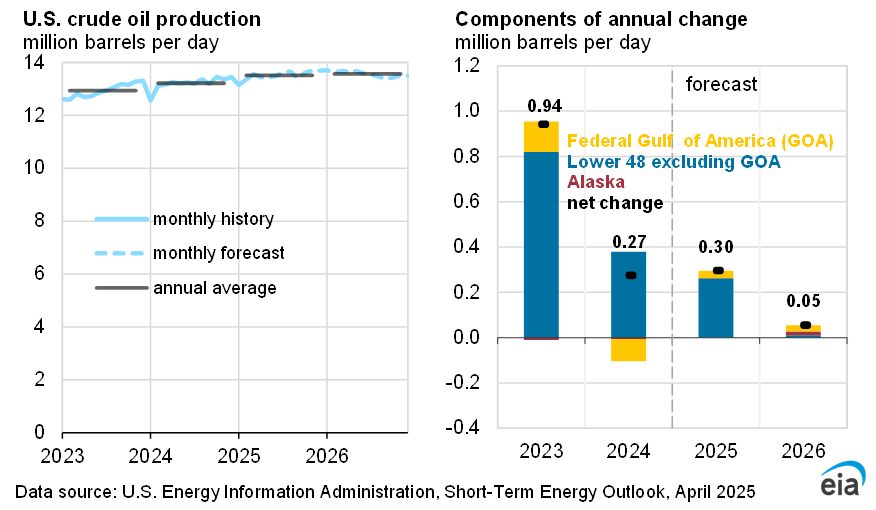
According to the Energy Information Administration’s (EIA) August Short-Term Energy Outlook (STEO), U.S. oil production is expected to reach a record 13.8 million barrels per day this year. The EIA projects the Lower 48 states will contribute 11.36 million barrels per day, the Gulf of America 1.98 million barrels per day, and Alaska 450,000 barrels per day—all higher than their 2025 production. Projected 2026 U.S. oil production of 13.8 million barrels per day would account for 18.4% of projected 2026 global oil production of 74.89 million barrels per day. Total U.S. oil production of 13.59 million barrels per day in 2025 made up 17.2% of global oil production of 78.89 million barrels per day last year. The EIA forecasts global oil production in 2026 to be down 4 million barrels per day from last year.
Of the total global projected figure in 2026, OPEC+ is expected to contribute 28.99 million barrels per day (38.7%)—down from a 42.4% share last year– and non-OPEC+, excluding the United States, is expected to produce 32.11 million barrels per day (42.9%)—up from a 40.6% share last year. EIA assumes that constraints on Strait of Hormuz transits will continue through August with flows slowly increasing in September. EIA expects most oil production in the region to return to near pre-conflict averages in early 2027, with ongoing disruptions of about 0.6 million barrels per day continuing through the end of next year.
EIA estimates that crude oil and petroleum liquids transported through the Strait of Hormuz averaged 4.9 million barrels per day in the second quarter of 2026, down from an average of 21.6 million barrels per day in the fourth quarter of 2025 before the conflict in the Middle East began. It estimates that total volumes of crude oil and liquids through the Bab el-Mandeb Strait averaged 8.1 million barrels per day in the second quarter of 2026, up from an average of 5.4 million barrels per day in the fourth quarter of 2025 as Saudi Arabia re-routed crude oil flows away from the Strait of Hormuz through the East-West pipeline to the port of Yanbu on the Red Sea. EIA projects that production shut-ins averaged 5.5 million barrels per day in July.
According to EIA, reduced oil shipments through the Strait of Hormuz are expected to lower global oil inventories further in the coming months and keep oil prices near levels seen in the first week of August. EIA expects the Brent oil spot price to average around $85 per barrel in the third quarter of 2026 and to gradually fall to an average of $69 per barrel in 2027 as inventories rebuild, with most Middle East production expected to recover by early 2027. U.S. commercial crude oil inventories are expected to remain below the five-year (2021–2025) low through the end of 2026 with weekly declines since mid-April due to increased oil exports, reduced imports, and high refinery runs.
EIA sees ongoing tightness in global petroleum product markets, thereby supporting refinery margins for U.S. refiners through the end of the year. U.S. refinery margins in July increased because of lower global market activity due to lower refined product exports from Russia as a result of the war with Ukraine, the resumption of the conflict around the Strait of Hormuz limiting refined products from refineries in Saudi Arabia and Kuwait, and reduced crude oil runs from refineries in China due to its ban on petroleum product exports until its recent gradual lifting of the ban. EIA expects U.S. retail gasoline prices to average $3.78 a gallon this year, dropping to $3.29 a gallon next year, and U.S. retail diesel prices to average $4.85 per gallon this year, dropping to $4.07 a gallon next year. California’s significantly higher prices skew the national average because of its anti-oil and gas policies.
Conclusion
EIA’s August Short-Term Energy Outlook expects U.S. oil production this year to set a record at 13.8 million barrels per day, accounting for 18.4% of projected global oil production totaling 74.89 million barrels per day–4 million barrels per day less than last year’s global oil production. EIA assumes constraints on Strait of Hormuz transits will continue through August, with flows slowly increasing in September, and that most Middle East oil production will return to near pre-conflict averages in early 2027. It expects ongoing disruptions of about 0.6 million barrels per day to continue through the end of next year. The Brent oil spot price is projected to average around $85 per barrel in the third quarter of 2026 and to gradually fall to an average of $69 per barrel in 2027 as inventories rebuild. EIA expects U.S. retail gasoline prices to average $3.78 a gallon this year, dropping to $3.29 a gallon next year, and U.S. retail diesel prices to average $4.85 per gallon this year, dropping to $4.07 a gallon next year.
For media inquiries, please contact press@ierdc.org.

