

Liquefied natural gas (LNG) export growth, rising data center electricity demand, and manufacturing are accelerating pipeline construction across multiple U.S. regions to connect gas-producing areas to demand facilities. Williams Companies is beginning construction on the Northeast Supply Enhancement expansion of its Transco network — the first major new pipeline project in New York in more than a decade. Natural gas is needed because the state’s clean energy policies are causing electricity prices to rise. According to Fortune, the construction of gas pipelines in the United States is at its biggest growth surge in nearly 20 years, since the beginning of the shale gas boom.
Over 150 pipeline projects are planned nationwide, representing about 150 billion cubic feet of new capacity, according to the analytics firm, Arbo. Long-haul pipelines are being constructed to LNG export hubs in Texas and Louisiana, and smaller gas pipelines or expansions are happening across the country to connect data centers with gas-fired power. Via OilPrice, in 2026, 12 projects for new or expanded gas pipelines are set to be completed in Texas, Louisiana, and Oklahoma, which will increase the U.S. Gulf Coast region’s capacity to transport natural gas by 13%. According to Wood Mackenzie, companies have committed $50 billion worth of investments in new gas pipelines that would add 8,800 miles of new pipeline in the United States.
Fortune reports that the Northeast Supply Enhancement pipeline will expand the Transco natural gas network in New York, New Jersey, and Pennsylvania. It includes installing pipeline loops, adding pipeline segments next to existing pipelines, modifying existing facilities, and connecting new infrastructure to existing systems. It will bring much-needed natural gas into the area from the Pennsylvania gas fields. The project is expected to be completed in the fourth quarter of 2027.
Mexico’s LNG Project Awaits Gas Pipeline from the United States
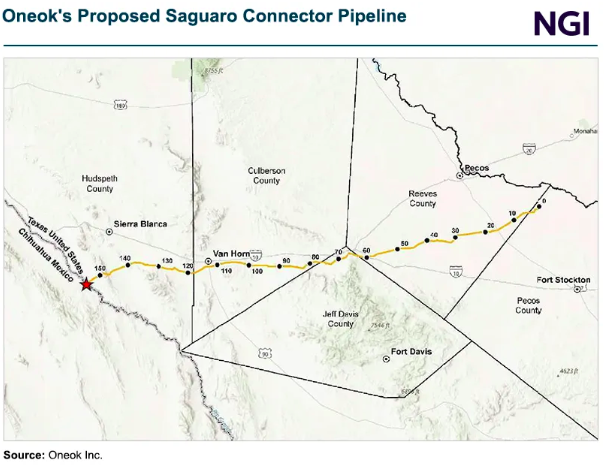
Saguaro Connector Pipeline LLC has asked the Federal Energy Regulatory Commission (FERC) for a three-year extension to complete a cross-border pipeline segment that would feed an LNG project in Mexico. The project, which was originally to be completed by February 15, 2027, under FERC’s 2024 authorization, was to construct and place into service a 1,000-foot, 48-inch-diameter pipeline crossing the Rio Grande in Hudspeth County, Texas. The pipeline is to supply natural gas from the Permian Basin to a proposed LNG export terminal in Mexico. The delay was caused by prolonged litigation, ongoing commercial negotiations, and the timing of a planned LNG export facility on Mexico’s west coast.
EIA’s Annual Energy Outlook Supports Robust Natural Gas Growth
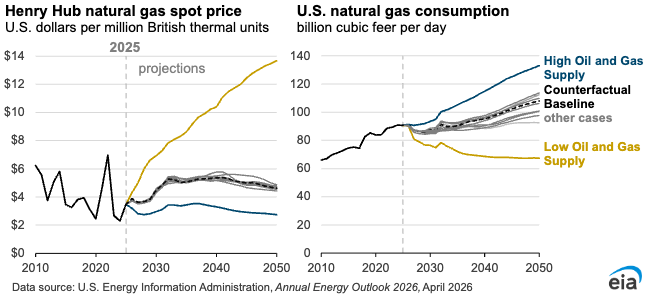
In its 2026 Annual Energy Outlook, the Energy Information Administration (EIA) expects robust growth of natural gas in both the export market and in the generating sector. U.S. exports of natural gas are the fastest-growing source of natural gas demand across all cases that the EIA considers, with LNG export capacity expected to increase to 27.7 billion cubic feet per day by 2030 through planned projects. In addition to these additions through 2030, the EIA projects that additional LNG export capacity will be built in the 2030s and 2040s across most of its cases due to prices remaining economic in global markets, resulting in LNG export volumes ranging from 29.6 billion cubic feet per day to 37.9 billion cubic feet per day by 2050.
The EIA projects that natural gas use for electric power generation by 2050 increases more than it does in any other end-use sector, rising from 35.2 billion cubic feet per day in 2025 to between 38.1 billion cubic feet per day and 50.4 billion cubic feet per day in 2050 in most cases considered due to higher electricity demand and some policy and methodological changes. It also expects industrial sector natural gas use to grow, with consumption in 2050 projected to increase in most cases by 11% to 35% from 2025 levels. The growth is due to consumption in bulk chemicals and other natural gas-intensive industries, and because natural gas increasingly replaces coal as a boiler fuel in the forecast.
With natural gas demand increasing both at home and abroad, the EIA projects dry natural gas production to rise significantly, from 107 billion cubic feet per day in 2025 to between 133 and 151 billion cubic feet per day by 2050 in most cases. Natural gas production is expected to increase the most in the East region, where the Appalachian Basin is located, since production costs are relatively low. Natural gas production in that region increases from 37 billion cubic feet per day in 2025 to between 66 and 73 billion cubic feet per day by 2050 in most cases. Regions with significant associated natural gas — gas extracted as a by-product of crude oil — also contribute to higher natural gas production across all cases.
The increased output from the East region requires new infrastructure to move natural gas to the Gulf Coast to accommodate growing demand. The buildout is supported by price differences between the relatively low-cost natural gas in Appalachia compared with that produced near the Gulf Coast, where the Henry Hub is located.
In the EIA’s High Oil and Gas Supply case, where more recoverable resources are assumed available, most of the additional gas supply comes from regions rich in associated gas, such as the Permian Basin, or from areas in close proximity to demand centers, with the Haynesville play being a key contributor. In this case, the lower-cost, higher-productivity unconventional resources from these regions make further increasing production out of the gas basins in the East (for example, the Marcellus) uneconomic because of the additional pipeline infrastructure costs that would be needed.
Analysis
Due to rising natural gas demand from LNG export projects, electricity generation, and manufacturing demand, pipeline capacity to move natural gas from producing areas to consumption centers is set to increase, exemplified by the construction of the Northeast Supply Enhancement project and the Saguaro project. Pipelines are an essential component of the energy supply chain, providing safe and reliable transportation across the country. As IER’s Alexander Stevens explains, “Pipelines are critical to modern life, delivering the energy and resources that power homes, businesses, and industries. Most importantly, they do so with an impressive safety record, thanks to advanced engineering, real-time monitoring, and strict oversight.”
For inquiries, please contact wrampe@ierdc.org.

