

China views Canada as the perfect springboard for Chinese cars to enter the U.S. auto market, the world’s second largest after its own. China’s BYD, the world’s largest EV maker, plans to open six dealerships in Canada and has begun compliance procedures to import two passenger cars into the country. China’s biggest auto exporter, Chery, held its first meetings with car dealers in Canada just two weeks after Canadian Prime Minister Mark Carney announced limited EV imports from China into the Canadian market, despite meager prospects for near-term sales and profits. Chery plans to launch sales in Canada in the fourth quarter and is road-testing vehicles to assess how Canada’s cold climate could affect warranty costs. Lotus, a luxury sports carmaker owned by China’s Geely, also plans to open a half dozen Canadian dealerships this year – just to sell a few hundred cars. And state-owned automaker Changan has a team working on a Canada launch.
Canada approved imports of 49,000 cars annually at a low tariff rate of 6.1%, rising to 70,000 cars over five years. Canada’s car market is similar to that of the United States in consumer tastes and industry regulations, so shifting to the U.S. market would be trivial for Chinese automakers. The only major difference in the two markets is size. Last year, in Canada, 1.9 million cars were sold, compared with more than 16 million in the United States.
Chinese competition frightens U.S. automakers, who have seen their sales plunge in China, the world’s largest car market, in recent years as EV and hybrid sales have risen due to China’s heavily subsidized, innovative industry that rapidly incorporated technologies consumers wanted. Those technologies also provide opportunities for China to procure information about U.S. drivers and the United States, which worries intelligence experts. The Alliance for Automotive Innovation warned that Canada’s trade arrangement with China could create a potential “backdoor” for Chinese vehicles to reach American consumers. The group argues that Chinese vehicles pose both economic and national security concerns, whether they are imported directly or manufactured locally.
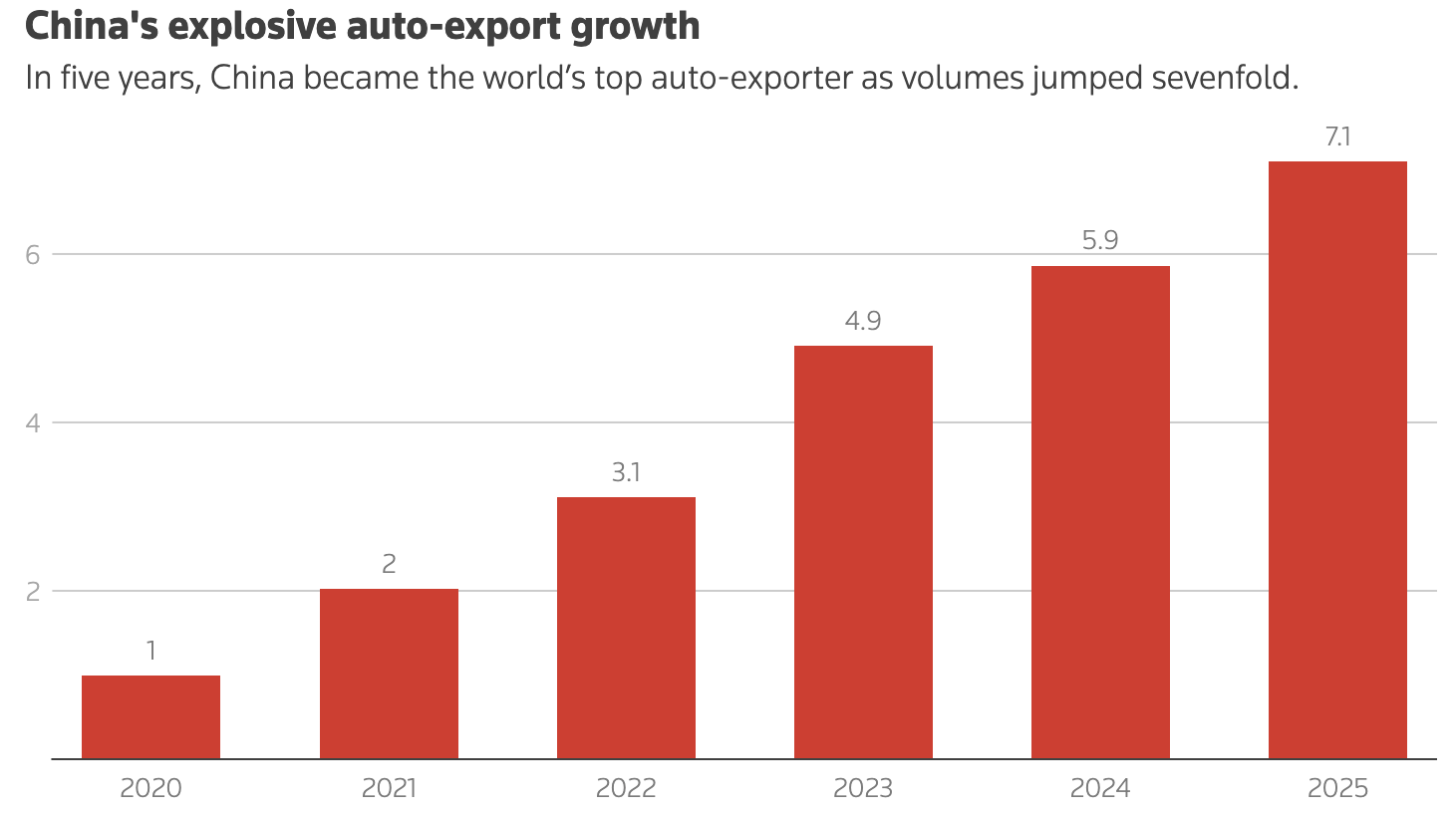
China has also become the world’s largest auto exporter, surpassing Germany, Japan, Mexico, South Korea, and the United States, largely due to China’s electric vehicles displacing gasoline vehicles, according to Reuters. As depicted below, China’s auto exports rose sevenfold over five years.

Currently, Chinese carmakers are blocked by U.S. tariffs and a U.S. ban on Chinese connected-car hardware and software—actions taken by the Biden and Trump administrations. U.S. lawmakers are working to codify the ban amid concerns over national security and growing Chinese competition. The United States also wants Canada and Mexico to erect trade barriers on Chinese cars. At President Trump’s urging, Mexico reversed its policies on China’s electric vehicles and imposed a 50% tariff.
In early May, Tesla started selling a Chinese-made Model 3 at about C$40,000 ($29,148), about half the price it charged in Canada for its U.S.-made version. The U.S. company imported over 44,000 Chinese-made cars into Canada in 2023, the year before tariffs were imposed. BYD is still deciding which models to launch in Canada and plans to start sales next year.
In 2022, BYD studied the establishment of a U.S. distribution network, engaging a Detroit-based consultancy. Reuters reports that BYD plans to increase its overseas sales to half of all vehicles, up from 23% of the 4.6 million cars it sold globally last year – a goal experts believe will be hard to meet without the U.S. market.
Canada’s EV Deal with China Could Affect a U.S.-Canada Trade Deal
Brian Kingston, head of the Canadian Vehicle Manufacturers Association, said the Carney government’s ambition to allow Chinese EV manufacturers to expand production in Canada poses a risk to renewing the Canada-United States-Mexico Agreement and to persuading President Trump to drop the 50% sectoral tariffs on Canadian autos, steel, and aluminum. Canada, in his opinion, needs to work with the Americans on a joint approach to China and not diverge from U.S. interests. The United States has been very clear about its concerns regarding the entry of Chinese and electric vehicles into North America, according to Kingston.
According to Carney, most of that import quota will be filled by Tesla’s made-in-China vehicles, which will be shipped to Canada. But while there is a cap, the deal provides for a rising level of Chinese electric vehicles that China’s automakers can access. According to Canadian Industry Minister Melanie Joly, Chinese carmakers are interested in forming joint ventures to make electric vehicles with Canadian labor, parts, and standards. But Canadian auto industry leaders disputed the claim, arguing it did not make business sense. They are worried about what the Chinese EV’s entrance into Canada’s auto market means for obtaining a deal with the United States.
Conclusion
Chinese automakers are targeting the Canadian market as a strategic entry point to the U.S. auto market. The Canadian government has approved limited imports of electric vehicles from China, facilitating their entry into the country. Companies like China’s Chery and BYD are establishing dealerships in Canada despite lower profit margins and a small Canadian auto market. U.S. automakers are concerned and view China’s interest in Canada’s auto market as a strategy to gain access to the much larger U.S. auto market. Further, Canada’s auto industry is worried about how the Canada-China deal will affect a U.S.-Canada trade deal, which they see as far more important given U.S. tariffs of 50% on aluminum, steel, and Canadian autos. China is the world’s largest auto exporter, and its growing presence in North America would reshape the global automotive industry.
For media inquiries, please contact press@ierdc.org.

