

The U.S. oil blockade on Cuba is contributing to blackouts across the island, with nighttime lighting reduced by as much as 50%. Last year, China provided Cuba with a gigawatt of photovoltaic solar panels. On top of that, Cuba will soon begin installing 5,000 2-kilowatt solar panels donated by China, which has also provided technical advice. According to Belly of the Beast, the panels will be installed in a wide range of locations, and many will not connect to the national grid. Just over half of the panels will go to maternity homes, nursing homes, senior centers, emergency rooms, funeral homes, banks, municipal radio stations, radio transmitters, internet communications facilities, and the commercial offices of the Electric Union, the state-run electric company. The rest will be installed in “isolated” homes, some of which have never had electricity. The solar panels will provide relief to institutions that cannot afford electricity interruptions, but will not solve the overall electric grid problem because solar power is intermittent, and the capacity donated is insufficient to replace Cuba’s oil-dependent electric grid. Cuba’s goal is to reach 24% renewable energy by 2030.
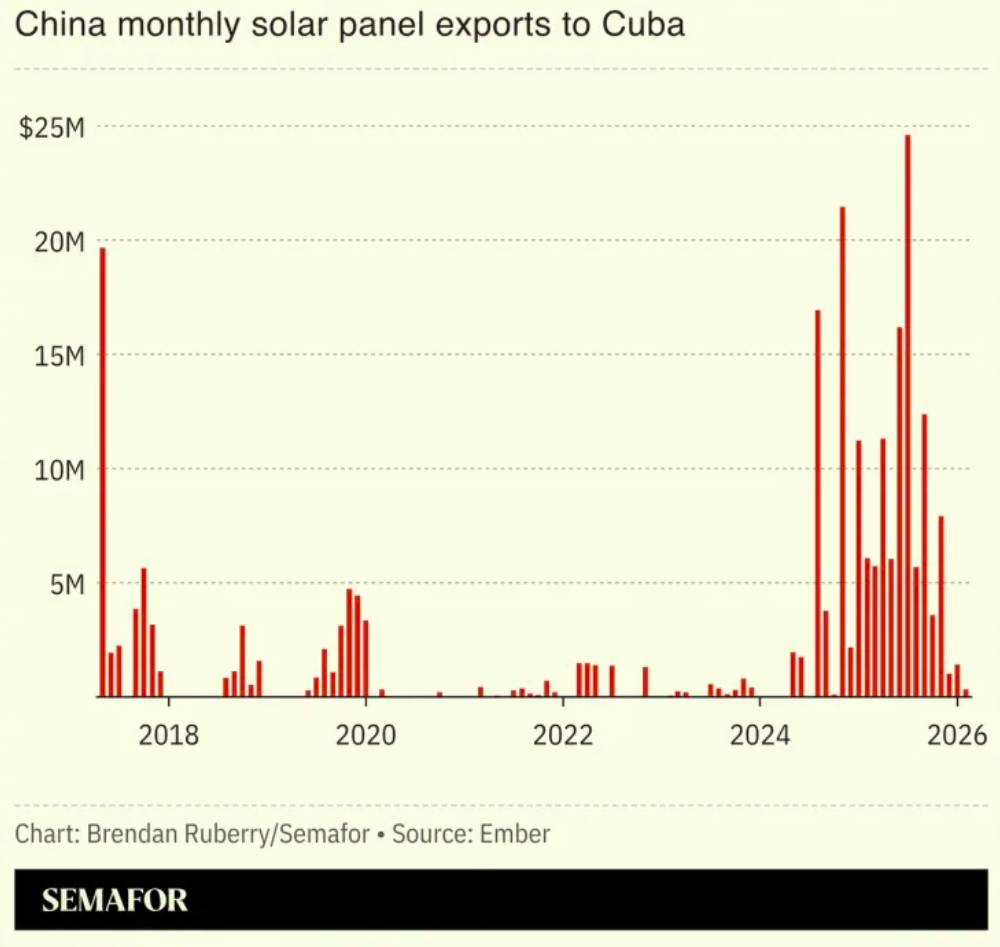
According to the New York Times, solar power will help address power outages, as the blockade has led to severe shortages of oil, gas, and diesel fuel. It takes over a month for a private car in Cuba to fill up with gas because it has to join a virtual queue, but an official government car, such as a taxi, can fill up once a week. As a result, gas has been selling on the black market.
The blockade has also incapacitated Cuba’s universal health care system, with hospitals canceling surgeries because doctors and nurses cannot commute to work. Clinics are struggling to administer treatments like chemotherapy and dialysis, and refrigerated vaccine stocks could spoil because of power outages. Many ambulances are parked due to insufficient gas. Pharmacies are largely empty, as medicine production has mostly stopped due to the factories running on diesel. Vaccine makers are searching for ingredients because flights that once brought them are canceled due to a lack of jet fuel.
China Is Expected to Do Well with Renewable and EV Exports
According to the Washington Post, China will benefit from the Iran conflict, given its world-beating green-tech sector, which has suffered from overcapacity in recent years. The conflict with Iran has renewed interest in renewable energy and electric vehicles (EVs) due to the rising cost of oil and liquefied natural gas (LNG) resulting from the 10% deficit in global oil supplies and Qatar’s production cut to LNG.
Factories in Asia are curbing production to save energy, and some gas stations are telling drivers they cannot fill up, hoping volumetric limits help mitigate the short-term impacts of the war. Countries across Asia are switching to coal-powered electricity generation. In Japan, coal could offset up to 70% of gas-fired power generation, and the country is also looking toward reviving nuclear power. Taiwan may restart two coal-power units. Via Semafor, to be less dependent on oil and gas in the future, the Philippines plans to install 100 gigawatts of solar power in the next two years, and Germany is planning to spend billions toward expanding wind power and promoting EV sales.
Thus, the Iran war may help China further expand its renewable and EV export sales, despite doing well even before the conflict began. As reported by The Wire China, African nations imported 18.8 gigawatts of solar panels from China in 2025 — 48% more than in 2024. The continent is a huge market for China’s solar panels since almost 600 million people still lack electricity there. China’s exports of batteries and electric vehicles rose 27% year-on-year in 2025, and sales of wind turbines rose nearly 50%. China’s battery manufacturer CATL’s Hong Kong-listed shares have gained nearly 30% since the war began, while its EV manufacturer BYD’s sales last month were 65% higher than a year ago.
China is the world’s leading exporter of automobiles, having mastered the EV market by producing inexpensive electric vehicles with new models quicker than its competitors. Low energy prices, cheap labor, dominance in the rare earth, mineral, and battery markets, and government subsidies have helped China expand its EV market at home and abroad. China has reached this dominance by burning over half of the world’s coal annually. Electric vehicles and hybrids made up almost half of all new car sales in China, helping the country reduce gasoline consumption and oil imports at a particularly good time, given the Iranian conflict.
Analysis
Lacking oil, Cuba has turned to China for help to supply power to the island through solar panels. The solar panels will provide some relief to institutions that cannot afford electricity interruptions, but will not solve the overall electric grid problem resulting from the blockade. According to an article by Ricardo Torres of Columbia Law School’s Cuba Capacity Building Project, “The recovery of the Cuban electrical system requires more than simply adding megawatts of installed capacity. It requires access to financing, operational discipline, and an incentive framework that values productivity and maintenance. Without these foundations, the grid will remain trapped in a cycle of temporary solutions—more rationing, greater wear and tear, and mounting losses—that erode economic activity and increase social discontent.”
For inquiries, please contact wrampe@ierdc.org.

