

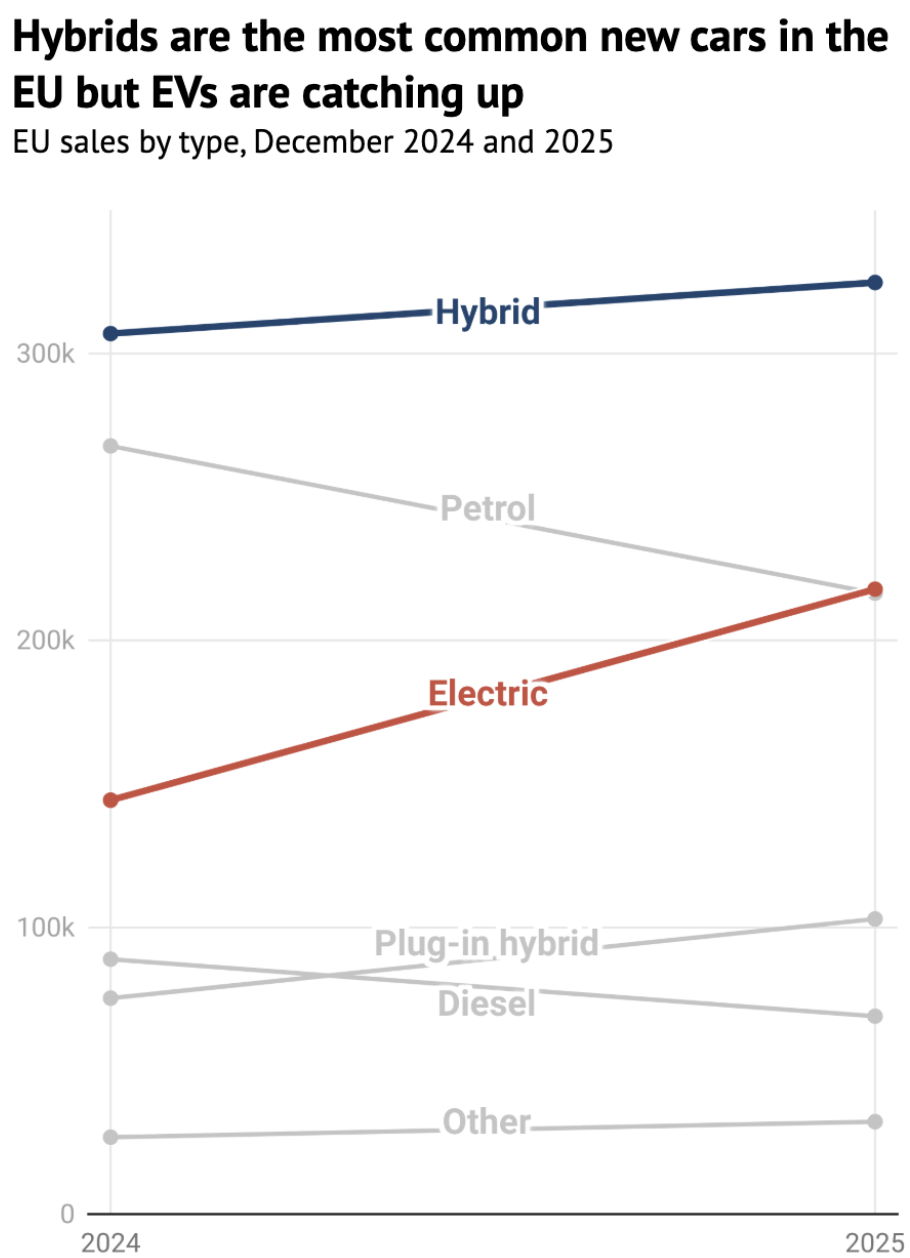
Sales of electric vehicles (EVs) overtook those of gasoline-powered vehicles in the European Union in December 2025 for the first time, with “hybrid” vehicles outselling both. The European Automobile Manufacturers’ Association found that registrations of battery electric vehicles reached 217,898, up 51% year-on-year from December 2024, with a market share of 22.6%. Sales of gasoline-powered cars in the EU fell 19% year-on-year, from 267,834 in December 2024 to 216,492 in December 2025, with a market share of 22.5%. Hybrids had the largest share of sales at 44% in December. The figures exclude hybrid vehicles that run on gasoline with regenerative braking and plug-in hybrid vehicles that also have battery power. Despite the good showing in December, for the 2025 calendar year, EV sales in the EU were 17.4% of the market, up from 13.6% in 2024. Registrations of gasoline-powered cars fell by 18.7% in 2025, with all major markets in the EU seeing a decrease. Total EU car sales rose 5.8% to almost one million vehicles in December, and by 1.8% to 10.8 million for the year.
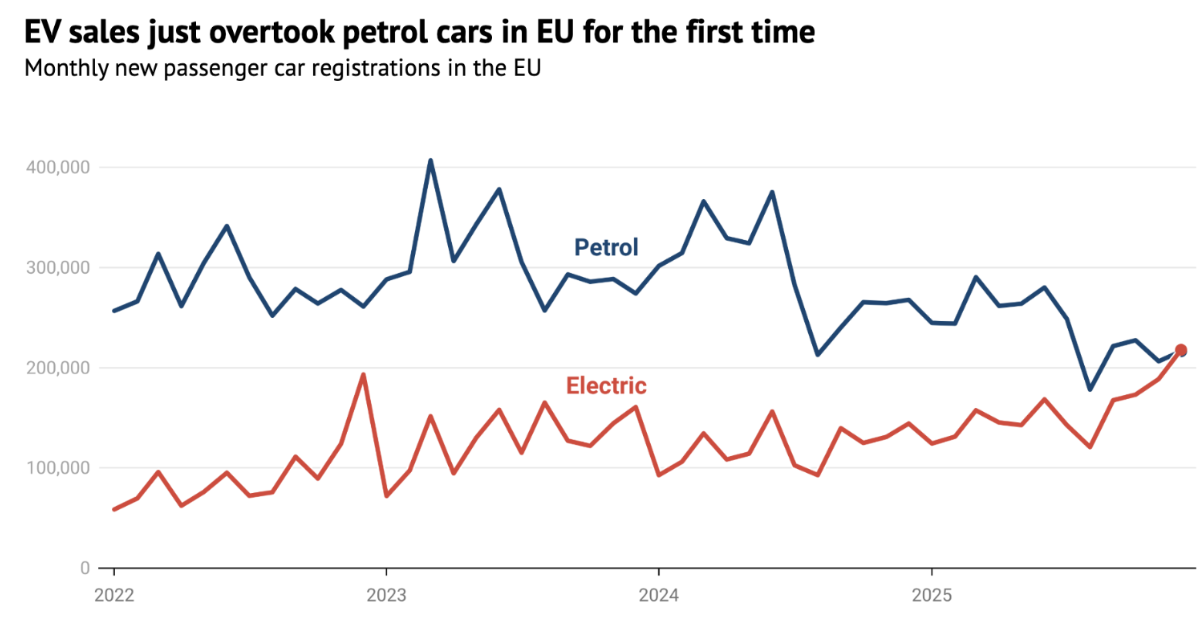
As Carbon Brief reports, in 2025, four countries accounted for 62% (1,880,370) of the EV registrations: Germany, the Netherlands, Belgium, and France. Registrations of gasoline-powered cars in 2025 totaled 2,880,298 in the EU. France accounted for the steepest decline in gasoline-powered vehicle registrations at 32%, followed by Germany (-21.6%), Italy (-18.2%), and Spain (-16%).
Hybrid vehicles fueled by gasoline or diesel with regenerative braking are the largest segment of the EU car market, with sales rising 5.8% from 307,001 in December 2024 to 324,799 in 2025. Battery electric vehicles and plug-in hybrids grew faster, with sales up 51% and 36.7% in December 2025, respectively.
According to Carbon Brief, the EU’s new climate proposal for autos requires a 90% cut in tailpipe carbon dioxide emissions from 2021 levels by 2035. Previously, the EU planned on banning the sale of gas cars starting in 2035. The new proposal requires that the remaining 10% of emissions be compensated through the use of low-carbon steel made in the EU or from e-fuels and biofuels. According to European automakers, the EU’s rigid car and van emission targets for 2030 and 2035 were no longer feasible as Europe’s top automakers face a global market challenged by Chinese EV imports and American trade barriers. Despite the slightly relaxed policy proposed, auto manufacturers had already geared up for the more stringent rules, which may have affected overall EV sales in the EU, particularly in December.
Tesla Leads EV Market Sales
According to The News Wheel, among Europe’s best-selling electric vehicles in 2025, the Tesla Model Y held the top position with registrations at 151,331 units, despite a 28% drop in sales. The Skoda Elroq, made by the Czech automaker Skoda, came in second with 94,106 sales, followed by Tesla’s Model 3 with 86,261 units. Also in the top five were the Renault 5 E-Tech and the Volkswagen ID.4, with 81,517 and 80,123 sales, respectively. Volkswagen had three models in the top seven: ID.4, ID.3 (78,667 units), and ID.7 (76,368 units). BMW and Kia also had models in the top ten, with the iX1 and EV3, while the Skoda Enyaq closed the list at 65,787 units sold.
Worldwide EV Growth
Electric vehicle demand grew across almost every region in 2025, except North America, where sales were down 4%. Global EV sales rose 20% to 20.7 million units, with China accounting for 12.9 million units, a 17% increase. China has minimal oil resources and provides lucrative subsidies for EVs.
EV sales were up only 1% in the United States, affected by the elimination of federal tax credits as of September 30, 2025, changes to the Corporate Average Fuel Economy standards that dropped fines to zero, and the introduction of policies to onshore vehicle production and supply chains. EV sales in Canada fell by 41% due to the removal of subsidies early in 2025. In contrast, EV sales in Mexico grew by 29%, with the majority of this growth driven by imports of electric vehicles from China. To protect its auto industry and at the urging of President Trump, Mexico upped its tariff on Chinese vehicles to 50%.
Analysis
In contrast with the U.S., Europe is moving full steam ahead with the transition to EVs, backed by stringent emissions standards. As we’ve written previously, “Subsidies have played a significant role in increasing the prominence of EVs globally, and data indicate that EVs become less popular when subsidies are removed. To ensure consumers have access to the cars that best suit their needs, governments should step out of the way by cutting subsidies and regulations promoting certain vehicle types over others, allowing price signals to guide market decisions.”
For inquiries, please contact wrampe@ierdc.org.

