

The price of Brent crude oil, the international benchmark, rose to almost $99 a barrel after Iran’s Houthi allies in Yemen struck two Saudi oil tankers in the Red Sea. The Houthis’ strikes were the first since the group announced a blockade on Saudi ships earlier this week, which has the potential to create a second choke point for global shipping. According to the Houthis, the Encelia and the Layla were violating their blockade. The group claimed that the strikes had caused large fires on both vessels. According to Reuters, Houthi attacks on tankers could effectively close the Bab el-Mandeb strait – the “Gate of Tears” – which controls access from the Red Sea to the Indian Ocean, the second most important waterway for energy markets after the Strait of Hormuz at the mouth of the Gulf. And, according to Iran’s Islamic Revolutionary Guards Corps, one of three oil tankers trying to pass through a “mined route” south of the Strait of Hormuz caught fire after an explosion, prompting the other two ships to turn back.

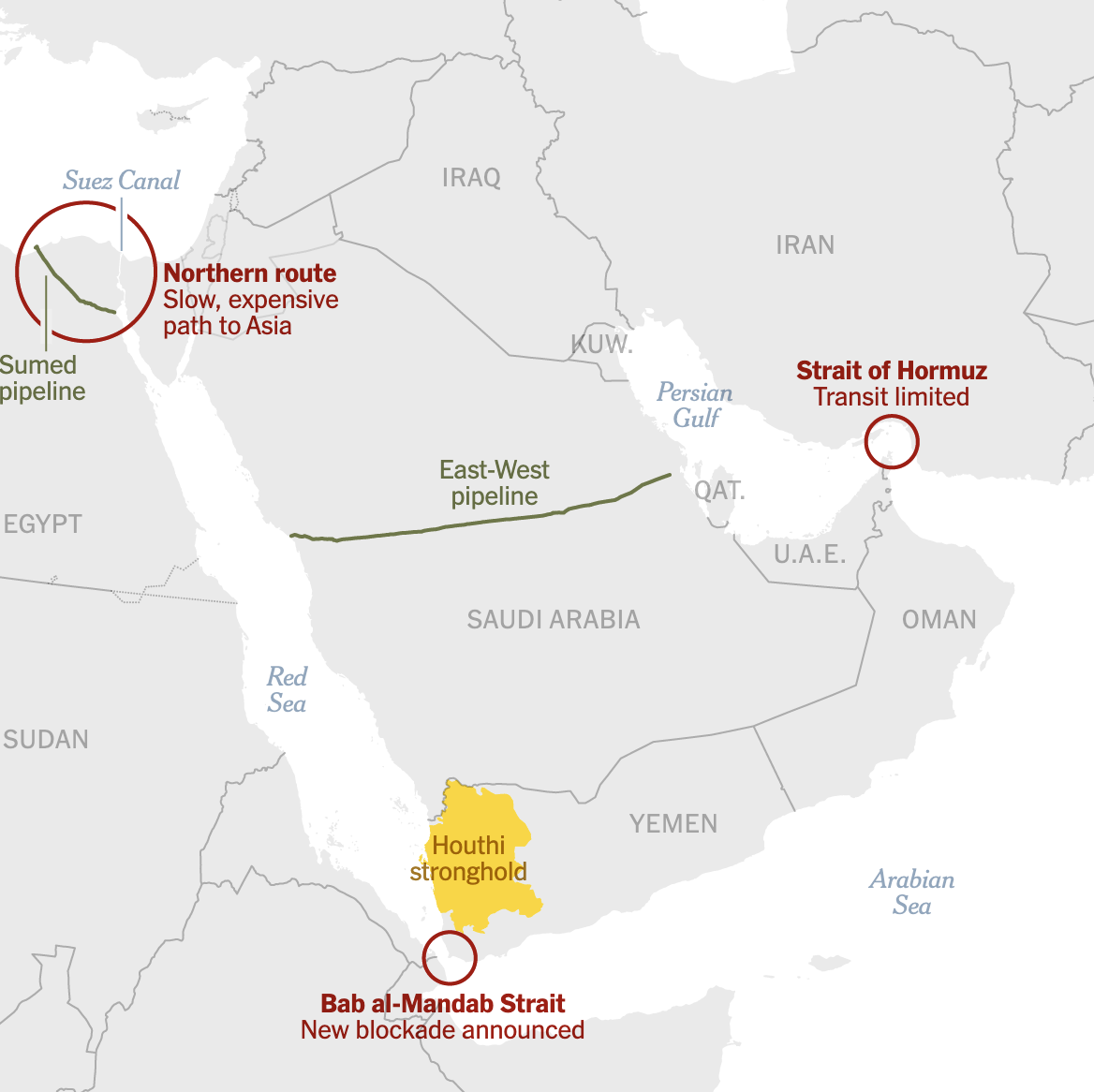
Since the Houthis announced their blockade of the Red Sea, several tankers have changed course to avoid the Bab el-Mandeb, heading north through the Suez Canal and potentially taking a much longer, more expensive route to reach Asian customers by sailing around Africa. Three oil tankers loaded with Saudi oil for China and India made U-turns in the Red Sea, heading towards the Suez Canal rather than transiting via the Yemeni coast. The Houthis told shipping companies not to load or discharge cargo at Saudi Arabian ports, or they may be targeted. Ships with links to Israel, the United States or Saudi Arabia are at a higher risk of being attacked by the Houthis and are being advised to avoid voyages through the Red Sea and Gulf of Aden until the threat level decreases.
Saudi Arabia has been using its Yanbu port as the outlet for its east-west pipeline via the Red Sea, where it was exporting about 5 million barrels of oil per day. Some 12% of global seaborne oil passed through Bab al-Mandeb before the war. Loadings at Saudi Arabia’s Red Sea port at Yanbu have averaged around 4 million barrels a day since the war began, up from around 1 million barrels a day before the war. Of those, about 2.5 million barrels a day head south through Bab al-Mandeb, toward Asia. Two Chinese supertankers carrying a combined 4 million barrels of oil were attempting to exit the Red Sea via the Bab el-Mandeb Strait on July 23, apparently escaping a blockade on shipments of Saudi oil by Yemen’s Houthi militias even as other Saudi vessels came under attack.
War risk insurance costs have risen with risk assessments for Saudi ports being re-evaluated, according to the insurance industry. Indicative war risk premiums rose to around 0.75% of the value of a ship, from around 0.3% before the Houthi blockade announcement. The full closure of the Bab el-Mandeb strait, the southern gateway linking the Red Sea to the Gulf of Aden, would halt Saudi oil exports to Asia and could reduce global oil supply by 7%.
Re-routing cargoes from the Red Sea via the Suez Canal to reach buyers in Asia will add another 10,000 nautical miles and an extra 34 days en route to circumvent Africa, resulting in additional estimated freight costs of more than $5 million, excluding fuel or insurance costs. In addition, transit costs to cross the Suez Canal would be about $1 million per vessel, according to Reuters. Further, the Suez cannot handle Very Large Crude Carriers (VLCC’s), the largest class of oil tankers, which can carry upwards of 2 million barrels in a single load. The Saudis will be forced to source smaller ships to carry their oil.
Brent oil futures crossed the $100 per barrel mark for the first time since May 26 by late morning ET on July 23. The international benchmark was up about 7% at $100.70 per barrel by 11:41 a.m. ET. U.S. West Texas Intermediate oil advanced about 6% to $92.25 per barrel. Oil prices have risen more than 30% this month as fighting in the Middle East escalates.
Conclusion
Oil prices rose after Iran’s Houthi allies attacked two Saudi oil tankers in the Red Sea, after the militants declared a maritime embargo against Saudi Arabia on July 20. Shipping data showed both tankers supply oil to Saudi power plants and local refineries. If the Bab el-Mandeb Strait – the “Gate of Tears” – that controls access from the Red Sea is effectively closed, it becomes a second chokepoint for oil leaving the Middle East that could halt Saudi oil exports to Asia and reduce global oil supply by 7%. An alternate route is through the Suez Canal, but it is much longer, takes longer, and is costlier, and it can only handle smaller tankers than VLCCs.

