

Against the backdrop of the Iran conflict, the International Energy Agency (IEA) produced its World Energy Outlook (WEO) 2026 report that provides forecasts of future energy supply and demand. The forecasters note that the Iran conflict led many countries to revise their energy strategies to reduce energy vulnerabilities and improve energy affordability, though not all in the same way. The IEA refocused on energy security this year, departing from years of concentration on climate change, which brought the agency back in line with its founding purpose. The authors assumed the following common directions: greater diversification of energy supplies, trade routes, fuel mixes and technology supply chains; a preference for domestically available energy resources; and a push for faster progress on electrification.
In the case of domestically available resources, the IEA refers mainly to those politically acceptable to the Eurocentric IEA: renewable energy, particularly solar and wind, and nuclear power. As of mid-year, nearly 90 gigawatts of new nuclear capacity were under construction, the highest level for more than 35 years, and over 50 countries now have plans or targets for nuclear power, including new technologies such as small modular reactors. Energy efficiency and biofuels are also expected to grow in the IEA’s WEO. Domestic fossil fuels flourish in some countries, such as coal consumption in Asia, where significant domestic coal resources and energy security concerns could encourage governments to rely on coal.
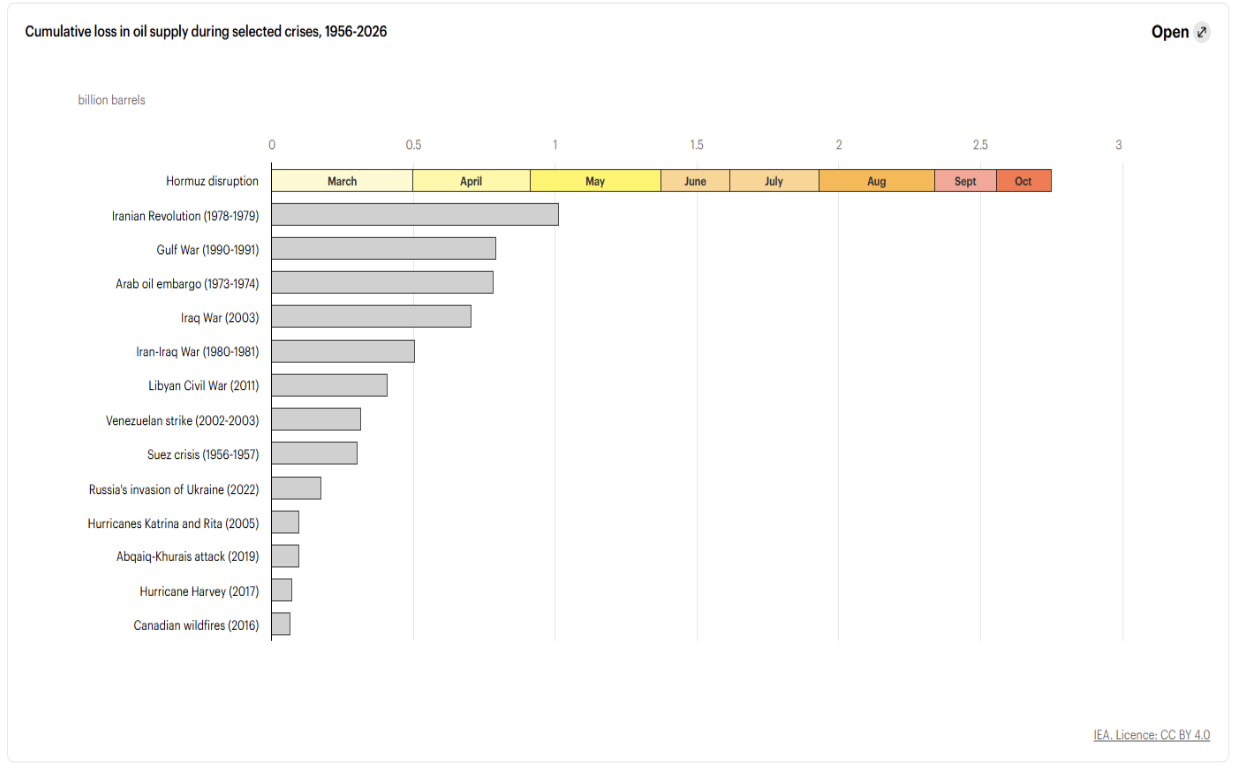
IEA says the disruption to energy flows through the Strait of Hormuz in 2026 has been the largest energy supply shock the world has faced, and the energy system has shown considerable resilience, with cumulative losses of 2.8 billion barrels of oil and 60 billion cubic meters of gas supply from the Gulf. Exports from the Gulf have varied in response to changes in the security situation. It further notes that the Middle East conflict could cut world oil demand by more than 4% by 2035 if governments accelerate electrification, efficiency and fuel-switching measures in response. Market impacts have also been heightened by risks affecting transit through the Red Sea and by disruptions to Russian supply as Russia’s invasion of Ukraine entered its fifth year.

IEA considers two major cases, among others. The Current Policies Scenario (CPS) is based on energy policies and regulations already firmly in place and shows the least change to pre-existing trends. The Stated Policies Scenario (STEPS) considers specific policy measures that have been formally put forward but not yet adopted. Both scenarios assume a continued easing of constraints on Gulf exports and sufficient stability to allow for unimpeded transit through the Strait by the end of 2027. While electrification, efficiency, and biofuels cut passenger car oil use to 2035, this is more than offset by a combined demand increase of 5 million barrels per day for petrochemicals, aviation, and heavy trucks. Even in its Stated Policies Scenario, where the pace of structural change is assumed to be faster, oil demand increases to about 103 million barrels per day by 2030 before slowing and declining.
IEA sees investment in new bypass pipelines, alternative sources of supply, and measures by importers to displace demand, reducing the need for oil flows through the Strait of Hormuz from 20 million barrels per day before the crisis to 8.5 million barrels per day in 2030 and to under 2 million barrels per day by 2035. About 7 million barrels per day of pipeline projects are under construction or being considered to let Gulf producers bypass the Strait of Hormuz at an estimated cost of $40 billion, adding around $2 to the cost of a barrel of oil exported from the Middle East. Even with reduced flows through the strait, the Middle East is expected to remain the world’s largest exporter of oil to international markets, as it can produce and ship oil at favorable rates when no major conflict exists.
IEA sees the current crisis in the Middle East accelerating the shift towards greater use of electricity. Since 2019, global demand for electricity has grown twice as fast (3.3% per year) as overall energy demand (1.5% per year), driven by the increasing use of electric motors in industry, appliances, air conditioners, electric vehicles, heat pumps and data centers. The IEA expects electricity demand to grow even faster through 2035, with electricity’s share of final energy consumption reaching 30% globally in all scenarios, up from around 23% today. Renewables, including hydroelectricity, grow strongly in all IEA scenarios: from a share in electricity generation of 33% today, renewables account for 45-50% by 2035 in IEA’s CPS and STEPS scenarios. Solar leads, followed by onshore and offshore wind, hydropower, bioenergy, and geothermal. Over the next ten years, the agency expects at least 25 million kilometers (15.5 million miles) of new power lines to keep up with rising demand and integrate new supply sources, and 15 million kilometers (9.3 million miles) of existing lines to be replaced or upgraded.
Natural gas use grows strongly, due to new LNG supply. In the STEPS scenario, natural gas demand rises to the mid-2030s before plateauing. The IEA notes that despite the Gulf having no feasible bypass routes for LNG, the risk is “somewhat mitigated” by LNG supply from other countries, particularly the United States. A large number of new LNG export projects, led by the United States, are expected to expand global LNG supply by more than 50%.
Conclusion
The IEA Outlook has shifted its focus from climate change to security and affordability, supposedly because of the conflict in Iran and the Middle East. The IEA has spent years telling the world to stop investing in new oil and gas because of climate change and the need to reach net-zero carbon emissions, but now it focuses on pipelines, LNG, and supply security, while also promoting non-carbon energy through renewables and nuclear power. While the IEA’s press release does not mention the agency’s Net Zero Emissions scenario, the report does include it and discusses it in the Executive Summary.
For media inquiries, please contact press@ierdc.org.

