

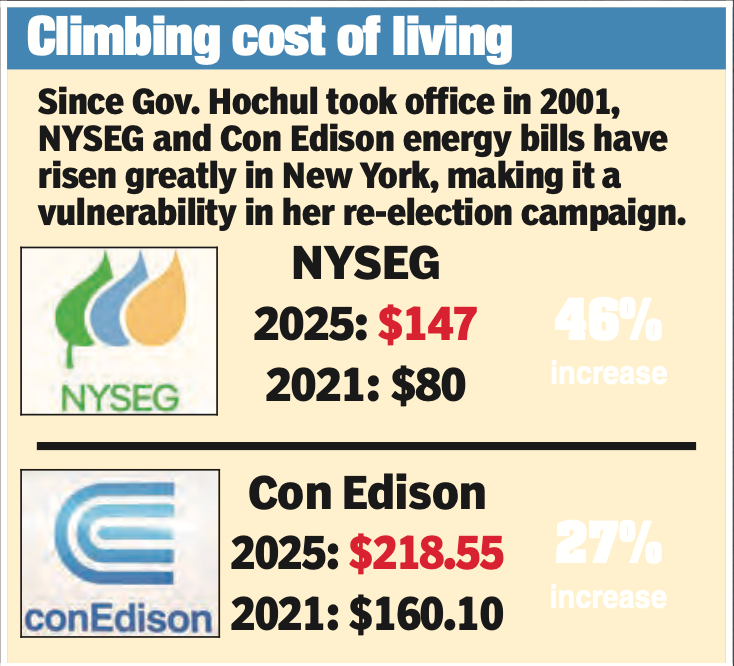
On September 14, New York Governor Kathy Hochul announced that the state will begin mailing energy rebate checks of up to $200 to 8.2 million households on September 21, with deliveries continuing through December. The checks come from a one-time $1 billion Protecting Our Wallets Energy Rebate, or POWER, included in the state’s enacted fiscal year 2027 budget. She hopes to ease the pain of high energy bills in New York, which her administration contributed to with its “green” policies. Since Hochul became governor, the New York Post reports that Con Edison’s bills have risen 27% and New York State Electric and Gas (NYSEG) bills have risen 46%.

Hochul’s opponent for governor this November, Nassau County Executive Bruce Blakeman, is offering to make energy resources within the state more accessible by allowing hydraulic fracturing that neighboring Pennsylvania allows and rolling back New York’s green initiatives that are supporting very expensive offshore wind power and solar power, both intermittent sources that need expensive batteries or other generating capacity as backup. According to Blakeman, “The Marcellus Shale holds more than 9 trillion cubic feet of clean-burning natural gas, but Kathy Hochul’s fracking ban keeps that prosperity locked in the ground.” “As Governor, I will bring fracking back to New York, unleash our energy economy while protecting the environment, and cut utility bills in half.” According to Blakeman, Pennsylvania’s use of natural gas saved families nearly $9 billion on energy bills last year.
Under NY’s rebate, joint filers with incomes under $150,000 will receive $200, and joint filers with incomes between $150,000 and $300,000 will receive $150. Single filers with incomes under $150,000 will receive $100. Eligibility for the rebate is determined from 2024 tax returns. To qualify, a taxpayer must have filed a New York State resident income tax return, been a full-time state resident, reported income within the qualifying thresholds, and not been claimed as a dependent on another return. The mailing begins seven weeks before Hochul faces her Republican challenger in the November 3rd election. It is the second consecutive year that the state has funded the program and sent rebate checks to taxpayers in the fall. Last year’s inflation refund checks, worth up to $400, went to the same number of NY households beginning on September 26, 2025.
Hochul admits that the rebate would not resolve the underlying cause of high energy prices. She attributes higher fuel costs to the war in Iran and federal tariffs, not the state’s anti-fossil fuel policies under her leadership, which have led to one of the highest electricity bills in the nation. According to the Energy Information Administration, New York’s average residential electricity price is 60% higher than the national average and 95% higher than Florida’s average price—a state where many New Yorkers have migrated. According to yearly average billing data from Con Edison and NYSEG, Hochul has presided over larger rate increases compared with her predecessor, former Governor Andrew Cuomo. Instead, Hochul focuses on the Iran conflict, saying, “The gas price is going up since Donald Trump started the war with Iran.” The average price of a gallon is $4.35, and I hope to God you don’t need diesel because that’s upwards of $6 as well, the highest in history. And this is what I’d call an unforced error.”
It is true the gas and diesel prices have escalated due to the Iran conflict, but they are expected to drop once a deal is reached that President Trump expects after the mid-term election. According to AAA, on September 16, the national average for regular gasoline was $4.36 per gallon—up 14 cents from a week earlier and up from $3.18 a year ago—with New York averaging $4.42 per gallon. AAA listed diesel at $6.31 a gallon on average. The previous record for regular gasoline, $5.02, was set in June 2022.
On September 15, Hochul announced another utility program that she described as continuous rather than one-time. The utility bill discount program could benefit 2.5 million eligible NY households. The State’s Energy Affordability Program offers qualifying residents discounts of up to $500 annually on their utility bills. According to the governor, eligibility expanded earlier this year to include anyone earning below the state or area’s median income. Of course, the program would not be necessary if NY residents were offered the electric rates that states without net-zero carbon policies pay, such as Florida. New York stands out for high prices because it has significant natural gas resources that it deliberately refuses to develop as a matter of state policy.
On July 14, Hochul issued the nation’s first statewide moratorium on large data centers, those of 50 megawatts or more, imposing up to a one-year moratorium over concerns that the data facilities are raising power costs, straining water supplies and burdening local communities. According to Hochul, data centers that come to the state after the moratorium ends would have to generate their own power, pay into a statewide fund supporting transmission infrastructure, and show that local ratepayers’ bills were going down. Although some argue electricity prices are rising because of data centers, an IER study shows this is not the case, pointing instead to state energy and climate policies as the cause of rising rates. It also shows that states with growing electricity demand saw smaller increases in electricity rates.
The Epoch Times reports that the NY fiscal year 2027 budget that created the energy rebate program also created a Ratepayer Protection Plan and a RATES Commission. Utilities requesting a rate increase must show that capital projects are necessary and present a budget-constrained option that keeps operating costs below inflation. Under the plan, regulators get 14 months to examine rate requests. Utilities are barred from passing lobbying, public relations campaigns, political donations, and luxury travel costs to ratepayers, and utility executives’ salaries will be benchmarked to affordability goals set by the Public Service Commission. The RATES Commission is tasked with examining the causes of rising utility bills, utility profits, and energy market design.
Conclusion
New York Governor Hochul is giving eligible NY residents a one-time energy rebate of up to $200 to help pay for rising energy bills. This program is in addition to the State’s Energy Affordability Program that offers qualifying residents discounts of up to $500 annually on their utility bills. New York’s residential electricity prices are among the highest in the nation, 60% higher than the national average and 95% higher than Florida’s average residential prices, where many New Yorkers have migrated. Hochul admits that the rebate would not resolve the underlying causes of high energy prices. She attributes higher fuel costs to the war in Iran and to federal tariffs, rather than the state’s anti-fossil fuel policies under her leadership and her preference for expensive offshore wind power and solar power, both intermittent sources that require backup from expensive batteries or dispatchable capacity such as natural gas-powered generation. Hochul’s opponent, Nassau County Executive Bruce Blakeman, is offering to make energy resources within the state more accessible by allowing hydraulic fracturing, which neighboring state Pennsylvania allows, and rolling back New York’s green initiatives.

