

President Trump announced that he has approved new federal fuel economy standards, which will end a Biden-era mandate designed to push an increasing percentage of the American vehicle fleet to be electric. On September 28, 2026, the U.S. Transportation Department finalized lower vehicle fuel economy standards through 2031. President Trump said that the new standards will strip regulatory waste from the cost of building cars in the United States, lowering vehicle prices while increasing domestic car manufacturing. He also said that more than $100 billion in new investments is currently being used to build out domestic auto manufacturing.
Under President Biden, the government mandated rising fuel-efficiency standards to push automakers to build more electric vehicles as part of their climate plans with the United Nations. The Biden administration increased required fuel efficiency for cars by 8% annually for model years 2024 and 2025, 10% for 2026, and 2% annually for passenger cars and 4% for light trucks from 2027 to 2031. Under Biden’s standards, if automakers could not meet them, they had to pay a fine, which would raise auto costs for consumers. Automakers were also losing vast amounts of money on each electric vehicle they produced, and they passed those losses on to consumers of internal combustion vehicles, driving vehicle costs higher.
In December of 2025, the Trump administration proposed retroactively revising down the 2022 model year fuel economy standard and then raising it between 0.25% and 0.5% annually through 2031—a more reasonable level that automakers are more likely to be able to meet. The Trump Transportation Department proposed a fleetwide average of 34.5 miles per gallon by 2031, down from 50.4 miles per gallon under Biden. It estimated its proposal would cut average new-vehicle costs by $1,300 per vehicle.
EV Manufacturing Under Biden’s Standards
While EV automaker Tesla remained profitable under the Biden standard because it sells only electric vehicles, American automakers—Ford, GM, and Stellantis—expanded their EV lines and incurred heavy losses. They have written down about $50 billion.
The Biden EV expansion required a large commitment to EV charging stations. Congress enacted the National Electric Vehicle Infrastructure (NEVI) program in 2021 as part of the Infrastructure Investment and Jobs Act, making $7.5 billion available to build thousands of electric charging stations. NEVI was supposed to install more than 30,000 charging ports across the country; however, a June 2026 Congressional Research Service report found that hundreds, not thousands, were installed, noting 183 NEVI-funded charging stations across 20 states.
Total American EV sales reached a high of 437,487 vehicles in the third quarter of 2025, the last quarter when a generous federal tax credit for EV purchases was available. EV sales fell to 239,000 in the third quarter of 2026, nearly matching the average for the past four quarters.
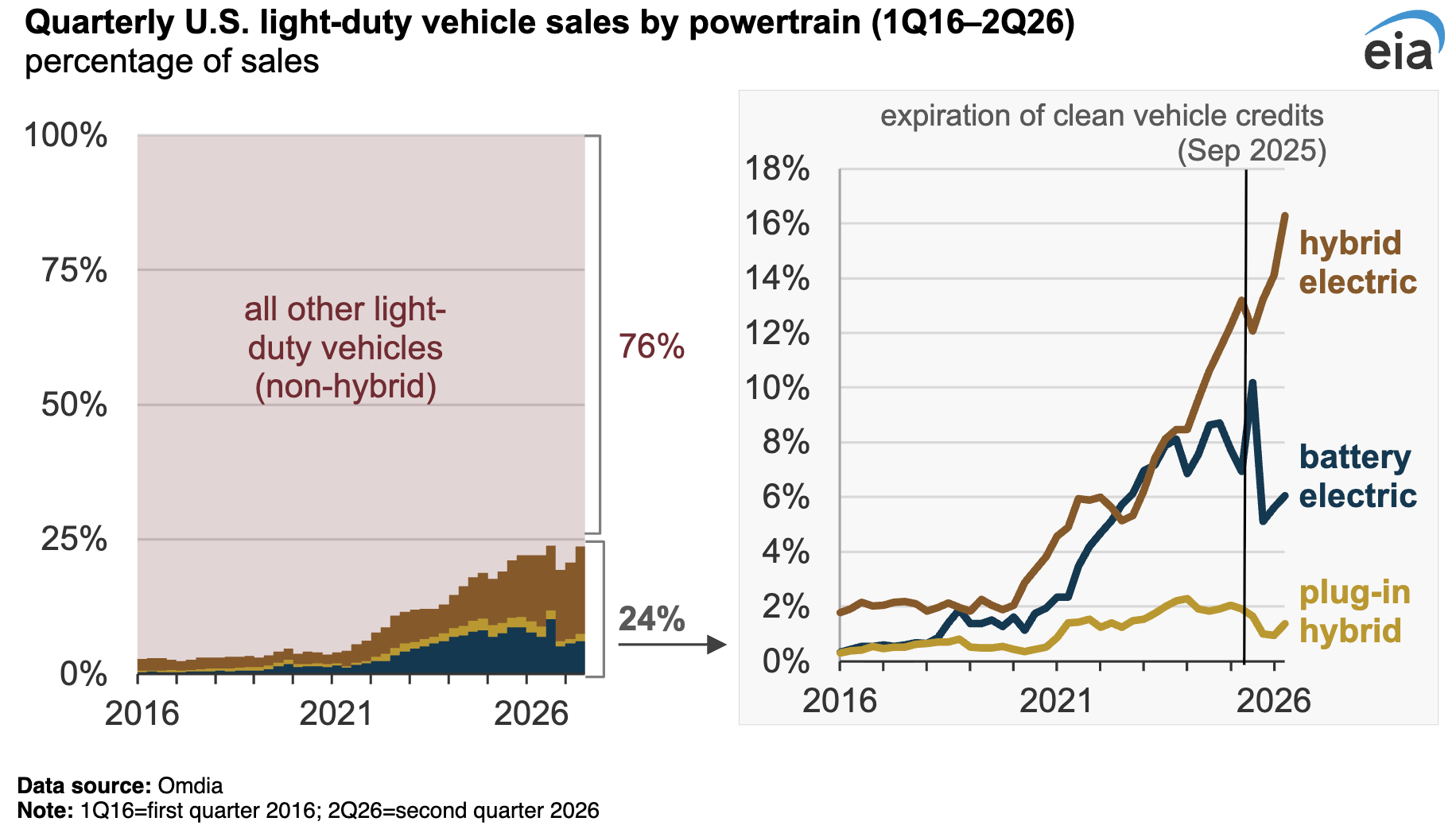
Electric vehicles have fallen from 10% of the U.S. new-car market to 6%, despite significant technological improvements, according to Cox. The average EV range is now about 300 miles per charge, up 20% from 2021. At the same time, global battery pack prices have fallen by 21%. High gas prices usually encourage EV sales. While new EV sales have been relatively flat, the used EV market has risen, reaching a new high of 126,589 vehicles sold in the third quarter after initially dropping. Used electric vehicles, however, only account for about 3% of that market. But the reduced prices, coupled with ongoing improvements in electric vehicles, give them upward growth potential.
Most drivers will not buy a new vehicle because of temporary high pump prices; instead, when it’s time to buy, they consider their options. According to Cox, auto manufacturers are responding to current market demands with “more midsize and hybrid vehicles.” Hybrid vehicles offer better gas mileage and some EV-like features while still allowing motorists to keep their internal combustion engines, which alleviates the “range anxiety” of electric vehicles. Hybrid vehicles tend to be the winners in the current gas price situation.
Two tax credits for purchasing or leasing new electric vehicles both expired on September 30, 2025: the New Clean Vehicle Credit and the Qualified Commercial Clean Vehicle Credit. Before the tax credits expired, battery electric vehicles made up a record 12% of light-duty vehicle sales in September 2025. In the second quarter of this year, battery electric vehicles accounted for just 6% of new car purchases, while hybrid electric vehicles accounted for 16% of new vehicle purchases. Automakers have responded to consumer demand by offering more hybrid models.

Conclusion
The Trump administration has revised the federal fuel economy standards, reversing the Biden-era mandates that required automakers to manufacture electric vehicles. The revised standards require a fleetwide average of 34.5 miles per gallon by 2031, down from 50.4 miles per gallon under Biden, cutting the average new vehicle cost by $1,300. Electric vehicles have fallen from 10% of the U.S. new-car market to 6% in the second quarter of 2026. U.S. consumers find hybrid electric vehicles more attractive than battery electric vehicles because they still offer the benefits of the internal combustion engine, and they represented 16% of new vehicle purchases in the second quarter of this year. Despite 2021 legislation that funded EV charging stations, a June 2026 Congressional Research Service report found that hundreds, not thousands, were installed.

