

Despite a large increase in solar capacity and generation, the U.S. generation sector mix has remained largely the same in 2025, built primarily on natural gas, followed by nuclear and coal, with shares of 40%, 18%, and 17%, respectively. According to the Energy Information Administration’s (EIA) December 2025 Short Term Energy Outlook, electricity generation is expected to have increased by 2.4% in 2025 due to increasing demand from large consumers, such as artificial intelligence (AI) data centers, but also from increased electrification that was encouraged by the Biden administration. The agency expects coal consumption in the utility sector to be 11% higher due to an over 40% increase in natural gas prices and increased electricity demand. Solar also increased its generation as 25 gigawatts of capacity were added to the grid in 2025, increasing its grid capacity by 20%. Wind’s capacity was up by seven gigawatts (almost 5%). EIA expects the solar and wind’s share of the generation market to be 7% and 11%, respectively, in 2025.
While wind and solar added a combined 32 gigawatts of capacity, the amount of generation that these technologies produce is far less than the generation that would come from coal, gas, or nuclear with the same level of capacity because neither wind nor solar are firm capacity due to their intermittent nature. The EIA defines “firm capacity” as “power or power-producing capacity, intended to be available at all times during the period covered by a guaranteed commitment to deliver, even under adverse conditions.” In Upstate New York, for example, thousands of solar panels are covered in ice, snow, and sleet during winter, only generating five to 10% of their potential power. In the summer, they fare slightly better. They produce an annual average of 15-17% of total power. As the House of Green Substack explains, they survive and continue to be built in New York due to the state’s Renewable Energy Certificates, where the state pays developers for each megawatt hour of renewable electricity generated, independent of the actual sale of the electricity. The solar developer earns two to three times more from the certificate than from selling the power generated from the solar facility.
The Energy Bad Boys Substack shows that what has grown in the United States is intermittent power from wind and solar rather than firm, reliable power. In fact, the graph below shows that the firm power in the United States is down to levels last seen in 2004 and that it has been declining since 2011. As a result, even though the grid has more capacity than it did 20 years ago, the growth is made up entirely of intermittent resources that may be producing no power when the grid needs it the most. This is raising concerns with system operators who must ensure the reliability of the grid.
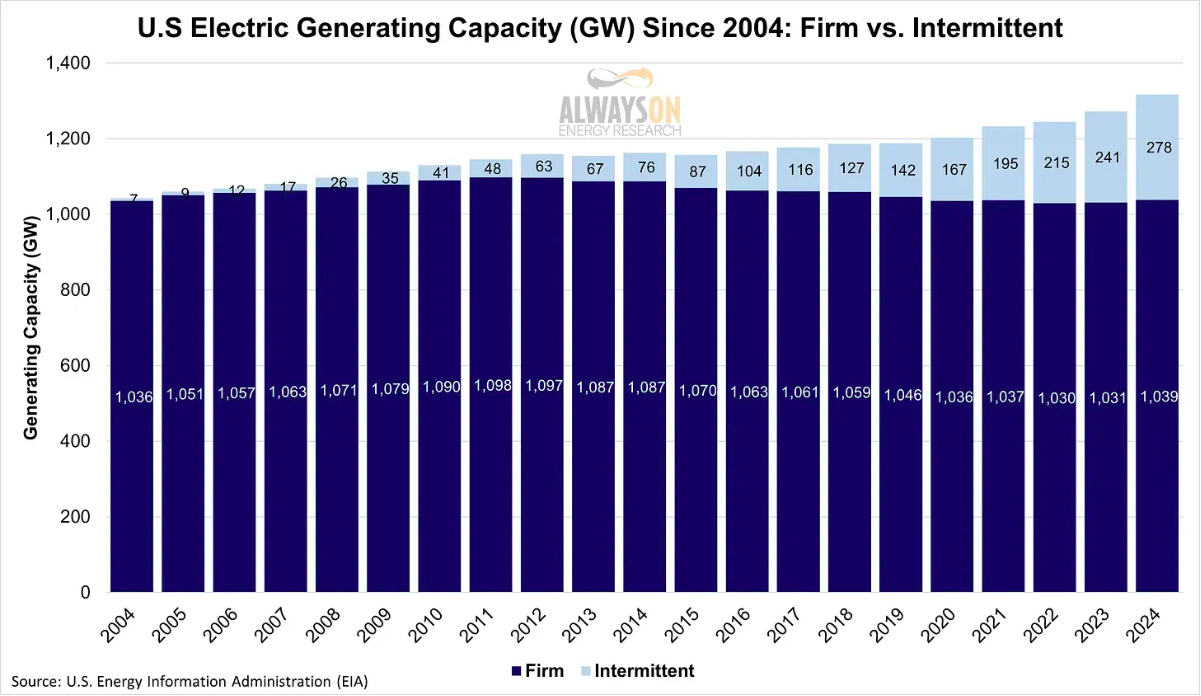
The construction of intermittent capacity is due to subsidies that states, such as New York, have provided to wind and solar developers, and also to state mandates for renewable power and generous federal subsidies that will start to be phased out mid-next year due to the One Big Beautiful Bill Act.
In the meantime, electricity prices have increased as the intermittent power essentially requires a dual power system because solar and wind power need to be backed up by expensive storage batteries or firm power sources that are only operated part of the time, raising their costs since the power they generate is spread over fewer hours. Under President Biden’s term in office, from January 2021 through January 2025, average U.S. electricity prices increased by 27%. They have continued to increase by an additional 11% from January through September 2025 due to the continued incentives for these technologies.
There is a fear that the growth in AI data centers will increase electricity prices for homeowners. Much of the recent growth in generation has been driven by increasing demand for electricity from data centers and other large customers that need firm power, mainly in Texas and Virginia. Virginia is known as the ‘data center alley’ as it houses over 600 data centers. Around 70% of the world’s internet traffic flows through northern Virginia due to the region’s flat terrain, proximity to the nation’s capital and other large East Coast cities, and access to water for cooling high-speed fiber optic infrastructure. Virginia’s energy demand is projected to increase 183% by 2040. The potential increase in electricity prices from rising demand from these data centers has raised concern from the state and from its largest utility.
To keep Virginia’s residential electricity prices from escalating, which currently average 16.62 cents per kilowatt hour (23rd in the nation and 8% less than the national average of 18.07 cents per kilowatt hour), Virginia’s State Corporation Commission approved a new electricity rate for large-scale customers requested by Dominion Energy, which takes effect in January 2027. According to the American Action Forum, “Affected large-scale customers must pay for at least 85% of contracted distribution and transmission demand and 60% of generation demand.”
Analysis
While solar and wind capacity have grown, the mix of U.S. electricity generation is still oriented toward natural gas, nuclear, and coal. However, firm capacity has diminished, as mostly Democratic states continue to supply incentives to expand wind and solar capacity, while heavily regulating and taxing reliable sources. These policies lead to higher electricity rates, placing an excessive burden on residential customers.
As we explain in Blue States, High Rates, 86% of states with electricity prices above the national average in the continental U.S. are reliably blue, having voted for the Democratic nominee for president in the 2020 and 2024 elections. In contrast, 80% of the 10 states with the lowest electricity prices are reliably red, having voted for the Republican candidate in these elections.
For inquiries, please contact wrampe@ierdc.org.

