

China’s heavy truck fleet is expected to electrify further this year as rising diesel prices from the Iran conflict allow China to reduce its oil imports. Electric heavy truck sales grew over the last two years from a niche market to nearly a third of new heavy truck purchases in 2025, driven by government subsidies, cheap refueling, and expanding charging infrastructure. Government subsidies cover up to 95,000 yuan (about $14,000) of the purchase price for new vehicles. With ranges of around 300 kilometers (186 miles), electric heavy trucks are mostly used for short-haul trips between industrial sites and transport hubs, although long-distance corridors are expanding and some producers are marketing trucks with ranges of up to 600 kilometers (373 miles). Widespread electrification of passenger cars and the rapid roll-out of electric and liquefied natural gas-powered trucks have reversed decades of growth in diesel and gasoline use in China. Forecasters expect diesel demand to decline by 4 to 5% this year.

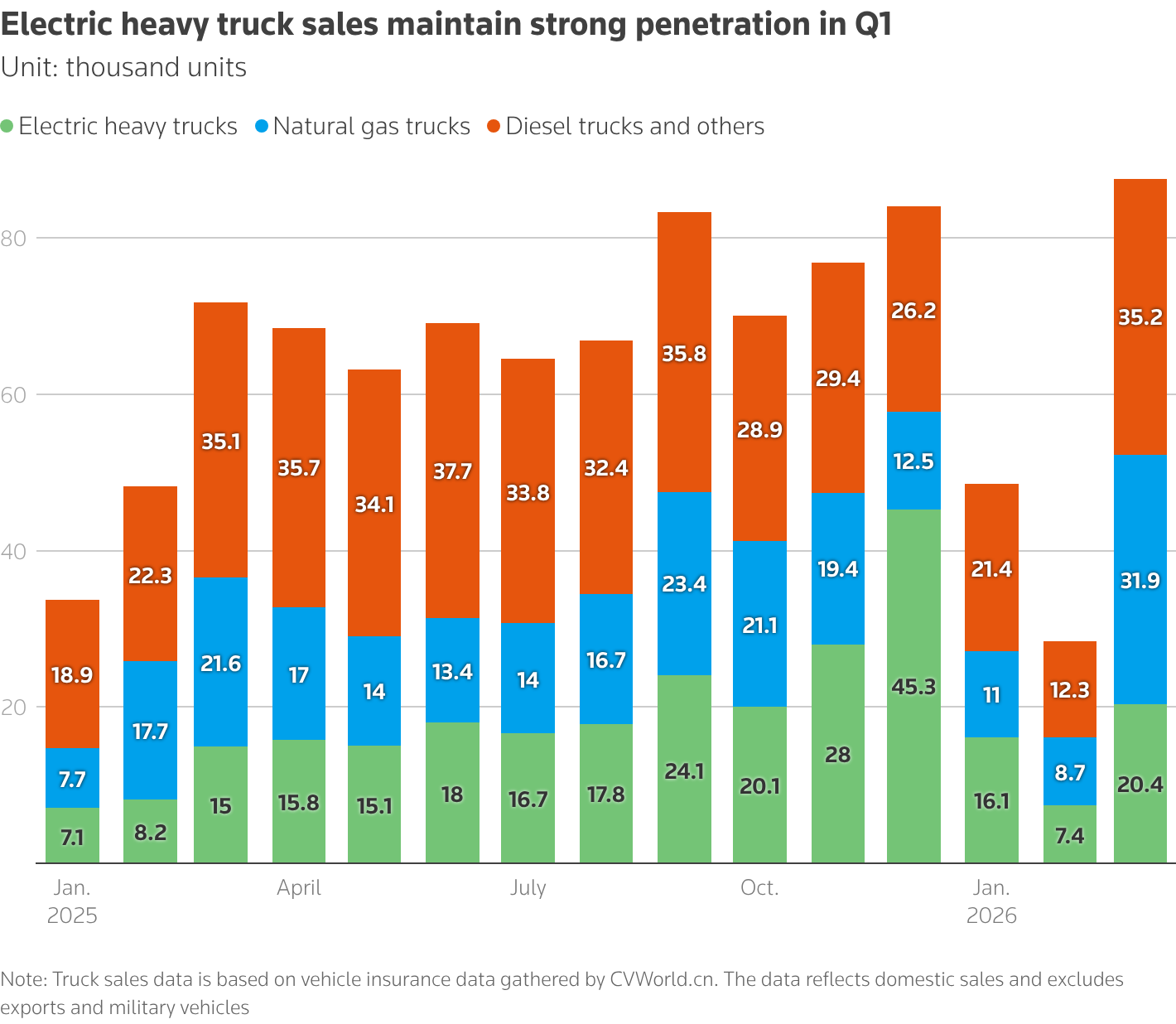
China’s electric truck sales, the biggest market for electric vehicles and the dominant producer of the batteries that power them, hit 600,000 in the first 10 months of the year, up 45%. Growth is strongest for heavy trucks, which have the largest batteries and contain the most lithium, with sales up 68% to 262,000 units. Chinese heavy electric truck exports more than doubled to 16,823 in the four months after the Iran conflict began on February 28. About half went to South and Southeast Asia, where higher fuel costs strengthened demand for electric vehicles. Electric trucks globally will use nearly 7% of lithium supply this year and 12% by 2030 — equivalent to demand from up to 11.5 million battery electric cars.
While there are more charging stations, charging time is an issue, making swapping batteries that can be done in about five minutes a big business in China. Electrek reports that CATL’s Qiji brand operated about 300 heavy-truck swap stations at the end of 2025 and plans 900 by the end of this year and 2,000 in 2027. In August, it agreed to pay 2.56 billion yuan (about $370 million) for nearly 25% of Qiyuan Green Power, China’s largest heavy-truck swap operator with more than 1,600 charging and swap stations. Its new standardized packs hold 432 kilowatt-hours and 513 kilowatt-hours. CATL is taking the swapping model to Europe with Octopus Energy. The joint venture, called “Swaptopus,” plans on building a network of battery-swapping hubs for electric trucks across the UK and Europe.
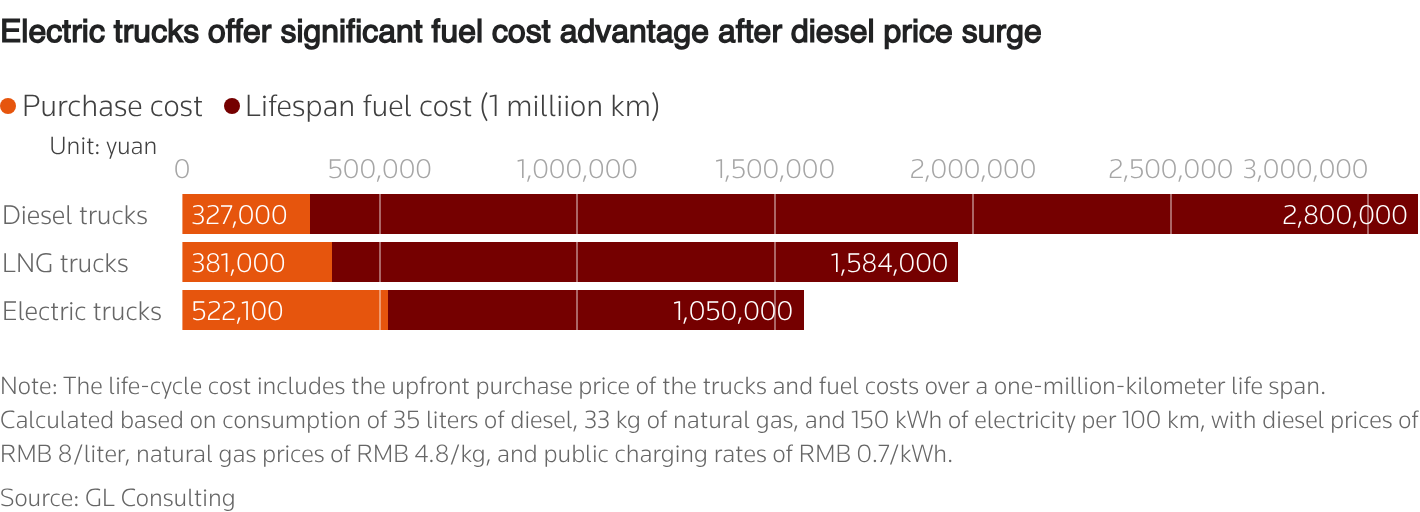
Electric heavy trucks cost more than 500,000 yuan (about $75,000) in China and diesel versions more than 300,000 yuan (about $45,000). China funds nearly half of the cost difference through a trade-in program — a Chinese version of a “cash for clunkers” program — extended in April through year-end. EV trucks are also cheaper to operate, as China has a large fleet of cheap coal-powered generators. China’s coal fleet’s capacity is almost as large as generators from all types in the United States. GL Consulting estimates lifetime expenditure on an electric truck – including the purchase price and fuel and operating costs to be half that of a diesel equivalent at current elevated fuel prices.

Lower costs are also driving an export boom to Europe, the world’s second-largest electric truck market. In 2024, China’s electric truck sales totaled 160,000, while Europe’s were fewer than 25,000, according to the International Energy Agency. At least a dozen Chinese manufacturers plan to launch sales in Europe this year at prices up to a third below the current average price there.
Despite the growth in electric trucks in China and plans for the EU market, lithium prices remain weighed down by uncertain demand from energy storage systems. Reuters reports that prices have nearly halved from their May high, with earlier optimism tempered by patchy installation rates in China and slowing domestic EV sales. Expectations of a surplus intensified as new mines and the restart of idled operations added supply after the May price rally.
While Australia has long been a top lithium producer, China has become not only the top lithium processor and refiner, but also a major miner of the commodity. In 2025, China was the second-largest lithium-producing country by mine production, behind Australia and ahead of Chile. Chinese companies are also mining in other countries, including Australia, where a few are part of major lithium joint ventures.
Conclusion
China has been shifting its truck fleet from diesel to electric, reducing its demand for diesel as the conflict with Iran has tightened oil supplies for much of this year and driven prices higher. Electric heavy truck sales grew over the last two years from a niche market to nearly a third of new heavy truck purchases in 2025, driven by government subsidies, cheap refueling, and expanding charging infrastructure, and sales continue to grow. Government subsidies cover up to 95,000 yuan (about $14,000) of the purchase price for new vehicles—about half the difference in the higher purchase cost of the electric model over the diesel model. Despite the added charging infrastructure, battery swapping has become a big business, with truck battery swaps taking only about 5 minutes. The increase in electric truck sales will help the lithium market, which has been in a slump. Electric trucks globally will use nearly 7% of lithium supply this year and 12% by 2030 — which would be equivalent to demand from up to 11.5 million battery electric cars.

