

Fueling The Conversation, Week of February 2nd, 2026
Too often, discussions about energy production in the United States emphasize its environmental effects instead of its economic benefits. This starting point inevitably leads to policy proposals looking to constrain producers, rather than creating the conditions for them to flourish. From taxes to adverse permitting requirements, federal, state, and local politicians make it their mission to ensure that gas, oil, and coal producers pay for real and imagined environmental impacts, working as disciples of the anti-impact framework and neglecting the vital role energy plays in our success as a civilization.
Ironically, the very advocacy that seeks to improve the environment by working to limit our ability to produce energy here at home ends up doing just the opposite. With our strong institutions and economic freedom, marked by relatively low levels of corruption and violence, the U.S. is the right place to produce the energy we rely on in our daily lives and to export those resources around the world. Therefore, we’re better off encouraging and investing in domestic energy rather than shifting production overseas, where in many places environmental and human freedom standards are significantly lower.
That’s why the results of our latest report, the 2026 Environmental Quality Index, come as no surprise. The report showcases the extent to which the U.S. dominates energy production, while still receiving high marks for environmental quality and political and economic freedom. Compared to other significant producers of natural gas, oil, and coal, the U.S. proves that the so-called “resource curse” comes from statism, not the existence of fossil fuels themselves.
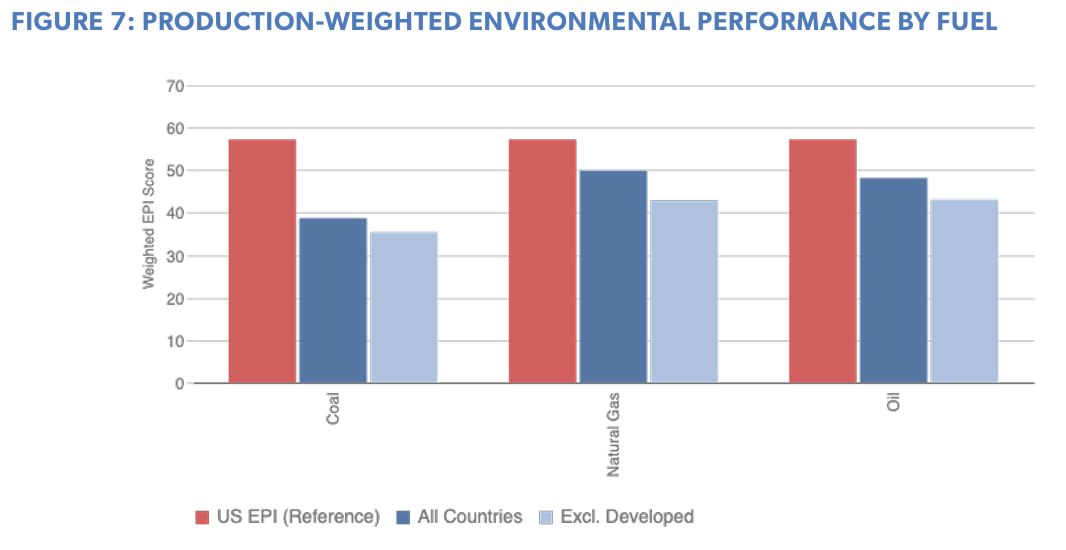
Relying on Yale University’s 2024 Environmental Performance Index (EPI), which rates countries on overall environmental quality using a 0-100 scale, we took the scores from the top producers of natural gas, oil, and coal and weighted them by their total production. The average production-weighted EPI score for the top producers was 48.14 for oil, 49.88 for natural gas, and 38.72 for coal.
In contrast, Yale gave the U.S. an EPI score of 57.2, a remarkable number considering that the U.S. leads the world in natural gas and oil production, while being ranked fourth for coal. As we state in the report, “Far from harming the planet, America’s energy abundance delivers more global economic growth and genuine environmental progress than equivalent production from any other country.”
Furthermore, the difference when you eliminate developed democracies from the weighted-average EPI score of the top producers reinforces the extent to which democratic political institutions contribute to better environmental quality. Per the figure below, EPI went down for each fuel type when developed democracies were removed. Even though the developed democracies on the list often produce far less than authoritarian countries like China, Russia, or Saudi Arabia, the U.S.’s high levels of production and environmental quality show that no trade-offs are needed.
The EQI strengthens the link between environmental quality and democratic institutions by using the Cato Institute’s Human Freedom Index, which ranks countries based on 86 unique indicators of personal and economic freedom. Using the same method through which production-weighted EPI scores were calculated, we found that the average rank of the largest oil producers, excluding the U.S., was 133.42, with that number being 102.95 for natural gas and 122.18 for coal. With the U.S. ranking 17th in human freedom, any barrel of oil or cubic meter of natural gas that the U.S. prevents its industry from producing leads to more profit for authoritarian regimes seeking to repress their people.
Clearly, more American energy production makes the world a better place. The EQI provides case studies on coal in China, natural gas in Russia, and oil in Venezuela to show how a lack of pro-freedom political and economic institutions leads to lower levels of freedom and a dirtier environment. For instance, workers for Russia’s state-run natural gas company, Gazprom, who suffer from extremely poor living conditions, have no recourse to improve working standards because of the threat of forced military service. In Venezuela, the Venezuelan Observatory of Human Rights Violations reported that from 2016 through 2021, there were 199 oil spills. American energy companies set the highest standards for environmental protection and worker safety in the world, minimizing negative impacts from production to end use.
The EQI makes the pro-American energy argument clear: if the U.S. doesn’t produce these resources, then autocratic countries with poor environmental records will. Democrats and “green” advocates need to recognize that policies like renewable portfolio standards, carbon taxes, and emissions regulations don’t just hurt energy companies; they also contribute to worse environmental outcomes worldwide.
__________________
Fueling the Conversation, a weekly column by IER President Tom Pyle, offers a principled take on energy events. Energy underpins all aspects of modern life, so policies that artificially limit production hurt everyday people paying to heat their homes and drive to work. “Green” groups push these policies for ideological reasons, but this column uses economic logic and hard facts to advocate for energy freedom.

