

Coal makes up a third of the world’s power generation, with Southeast Asia among the largest users. In 2025, Asia accounted for 83% of global coal consumption. China is the world’s largest consumer of coal, consuming around 11 times as much annually as the United States and generating 54% of its electricity from the fuel. China’s coal-generating capacity (1,285 gigawatts) is almost equal to the entire generating capacity from all sources in the United States. The next-largest coal user is India, which generated 71% of its electricity from coal in 2025. Both countries mine coal domestically and also import it. Other major Asian coal users include Indonesia, Japan, South Korea, and Vietnam. In 2025, Indonesia generated 61% of its electricity from coal, and Vietnam generated 48%.
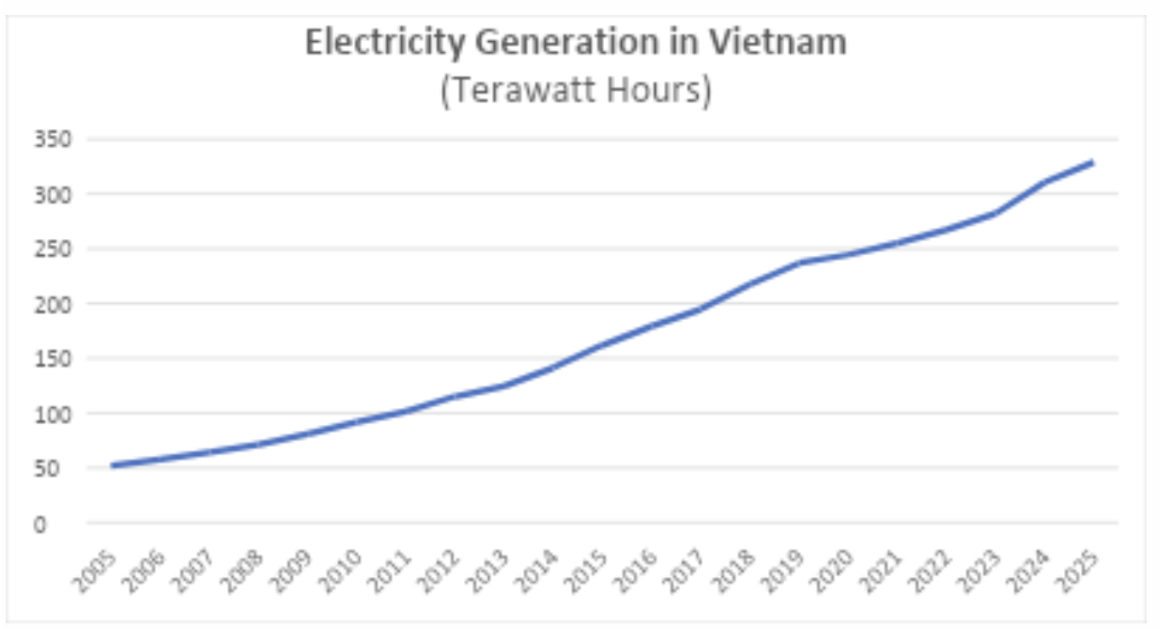
Vietnam has become a manufacturing powerhouse, driven by an electricity boom that has grown at over 7% per year over the last decade, fueled mainly by coal. As the country’s power demand grows, Vietnam is allowing domestic coal mining companies to increase output by up to 15% above the quotas in their existing licenses until the end of next year. Vietnam also imports coal, mainly from Indonesia and Australia, with imports rising 4.7% in the January to May period to 32.9 million tons. Vietnam also has the largest trade surplus with the United States of any country in the world—larger than China’s and bigger than Mexico’s—as manufacturing companies have found its abundant, cheap labor and energy availability beneficial to production.

China has the world’s fourth-largest coal reserves after the United States, Russia, and Australia, and it is using them effectively. It produced more coal than any other country in 2025, at 4.66 billion metric tons (51.5% of global total coal production). Despite having the world’s largest domestic production, it imports more coal than any other country, accounting for nearly 30% of the world’s coal imports in 2025. Coal serves as the backbone of China’s power grid. Because of China’s cheap coal-fired electricity, it can dominate critical-mineral processing and supply EV batteries, solar panels, and electronic technology.
China is also becoming an industry leader in converting coal using the Fischer-Tropsch technology into natural gas liquids, petrochemical feedstocks, and synthetic transportation fuels. China uses almost as much coal annually through this process as the United States uses for all purposes. It plans to triple its coal-to-gas industry to 28 billion cubic meters by 2030 and increase coal output by 25%. China has about 20 billion cubic meters per year of coal-to-gas capacity under development, much of it in Xinjiang, where coal is cheap. Mine-mouth coal prices in China’s Xinjiang province averaged $30 per metric ton between April 2025 and May 2026 — less than 40% of the equivalent price in Inner Mongolia. Its coal-to-gas plants are operating at over 90% utilization.
India is the second-largest producer and consumer of coal in the world after China, mining 1,085 million metric tons in 2025. India is the second-largest importer of coal (15% of global coal trade) behind China, accounting for less than a quarter of India’s coal consumption. India is looking to increase domestic coal production by nearly 100 million metric tons to 1.15 billion metric tons in the 2025 to 2026 fiscal year to meet rising electricity demand, support economic growth, and have the power to deal with heatwaves.
Electricity access has been growing in India. Since the 2000s, it has increased from 60% to 99.5% of the population. This has potentially improved the lives of hundreds of millions in the world’s most populous country. However, grid reliability has been a challenge due to supply shortages and aging transmission and distribution infrastructure. According to a 2020 survey, half of rural households experience daily power cuts between 6 pm and midnight.
Indonesia continues to rely heavily on coal, using it to supply over 60% of its electricity generation and power a massive surge in industrial smelting. As the world’s largest coal exporter, supplying about 30% of the world’s coal exports, Indonesia produced 790 million metric tons of coal in 2025. Domestic consumption continues to rise alongside industrial output. Indonesia is expanding aluminum production as the Iran conflict disrupts supplies, relying on its coal reserves to power new smelters. The Middle East usually makes about 9% of the world’s aluminum, but output from the region is expected to drop 44% this year from 2025 levels.
Aluminum production is highly energy-intensive and benefits from Indonesia’s coal power. The process starts with the mining of bauxite ore, which is refined into alumina and then smelted into aluminum. By the end of the decade, Indonesia wants to quadruple its alumina output to 32.5 million metric tons and ramp up aluminum production from around 1 million metric tons in 2025 to 14.5 million metric tons by 2030. There are 32 prospective off-grid coal plants, built by private companies to exclusively power aluminum smelters, known as “captive coal” facilities.
Conclusion
Coal continues to fuel Asia, accounting for 83% of the world’s coal use, as domestic consumption grows alongside manufacturing and industrial production. China is the largest producer and consumer of coal, followed by India. Other Asian countries are also growing their economies with coal, including Indonesia and Vietnam. Vietnam has become a manufacturing powerhouse, driven by an electricity boom that has been growing at over 7% per year over the last decade, fueled mainly by coal. Vietnam has the largest trade surplus with the United States of any country in the world, as manufacturing companies have found its abundant, cheap labor and energy to be beneficial to production. These four Asian countries generate between 48% and 71% of their electricity from coal. While all four have coal reserves and mine coal domestically, three need to supplement their production with coal imports to meet growing demand.

