

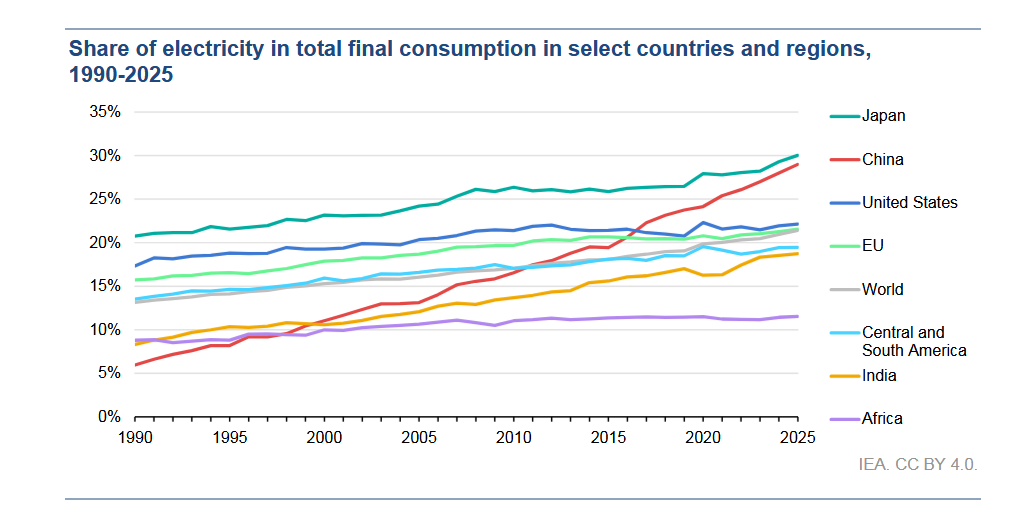
The European Union (EU) wants to increase its electricity use and is setting a goal of 46% of energy consumption across the bloc by 2040, doubling the rate today, following the direction of the World Economic Forum. The Electrification Action Plan is part of the EU’s response to the Iran War, which raised oil and gas prices, prompting the EU to turn to new measures to cut Europe’s reliance on imported oil and gas. Today, 23% of the EU’s energy consumption is met by electricity — a share that has been steady for a decade. The rest of the economy runs mostly on fossil fuels, and imports dominate those supplies due to European policies such as banning hydraulic fracturing and cutting offshore leasing. About 70% of EU electricity generation comes from renewables and nuclear. The EU plan includes policies and funding to incentivize the transition to greater electrification, including tackling long grid connection times and helping new technologies reach commercial scale.
Raising the electrification share to 46% would require a massive increase in electric vehicles, more widespread replacement of gas boilers with heat pumps in homes, electrifying industrial processes, and extensive upgrades of Europe’s aging power grids, requiring hundreds of billions of euros in investments. For the plan to succeed, policymakers would need to lower Europe’s high electricity prices, which are already much higher than those in the United States and have been leading to deindustrialization in Europe. Even then, for some firms it would not be economically feasible to electrify their operations.
According to the draft plan, achieving a 46% electrification target could reduce the EU’s fossil fuel import bill by up to €260 billion ($297 billion) per year by 2040. The EU imports more than 80% of the natural gas it consumes, and more than 90% of its oil. The Commission estimates that hitting the target of 46% would cut oil demand by 40% and gas demand by 70%. Since the escalation of the Middle East conflict, the EU has spent more than €50 billion ($57 billion) extra on fossil fuel imports.
The plan focuses on the main barriers identified by the Commission: the gap between electricity and gas prices; access to infrastructure; innovation; and the upfront cost of electrification technologies such as heat pumps and electric vehicles. The energy package also includes new measures on network charges aimed at making electricity grids more efficient by encouraging consumers, producers and grid operators to adapt their behavior. The initiative calls on member states to ensure electricity is not taxed more heavily than gas, arguing that taxation remains a barrier to electrification. However, the proposal stops short of dictating how countries set electricity tariffs. Instead, it establishes principles for national regulators to encourage smarter consumption, flexibility and more efficient grid management.
There is likely to be resistance from member states and challenges. The EU’s high consumer electricity-to-gas price ratios that compare the cost of a unit of electricity to a unit of natural gas per kilowatt hour are one challenge, as mentioned above. The EU electricity-to-gas price ratio currently exceeds 3.0, which is above the bloc’s targets of 2.5 for households and 2.0 for industry, mainly due to non-energy charges, levies, social tariffs and legacy subsidies.
According to the Commission’s Electrification Plan, “An energy transition with electrification at the forefront could, for example, support the business case for manufacturing electric vehicles in the EU by stimulating the uptake of approximately 120 million battery EVs compared to 8 million battery EVs today, and of approximately 100 million heat pumps compared to 30 million heat pumps installed today.” Around half of the EU’s gas consumption comes from buildings, which have been identified as one of the sectors with the greatest potential for electrification. On the other hand, buildings in Europe are not easily adapted to newer technologies, as demonstrated by low adoption of air conditioning. This is in part due to the age of the housing stock and intrinsic construction techniques.
The EU’s electrification rate of 23% is below those of China, Japan, and South Korea, which are closer to 30%, but is close to that of the United States and the world average.
As part of the new plan, the Commission intends to pursue a series of initiatives to support investment in electrification-related skills. These initiatives include adopting an initiative to support the portability of qualifications and skills across the EU to attract more electricians and clean technology installers, providing incentives for manufacturers to support training of electricians and installers under a new Clean Heat Market Mechanism, and for a new Construction Services Act that will make it easier to obtain certifications for energy-efficient building and installation work.
The Commission plans to assess whether to make the electrification rate binding as part of the post-2030 Energy Union package.
Conclusion
The EU wants to phase out fossil fuels and increase electrification, which means more electric vehicles, more heat pumps, and more electrification of industry. The Commission is targeting a 46% share of electricity by 2040, double its current share, which has been stagnant for the last decade. The EU sees this as relying on its own “clean” energy rather than on fossil fuels, which it mostly imports due to policies that ban hydraulic fracturing and cut offshore oil and gas leasing. Since the conflict in Iran began on February 28, the EU has spent $57 billion more on fossil fuels. An electrification target of 46% could reduce the EU’s fossil fuel import bill by up to €260 billion ($297 billion) per year by 2040 and cut oil demand by 40% and natural gas demand by 70%.
For media inquiries, please contact press@ierdc.org

