

Oil and gas shipments through the Strait of Hormuz have dropped since hostilities resumed by both sides of the U.S.-Iran conflict. U.S. forces hit Iran for a ninth consecutive day on July 20 as concerns grew over shipping through the Strait of Hormuz after Iran said two oil tankers had exploded and been immobilized, and after several U.S. servicemen were killed and others wounded. Iran continues to target vessels trying to cross the Strait of Hormuz through the Omani route. According to the Iranian Revolutionary Guards, the strait would remain unsafe as long as U.S. “aggression” in the region continued, warning that “this passage will not be safe for the transit of petrochemical products, nor even a single drop of oil and gas.” Only four vessels made the transit through the Strait on July 19, down from eight the previous day, and nearly 50 daily transits before the re-escalation.
Brent oil prices rose above $90 a barrel on July 20, their highest level in over a month, before falling to around $88 a barrel after Iran’s foreign ministry said negotiations with the United States could be pursued based on national interests. According to Secretary of State Marco Rubio, the United States was still willing to pursue diplomacy, and Iran had signaled directly and through mediators that it wanted to negotiate. U.S. gasoline prices rose back to $4 per gallon on July 20, according to AAA, rising 13 cents over the past week. Prices at the pump were last at that level on June 17, when the U.S. and Iran signed an interim agreement that would reopen the strait during a ceasefire.
Iran’s Houthi allies in Yemen declared a maritime embargo against Saudi Arabia on July 20, which could exacerbate the oil supply disruption triggered by Iran’s tanker attacks in Hormuz. The Houthis have repeatedly threatened to close the Bab el-Mandeb Strait, which connects the Red Sea to global markets where the Saudis have diverted millions of barrels of oil per day through a pipeline to an export terminal. Those exports have added about 5 million barrels per day to the global market. Iran has also pressed the Houthis to close the Red Sea route if the U.S. attacks Iranian power infrastructure.
Putting further pressure on the oil market, exports from the Caspian Pipeline Consortium (CPC) terminal off Russia’s Black Sea coast were suspended on July 20 following drone attacks on two tankers reportedly by Ukraine. The CPC terminal in the port of Novorossiysk, while in Russian territory, is the main export hub for Kazakhstan’s 2 million barrels per day of oil.
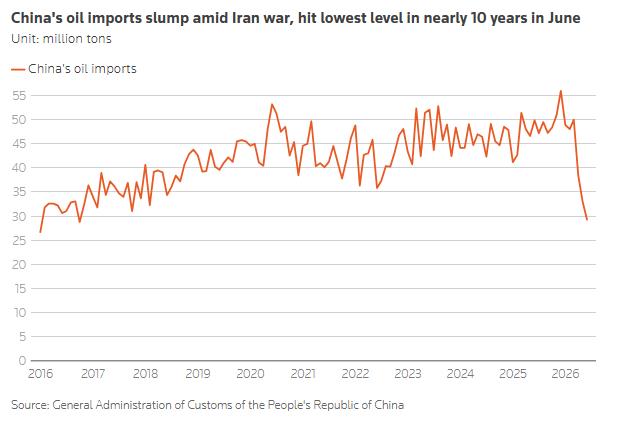
Beyond oil market pressures, the refinery sector is under immense strain as it works to produce the fuels the public needs. Gasoline and diesel inventories are near multi-year lows, refining margins are at record levels, and refinery throughput remains severely curtailed across key producing regions. China has limited oil imports to its private teapot refineries and has cut exports of refined products. The Chinese even started using electric taxis instead of personal cars, and its petrochemical sector also reduced its oil demand. China’s reduction in oil imports is one of the major reasons that oil prices have remained somewhat contained on the global market.

U.S. inventories of diesel have been tight due to refinery closures in the West. Disruptions to Middle Eastern exports due to the war in Iran have tightened the market. A temporary ban on Russian exports announced this month exacerbated the global diesel shortage even more as Russia loses refining capacity due to Ukraine intensifying attacks on its energy infrastructure. U.S. and global refiners have lowered gasoline output in favor of higher diesel and jet fuel yields, which could become a concern.
Conclusion
Hostilities are escalating in the Middle East as the United States and Iran continue their attacks, raising oil and gasoline prices. On July 20, Brent oil prices, the international benchmark, rose over $90 a barrel but later settled at $88 a barrel after Iran’s foreign ministry said negotiations with the United States could be pursued. U.S. gasoline prices returned to $4 a gallon on July 20, increasing 13 cents over the past week. Iran’s Houthi allies in Yemen declared a maritime embargo against Saudi Arabia on July 20, which would cut off oil exports from the Red Sea, where Saudi Arabia is exporting about 5 million barrels of oil per day via a pipeline to its port on the Red Sea. Refinery margins are high as refinery capacity is tight due to refinery closures, attacks on Russian refineries by Ukraine, China’s reduction in refined product exports, and the effective closure of the Strait of Hormuz, limiting refined products from the Middle East.
For media inquiries, please contact press@ierdc.org.

