

Russian President Putin and China’s President Xi met in China after the Chinese summit with President Trump and discussed a number of items of agreement. However, when it came to discussing a contract for a new pipeline that would enable Russia to more than double the amount of natural gas it sells to China, there was no agreement reached, according to Reuters. Before the visit, Russia had indicated that it was looking for further energy agreements with China, the largest buyer of Russian oil, including pipeline supplies and sea-borne shipments. China, however, was interested in increasing Russian oil supplies in the long term, which were up by 10% in four months.
According to Russian gas company Gazprom, in September 2025, during Putin’s last visit to China, both countries had agreed to a new 1,616-mile gas pipeline, Power of Siberia 2, to carry 50 billion cubic meters of gas per year from Russia to China via Mongolia from the Arctic gas fields of Yamal. Issues involving gas pricing are still unresolved and expectations are that it could take years for negotiations to reach a resolution. At a previous meeting with President Xi, Putin said the price of gas on the system would be based on a market formula similar to the one for Russian shipments to Europe. The Kremlin indicated both sides had reached a “general understanding on the parameters” of the project, although no timeline was agreed to. Russian Deputy Prime Minister Alexander Novak said Russia and China were finalizing contracts for supplies via the pipeline. Xi indicated that cooperation in energy and resource connectivity should be the “ballast stone” in China-Russia relations but did not mention the pipeline.
Power of Siberia 2 would complement the existing Power of Siberia 1 pipeline that brought 38 billion cubic meters of gas from Russia to China last year. In late 2019, Russia began shipping gas from eastern Siberia to China via the Power of Siberia 1 pipeline under a 30-year, $400 billion deal. In a previous meeting between Putin and Xi, the two countries agreed to increase the capacity of the Power of Siberia 1 to 44 billion cubic meters a year. China had also agreed to import an additional 2 billion cubic meters annually from Russia via a pipeline from the Pacific island of Sakhalin. Gas exports are scheduled to begin on that pipeline in 2027 and ramp up to 12 billion cubic meters per year from a previous commitment of 10 billion cubic meters annually.
Last year, during a visit by President Putin to China, Russia provided a “legally binding memorandum” for the construction of Power of Siberia 2, but a firm contract has not been agreed to. Russia is very interested in more sales to China as its European customers have been cut off due to sanctions instituted after Russia invaded Ukraine. According to the head of the research unit at China National Petroleum Corporation, giant gas projects like Power of Siberia 2 need at least eight to 10 years to build.

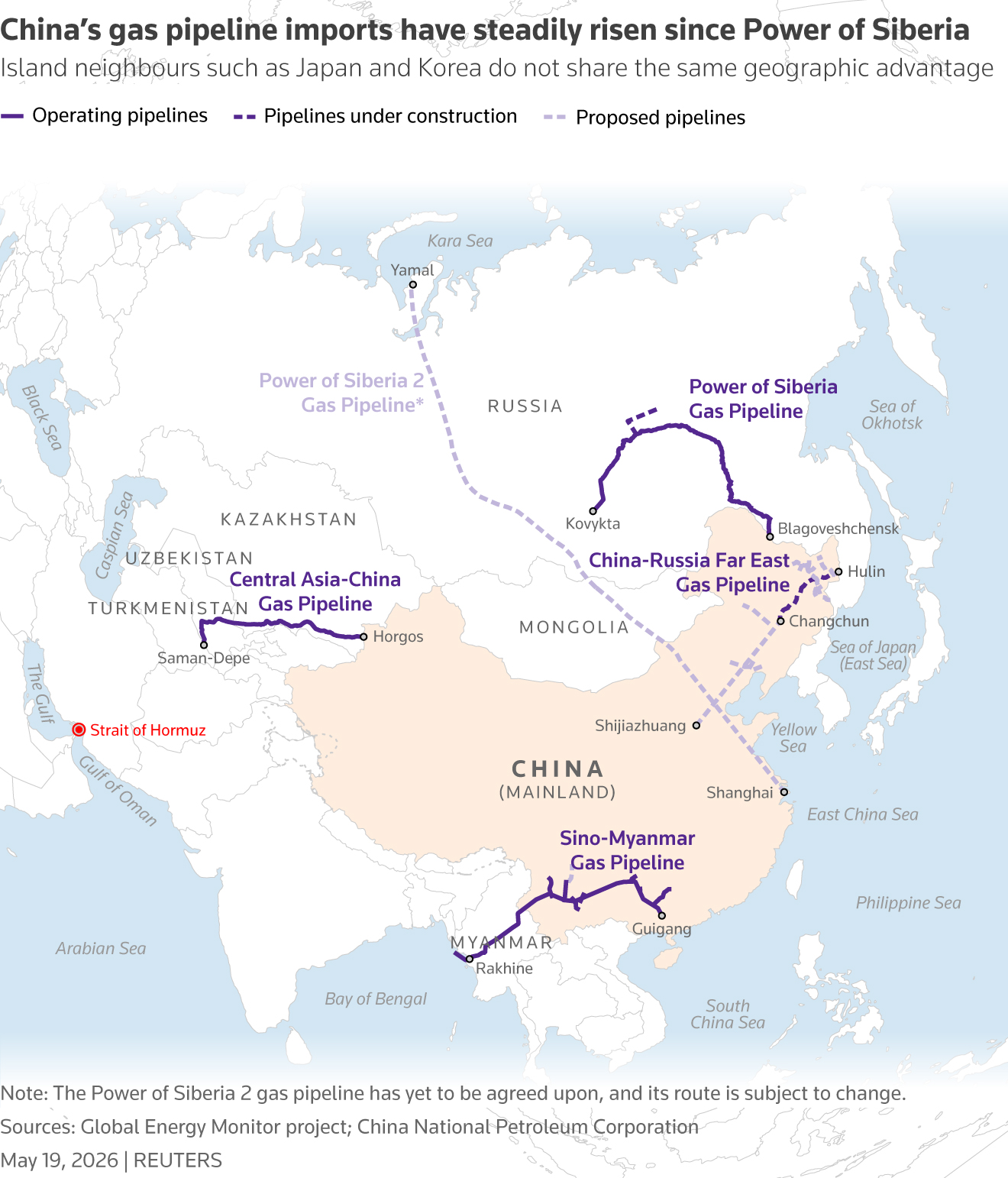
China’s natural gas pipeline imports accounted for about 19% of domestic consumption last year. China has five existing pipelines that bring natural gas from Central Asia, Russia and Myanmar. There are three pipelines that start in Turkmenistan and Uzbekistan, cross Kazakhstan, and enter China in the Xinjiang region, supplying more than 40 billion cubic meters of natural gas annually. In the south, the 493-mile Myanmar-China Gas Pipeline began operating in 2013 and can carry 12 billion cubic meters a year.
Russia’s LNG exports to China increased last year by 18.2% to 9.79 million metric tons. After Australia and Qatar, Russia is the third-largest supplier of LNG to China, which is the world’s largest buyer of seaborne gas.
Conclusion
At their summit in China, President Putin and President Xi discussed the Power of Siberia 2 pipeline but did not come to an agreement on the pricing of the gas from it. It is designed to provide 50 billion cubic meters of natural gas annually under a memorandum of understanding. China gets both pipeline gas and seaborne gas via LNG from Russia. Currently, pipeline gas comes from the Power of Siberia 1 pipeline, which is currently providing over 38 billion cubic meters of gas with plans to up that to 44 billion cubic meters annually. Russia is expected to provide more natural gas beginning next year via a pipeline from the Pacific island of Sakhalin. Russia is also China’s third-largest supplier of LNG, after Australia and Qatar. Russia is looking to enlarge China’s gas market via the Power of Siberia 2 pipeline, as it lost its EU gas customers from sanctions when it invaded Ukraine.

