

The United States has become the world’s largest oil exporter after sanctions against Russia for its invasion of Ukraine reduced its exports, and the conflict with Iran shut in some Saudi Arabian oil production, thereby reducing its exports. These wars are reshaping global energy trade. At one time, the United States was the world’s largest oil importer and had been dependent on Middle Eastern oil for decades. In 1973, the United States suffered an oil embargo imposed by some OPEC members, causing gas prices to spike and long lines at gas stations. Government policies flourished in the wake of 1973, resulting in the creation of congressional energy committees and the establishment of the Department of Energy under President Jimmy Carter. Yet the dependency continued and worsened. The situation changed in the late 2000s with hydraulic fracturing and directional drilling technologies that enabled the production of oil from shale basins. That enabled the United States to become the world’s top oil producer in 2019 after it repealed a 40-year export ban in 2015, in place since the Arab oil embargo, and it has since become the world’s top oil exporter.
According to Reuters, U.S. exports of oil and petroleum products rose to about 10.5 million barrels per day in May, driven by higher production and the release of strategic reserves, making the United States the top global exporter for the third month in a row. Russian exports were 7 million barrels per day in May, while Saudi Arabia’s exports were 5.9 million barrels per day. In 2025, Saudi Arabia exported about 8.1 million barrels per day, compared to 6.6 million barrels per day for the United States and 5.8 million barrels per day for Russia.

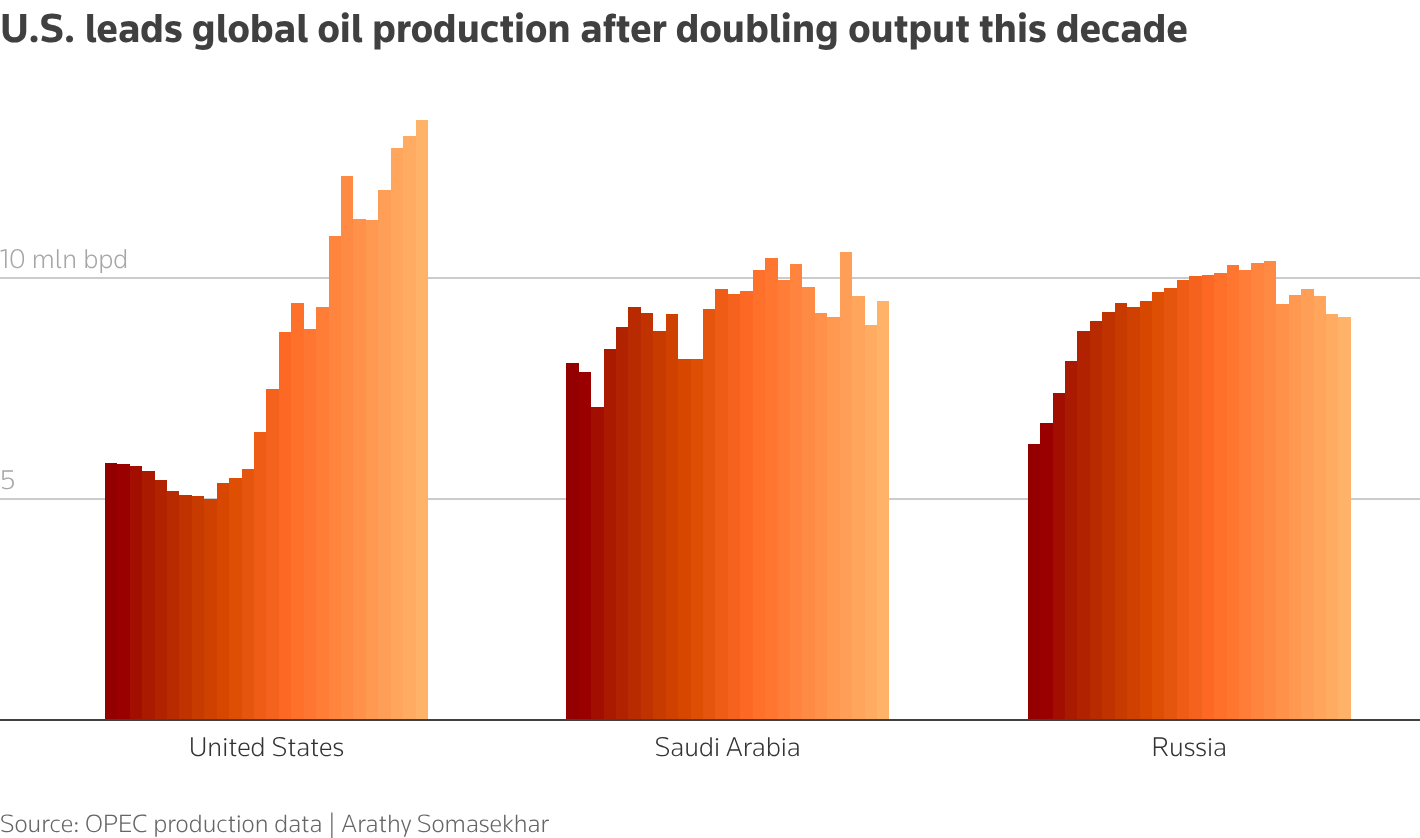
Oil production in the United States has been slowly increasing since the shale oil renaissance. Since 2000, oil and liquids production in the United States has nearly tripled to about 22 million barrels per day, while Saudi oil and liquids output has largely fluctuated between 10 million and 12 million barrels per day, depending on OPEC quotas between 2000 and 2026. Russian oil and liquids output increased from 6 million barrels per day to 10 million barrels per day between 2000 and 2010, grew by a further 2 million barrels per day during the 2010s, but has largely stagnated and declined to below 10 million barrels per day since 2020.
The United States has been providing the majority of supplies to meet growth in oil demand, as demand has risen from 87 million barrels per day in 2010 to 104 million barrels per day in 2025. The United States is now the principal supplier of oil to Europe and the second largest supplier of distillates. Since the war in Ukraine began in 2022, Europe has increasingly turned to the United States for fuel. Europe has purchased about 47% of U.S. oil exports so far this year, up from 37% in 2021. Asia has also turned to the United States for oil supplies, purchasing about 46% of U.S. oil exports in May, compared with around 37% last year.
The U.S. oil boom is driven by private firms that respond to price changes, in contrast to government quotas set by OPEC and its allies. When prices are high, U.S. firms expand production; when they are low, they cut production. That balancing settles into an equilibrium if no disruptions affect the system.
This reshaping of global oil trade could weaken the pricing power that the Organization of Petroleum Exporting Countries and its allies have held over oil markets for decades. That could be especially true since the United Arab Emirates, OPEC’s third-largest oil producer, left the bloc in May after nearly 60 years as a member. Once the Strait of Hormuz is reopened, the UAE will become a major OPEC competitor, no longer subject to OPEC’s quotas.
Strategic Petroleum Reserves
The U.S. Strategic Petroleum Reserve (SPR) is currently releasing oil at a rate of nearly 9 million barrels per week. On June 5, the reserve was at 349.2 million barrels. The SPR had been severely depleted by President Biden in 2022, when he ordered a major release to lower gas prices after Russia’s invasion of Ukraine and before the midterm elections. The Biden administration did not replenish much of the drawdown, and the physical structure has required repairs, which have hindered its refilling.
China, which holds the world’s largest oil stockpile at 1.2 billion barrels, has begun drawing on its reserves after first finding alternative suppliers, reducing refinery use, and cutting petroleum exports to preserve domestic supply. The switch to electric vehicles has also helped to lower usage and demand. Inventory draws from its reserves are expected to average about 1 million barrels a day in the coming months–about a third of the oil that China is no longer receiving since the effective closure of the Strait of Hormuz. China began releasing its reserves in May and drew down almost 25 million barrels between May and June 7, according to Bloomberg.
Conclusion
The United States has become the world’s largest oil exporter as Saudi Arabia’s and Russia’s exports have been affected by the conflict in Iran and the war in Ukraine. The conflicts have altered the global oil trade, potentially reducing OPEC+’s influence over oil prices in the future, particularly if the new trade flows become permanent. The United States became the world’s largest oil producer in 2019 due to the oil shale renaissance and the advent of hydraulic fracturing and directional drilling. It has nearly tripled its oil and liquids production since 2010, while other producers have grown more slowly. Since 2010, the United States has been providing the majority of supplies to meet growth in oil demand, which reached 104 million barrels per day in 2025.
For media inquiries, please contact press@ierdc.org.

