

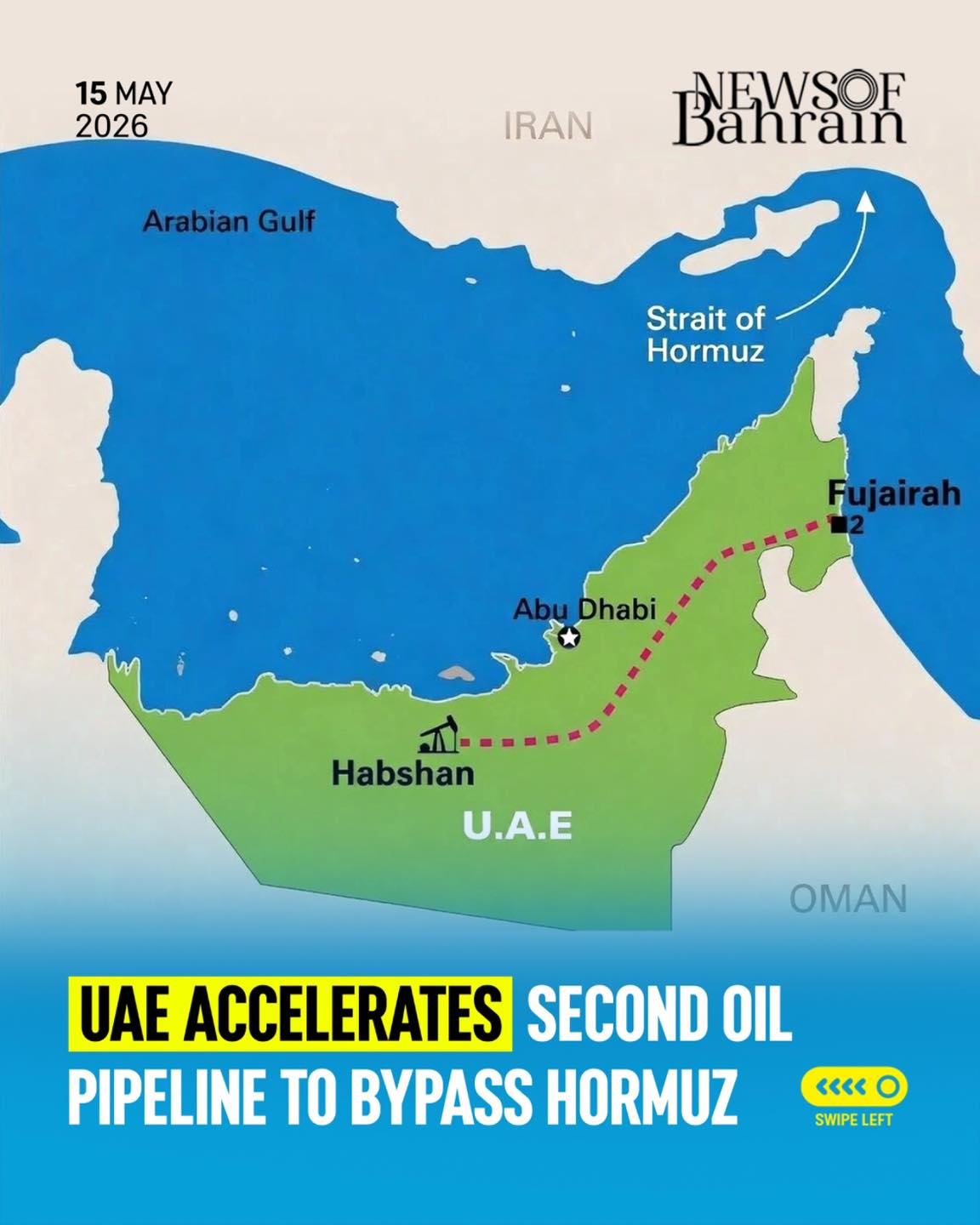
Reuters reports that the United Arab Emirates will accelerate construction of a new oil pipeline, the West-East 1 Pipeline, to double its pipeline export capacity by 2027, bypassing the Strait of Hormuz. The UAE’s existing Abu Dhabi Crude Oil Pipeline (ADCOP), also known as the Habshan-Fujairah pipeline, can carry up to 1.8 million barrels per day, and is an important asset as the country seeks to maximize oil exports from the Gulf of Oman coast. The UAE and Saudi Arabia are the only Gulf producers with pipelines that export oil without going through the Strait. Saudi Arabia ramped up its East-West pipeline’s capacity to 7 million barrels per day, keeping about 60% of the kingdom’s pre-war oil exports flowing. Other Gulf producers such as Kuwait, Iraq, Qatar, and Bahrain are almost totally reliant on the strait for shipments.

The UAE withdrew from the Organization of the Petroleum Exporting Countries on May 1, allowing it to export more oil when it chooses rather than be tied to OPEC’s quotas. Before the conflict began on February 28, the UAE produced about 3.4 million barrels per day—roughly its quota—but output fell by more than half after the effective closure of the Strait of Hormuz forced the UAE to shut in some production. In May 2024, its capacity had reached 4.85 million barrels per day. The UAE is targeting 5 million barrels per day of capacity by next year, a goal brought forward by three years. According to its energy minister, the UAE could boost output capacity to 6 million barrels per day if necessary, which would put it on par with Canada and would overtake the 2024 oil production levels of China, Iraq, and Iran. ADNOC Drilling, a subsidiary of Abu Dhabi National Oil Company (ADNOC), is ready to deliver whatever capacity expansion ADNOC needs, according to its finance chief.
The port of Fujairah has been used not only for oil exports but also for non-oil exports and food imports. The 252-mile pipeline from Habshan to Fujairah has not been targeted in the war, but infrastructure at both ends of the route has. Iranian drones hit a gas-processing facility near the pipeline’s starting point at Habshan, and the port of Fujairah on the Gulf of Oman has sustained damage that has temporarily disrupted shipments in multiple attacks during the conflict. Saudi Arabia’s Red Sea port of Yanbu, where the East-West pipeline terminates, was also attacked. Recently, several tankers carrying oil from the UAE have transited through the Strait with location trackers switched off to avoid Iranian attacks.
Iran has effectively shut the Strait of Hormuz since the country was attacked by the United States and Israel on February 28, cutting off about a fifth of global oil and gas supplies. Energy prices have surged due to the disruption, prompting fuel rationing in some countries and fears of an economic downturn as inflation builds.
Analysis
The UAE has accelerated completion of the East-West Pipeline 1—an oil pipeline that would double its capacity, reaching 3.6 million barrels per day by 2027 and bypassing the Strait of Hormuz. Iran’s effective closure of the Strait has resulted in ships being stranded in the Middle East, raising oil and LNG prices as the area has been held captive by Iran. The new pipeline project was launched as part of the UAE’s strategy to enhance energy security and ensure uninterrupted exports to international markets amid tensions in the Middle East. The UAE withdrew from OPEC on May 1 and can now produce and export above its OPEC quotas. Before the conflict, it was producing 3.4 million barrels per day, and by next year it expects its oil production capacity to reach 5 million barrels per day.

