

According to Rystad, shale oil cannot close the production gap expected by 2050 alone. The energy firm is forecasting a 76 million barrel per day need for new oil supply by 2050 due to rising demand and capital competition. Oil is not only needed for transportation, but also for heavy industry and petrochemicals. Rystad is projecting that offshore, particularly deepwater, production could dominate future oil production growth, which it was projected to do before the shale oil revolution was found to be more economic. A new report by the American Petroleum Institute and the National Ocean Industries Association, Unlocking the New South-Central Gulf of America for Energy Development: Potential Economic Impacts and Opportunities, identifies the South-Central Gulf of America as a potential new frontier for domestic energy production.
To help replace the natural decline of mature oil fields and to respond to the growth expected in demand, the report forecasts that the region could produce more than 470,000 barrels of oil equivalent per day by 2040, which would supplement the existing offshore Gulf production of nearly two million barrels per day. Oil and other liquids production would account for around 84% of production, and natural gas for around 16%. In the past, access to the Eastern Gulf planning area was restricted and unavailable for oil and natural gas development. However, in November of 2025, the Bureau of Ocean Energy Management proposed that lease sales be held, beginning in 2029, for a limited area of the Gulf of America, “Program Area B”, which is the newly designed South-Central Gulf of America Planning Area, and which excludes areas anywhere near the coasts of Florida. The area is adjacent to the Central Gulf planning area, as depicted below.
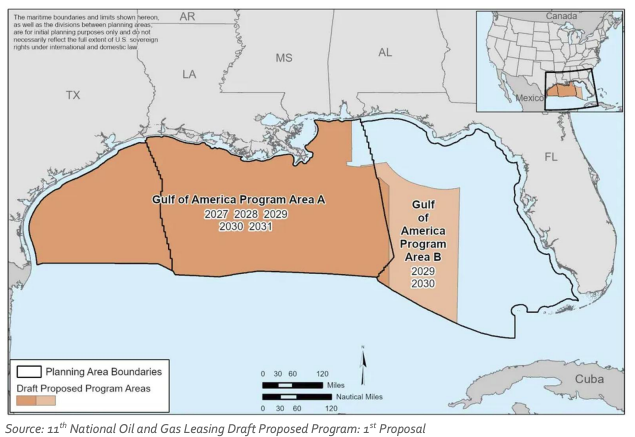
The report projects that the oil and natural gas industry exploration, production, and operational spending would reach $13.1 billion. Industry-supported employment from this spending is projected at around 130 thousand jobs, and supported GDP is projected at just over $11.3 billion. The government would stand to gain $1.5 billion in annual revenue from lease bids, rents, and royalties to federal and state coffers.
Based on leasing beginning in 2029, the study projects that through 2040, nine projects would come online in the South-Central GOA Planning Area, with the first project beginning production in 2035. Unlike onshore shale projects, which can be started relatively quickly, offshore developments require billions of dollars in upfront capital and years of planning.
According to industry data, the Gulf of America produces some of the least carbon-intensive barrels of oil in the world. As such, the South-Central expansion offers a way to meet global demand with a lower environmental footprint compared to many international alternatives. It would continue to guarantee U.S. energy abundance and fill the gap that may be looming in meeting future demand from both the decline in mature fields and the increase needed in supply. A leasing program that allows companies to plan and invest can ensure standards for safety and environmental stewardship using the best-in-class technologies and operations.
Analysis
Forecasters are projecting a shortage in oil supply by 2050. While there has been a tremendous push for wind and solar in the generating sector, these sources cannot fill all the myriad needs that oil provides in heavy industry, petrochemicals, and numerous manufacturing activities.
The South-Central Gulf represents a natural extension to oil development in the Gulf, with access to a specialized workforce and infrastructure that exists in the region. With a consistent schedule of lease sales beginning in 2029, companies can justify the capital outlays required for deepwater exploration. The federal government providing that signal would ensure that the capital stays in the United States rather than migrating to oil and gas basins in Guyana, Brazil, or West Africa.
For inquiries, please contact wrampe@ierdc.org.

