

The National News reports that the United Arab Emirates (UAE), the world’s seventh-largest oil producer, will withdraw from the Organization of the Petroleum Exporting Countries (OPEC) after more than five decades, with the decision taking effect on May 1. The UAE, which produces about 4% of the world’s oil, will also exit its terms and obligations under OPEC+, which includes non-OPEC members such as Russia. According to Suhail Al Mazrouei, UAE Minister of Energy and Infrastructure, the decision reflected a “policy-driven evolution aligned with long-term market fundamentals.” He indicated that the UAE chose to withdraw from OPEC at a time when the move would have minimal impact on other oil-producing members of the group.
The Abu Dhabi National Oil Company owns and operates most of the UAE’s producing oil and gas fields, which are largely concentrated in Abu Dhabi. The company is close to achieving the country’s goal of reaching five million barrels per day by 2027, having invested $150 billion. The UAE’s oil exports mostly go to Asia, with India, China, and Japan among key purchasers.
The conflict in Iran reduced OPEC’s oil production in March by 7.88 million barrels per day. OPEC’s production dropped 27% to 20.79 million barrels per day that month. The UAE produced 3.4 million barrels per day before the start of the Iran war — around its OPEC production quota. Following the effective closure of the Strait of Hormuz, the country’s production dropped by 44% to 1.9 million barrels per day in March. The UAE has been able to use its pipeline to Fujairah, which has a design capacity of 1.8 million barrels per day, to bypass the strait. The UAE’s current production capacity, defined as the maximum sustainable rate at which a country can maintain oil output over a period of time, is 4.85 million barrels per day. As part of OPEC+, the UAE has been producing close to 30% below its production capacity.
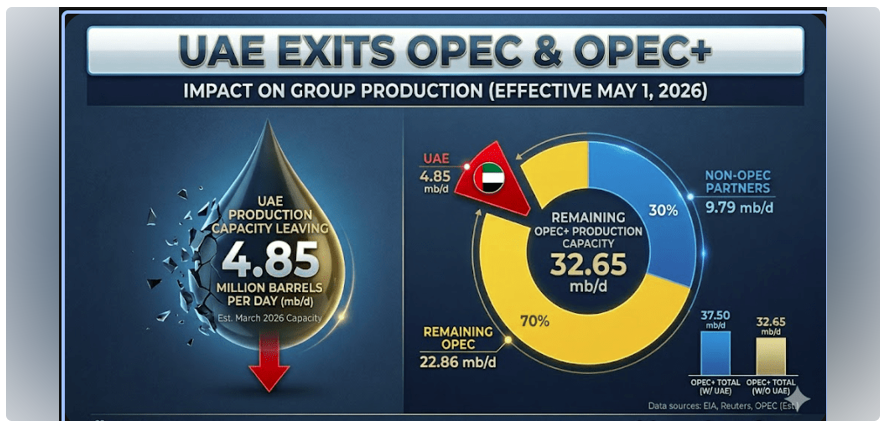
According to the New York Times, Abu Dhabi has often complained that OPEC has unfairly held back its oil exports. As Barron’s explains, the UAE’s exit from OPEC allows it to accelerate development of its oil reserves; however, the UAE indicated that it still plans to produce responsibly and keep the market balanced. It is one of the few OPEC members with significant spare capacity and the ability to quickly increase production to stabilize markets during global disruptions.
Via The Times of India, the departure of the UAE, one of OPEC’s long-standing members, could diminish the cartel’s influence. Collectively, OPEC nations account for about 36% of the world’s oil production and 80% of its proved reserves. The UAE became a member of OPEC in 1967, seven years after OPEC was founded by Saudi Arabia, Iran, Iraq, Venezuela, and Kuwait. Qatar, once a member of OPEC, left the cartel in 2019, saying that its position as a major gas producer was irrelevant to OPEC. Angola left in 2024 after its quota was cut below its actual production level. Bahrain and Oman are not OPEC members, but align with the group’s supply management efforts. Once the UAE departs, OPEC will have 11 members: Algeria, the Republic of the Congo, Equatorial Guinea, Gabon, Iran, Iraq, Kuwait, Libya, Nigeria, Saudi Arabia, and Venezuela.
According to the Wall Street Journal, the UAE has been looking for financial aid from the United States because the war in Iran has been draining its finances. While the country had so far avoided the worst economic effects of the conflict, it might need a financial lifeline in the future. The conflict damaged its oil-and-gas infrastructure and shut off its ability to sell oil using tankers transiting the Strait of Hormuz, removing a key source of dollar revenues.
Analysis
President Trump may view the UAE’s withdrawal from OPEC favorably because he wanted Middle East producers to increase output to help reduce oil prices before the conflict with Iran began. He has accused OPEC of “ripping off the rest of the world” with inflated oil prices managed by production quotas. The UAE’s move allows it to be flexible to increase production in the future once normal operations in the Strait of Hormuz resume. Moreover, Wood Mackenzie suggests that the U.S. may put pressure on Venezuela to leave the group, although it acknowledges that the Trump administration has not indicated that it is pursuing this course of action, or “leverage its role in the Venezuelan government” to influence OPEC decisions. However, the only surefire way to mitigate supply crunches or gluts from OPEC is to give American oil companies the ability to control their production levels through a permissive regulatory environment.
For inquiries, please contact wrampe@ierdc.org.

