

On May 12, the Energy Information Administration (EIA) released its May Short-Term Energy Outlook with revised assumptions about the conflict in Iran. The agency revised its earlier forecasts to reflect a much bigger and lengthier outlook to global oil supply disruptions from the Iran war than it previously projected, highlighting the uncertainty in energy markets since the conflict began on February 28. EIA estimates that Iraq, Saudi Arabia, Kuwait, the UAE, Qatar, and Bahrain collectively shut in 10.5 million barrels per day of oil production in April. The disrupted oil production results in large oil inventory draws, particularly in May and June, limiting downward oil price pressures even after flows through the strait rise. EIA expects global oil inventories to decrease by 2.6 million barrels per day this year, including a drop of 8.5 million barrels per day on average in the second quarter. That compares with a decrease of just 0.3 million barrels per day projected in the April Short-Term Energy Outlook (STEO). The forecast includes the emergency releases from strategic petroleum reserves.
The larger decrease in oil inventories and the disruptions to oil supplies in the Middle East result in higher oil prices. The Brent oil spot price on April 7 reached a high of $138 per barrel and averaged $117 per barrel for the month, $46 per barrel higher than the average in February. EIA expects Brent oil prices to remain over $100 per barrel in May and June, averaging $106 per barrel. Once the Strait is opened and oil production in the Middle East rises, the agency expects oil prices to fall, dropping to an average of $89 per barrel in the fourth quarter of 2026 and $79 per barrel in 2027. West Texas Intermediate oil is expected to average $86 a barrel this year and $74 a barrel in 2027. EIA expects that it will take until late 2026 or early 2027 for most pre-conflict production and trade patterns to resume, and some will take even longer.

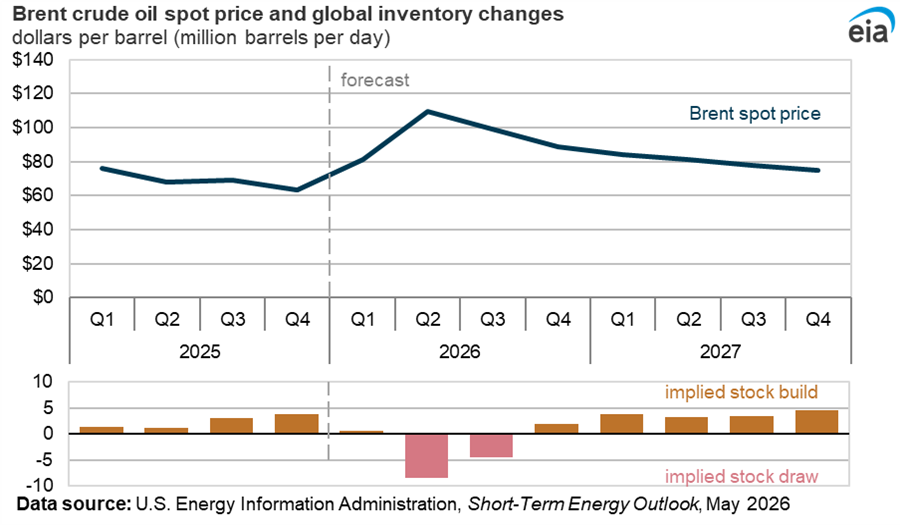
EIA expects the higher prices to reduce oil demand, which will help balance the oil market. EIA expects reductions in oil demand to occur primarily in Asia, which is more reliant on oil supplies from the Middle East than other areas. EIA now assumes that global oil demand will increase by an average of 0.2 million barrels per day in 2026, down from an average of 0.6 million barrels per day in the April STEO and 1.2 million barrels per day in the February STEO. Once oil production and trade return to the Middle East, EIA expects oil demand to rebound, growing by 1.5 million barrels per day in 2027 to 105.6 million barrels per day. The EIA also expects global inventories to rebuild in 2027 at a faster pace than previously estimated, increasing by 3.9 million barrels a day.
The May STEO assumes that the strait reopens in late May. If the Strait of Hormuz remains shut through June, one month longer than the current assumption, oil prices would be about $20 per barrel higher in the near term. Prices would remain higher than the current forecast through next year, with the difference narrowing over time.
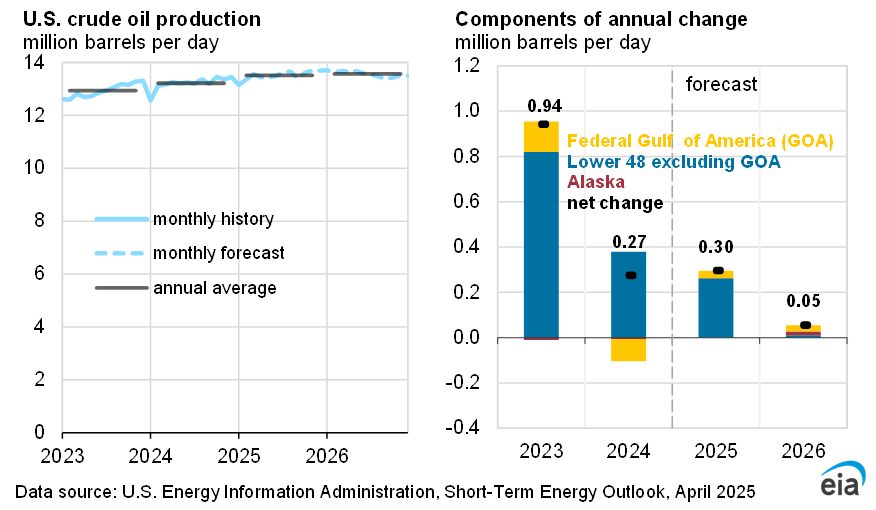
EIA reported that U.S. oil production set a record of 13.6 million barrels per day in 2025, up 3% —350,000 barrels per day —over the previous record set in 2024, making the United States the world’s largest oil producer—a ranking it has held since 2018. The May STEO expects U.S. oil production to remain at 13.6 million barrels per day in 2026 and then increase to 14.1 million barrels per day in 2027.
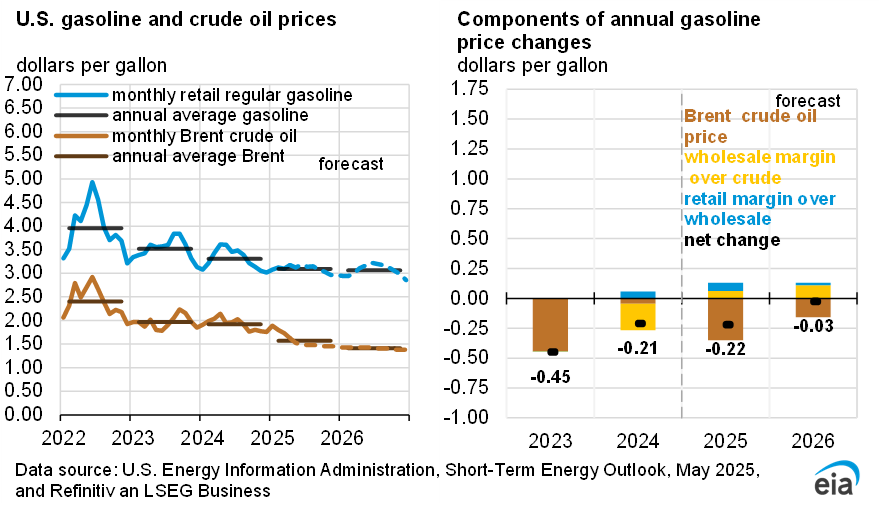
The May STEO expects U.S. gasoline prices to average $3.88 in 2026 and fall to $3.62 in 2027 from an average of $3.10 in 2025.
Analysis
EIA’s May STEO assumes that the conflict in Iran will end by the end of May, but that it will take until late this year or early next year for most oil production and trade flows to return to pre-conflict levels. EIA expects Brent oil prices to average $95 a barrel in 2026 and $79 a barrel in 2027, up from $69 a barrel in 2025. For May and June, it expects those prices to be over $100 per barrel, averaging $106 per barrel. The agency expects demand destruction to occur mainly in Asia, with global demand increasing just 0.2 million barrels per day in 2026, but rebounding in 2027 by 1.5 million barrels per day, reaching 105.6 million barrels per day. U.S. oil production reached a record 13.6 million barrels per day in 2025, and the EIA expects the same level in 2026, then increasing to 14.1 million barrels per day in 2027. The United States remains the world’s largest oil producer.

