

On September 11, an attack by Iran-backed fighters in Iraq knocked out Saudi Arabia’s East-West oil pipeline, which Saudi Arabia uses to export oil by avoiding the Strait of Hormuz. It does so by rerouting oil shipments to the Red Sea, but idling it threatens up to 4% of global oil supply. The East-West pipeline can carry up to 7 million barrels of oil a day–about 2 million for domestic Saudi refiners and the rest for export–750 miles from Saudi Arabia’s oil-producing region on the Persian Gulf to the port of Yanbu on the Red Sea. With the pipeline out of service, the Red Sea port of Yanbu will need to draw on storage, estimated to cover five to seven days of exports. Attacks earlier this year damaged a pumping station and reduced the line’s capacity by about 700,000 barrels a day, but the country restored the pipeline to full capacity within days.
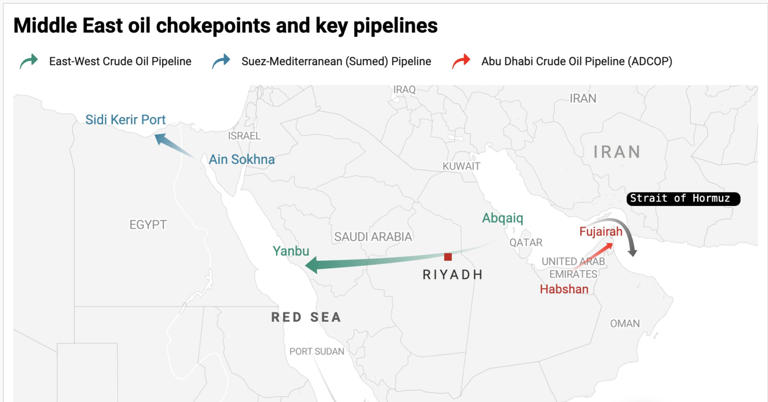
This time, it could take much longer to reestablish flows, with a partial restart possibly coming sooner than a full repair. The East-West system consists of two parallel pipelines that use separate pumping infrastructure. One line could continue operations after safety checks while repairs continue on the other line. Restoring damaged pumping stations is more complicated, with full repairs taking as long as six to eight weeks. Michael Haigh, head of commodities research at French bank Société Générale, estimated that, depending on the degree of damage, repair work could take three to seven days at best, but would more likely take one to three weeks. If the pumping stations have major structural or electrical damage, restoration could take five to six weeks.
Further affecting the conflict, Yemen’s Iran-aligned Houthis reached the island of Perim on September 11, tightening their control over the Bab el-Mandeb Strait. Perim Island is situated in the middle of the Bab el-Mandeb Strait at the southern entrance to the Red Sea. Its seizure adds a new dimension to the Iran conflict, as oil tankers must either sail north through the Suez Canal using smaller vessels, since very large crude carriers cannot fit, or take the longer route around Africa. Further, on September 13, the Houthis fired dozens of missiles and drones at a Saudi military airbase in Khamis Mushait, near the border, hitting aircraft hangars, radar systems, runways and ammunition depots. The attack, they said, was in retaliation for Saudi airstrikes on Yemen in recent days.
Saudi oil production has been falling during the conflict, hitting its lowest level in more than three decades last month. Saudi’s oil supply fell 2.3 million barrels a day to 6 million barrels a day in August, according to the International Energy Agency. Saudi Arabia produced around 9.4 million barrels a day on average last year.
After the weekend events, crude oil prices rose more than 4% on September 14, with benchmark Brent oil futures above $109 a barrel. The U.S. average retail price of diesel also reached a new all-time high above $6.23 a gallon. Diesel prices are affected by a number of factors, including the effective closure of the Strait of Hormuz, Russia’s diesel export ban and attacks by Ukraine on its refineries, U.S. refinery utilization at 98% amid a number of global refinery closures, refinery competition from jet fuel, and the short-run demand inelasticity of commercial freight and agriculture.
In July, Russia implemented a diesel-export ban and extended it to September 30. The ban was due to Ukraine’s 70+ drone attacks on Russian refinery facilities since the start of 2026, adding pressure to the already tight petroleum market. Russia was a major exporter of diesel – accounting for about 10% of global seaborne-traded diesel supplies. S&P Global estimated that about half of Russia’s refining capacity was offline by the end of August. On September 13, President Trump called on Ukrainian President Volodymyr Zelenskiy to stop targeting Russian diesel infrastructure, saying the attacks were causing a shortage of the fuel that is “hurting the world.” Ukraine is attacking Russian refineries to push up the cost to Russia of continuing its invasion of Ukraine.
Despite requests for military support from the Saudi Crown Prince Mohammed bin Salman, President Trump is so far unwilling to intervene in Yemen beyond providing intelligence sharing and targeting. President Trump has spoken to the prince and indicated that the Houthis had also phoned, asking the United States to keep out of the dispute. The United States had bombed the Houthis in 2025 for two months, but President Trump ended that conflict after reaching a ceasefire with the group, which he said had promised not to attack ships in the Red Sea. According to a White House official, “The United States is focused on protecting our core national security interests — such as ensuring freedom of navigation in the Red Sea — while empowering our regional partners to take the lead in managing and resolving regional security challenges.”
Conclusion
Iran-backed militia in Iraq targeted Saudi’s East-West oil pipeline with drones, causing damage that is likely to take several weeks to repair, though a partial reopening is possible as it consists of two parallel lines. Saudi Arabia used the pipeline as an alternate route to export oil when Iran closed the Strait of Hormuz, exporting as much as 5 million barrels per day. The Houthis took the island of Perim in the middle of the Bab al-Mandeb Strait at the southern entrance to the Red Sea, creating another choke point for Saudi Arabia’s oil exports that must now either use the Suez Canal with smaller oil tankers or sail the much longer distance around Africa. The events pushed Brent oil prices to over $109 a barrel on September 14 and the average U.S. retail price of diesel to a new all-time high of $6.23 a gallon. Several factors affect diesel prices, including the effective closure of the Strait of Hormuz, Russia’s diesel export ban, U.S. refinery utilization at 98% amid global refinery closures, refinery competition from jet fuel, and the short-run inelasticity of demand in commercial freight and agriculture.

