

U.S. Forces struck two Iranian rocket launchers loaded with sea mines on Larak Island in the Strait of Hormuz on August 30, after the U.S. military said Iran was preparing rockets carrying sea mines for launch into the Strait of Hormuz, marking the first military action against Iran in a month. Iran responded to the U.S. attack on its rocket launchers with an assault on two U.S. bases in Jordan: King Hussein and Al-Azraq U.S. air bases. As a spoof, President Trump posted an AI-generated video clip and declared that Iran’s oil hub Kharg Island was under attack, which an Iranian official dismissed as “laughable.” No evidence showed that Kharg had been attacked. Iran also said it struck the UAE’s Al Minhad air base early on August 31, but the UAE’s defense ministry dismissed the reports as false. Later, the UAE reported that its air force engaged a drone over its territorial waters that had come from Iran. Oil prices were trading more than 3% higher after the attack. Brent oil futures rose as high as $91.52 a barrel, but dropped to $90.27 a barrel at 12:12 p.m. EDT on August 31, while West Texas Intermediate oil was at $85.46 a barrel.

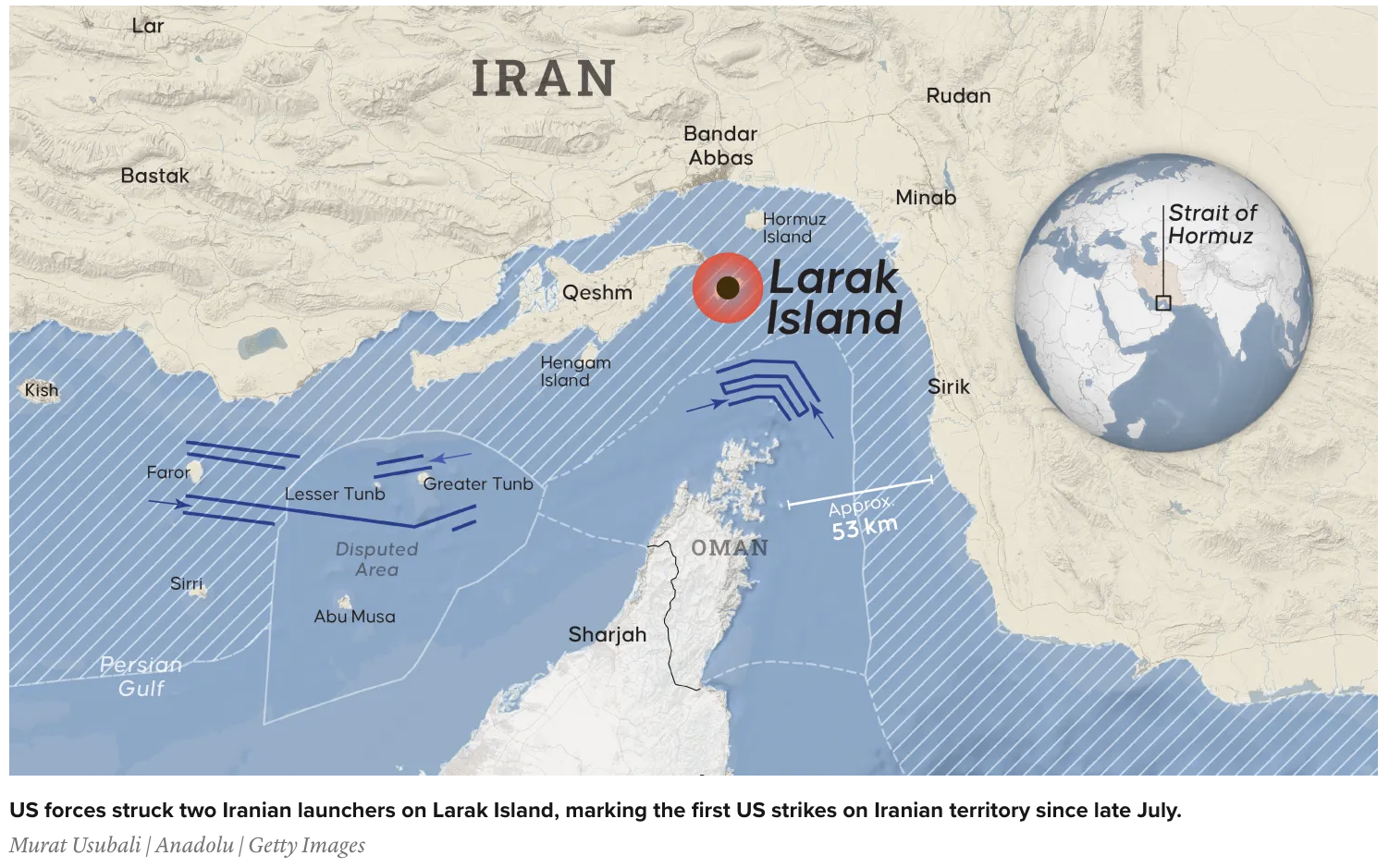
U.S. air defense systems intercepted all but one of the missiles launched at the Jordanian bases by Iran’s Revolutionary Guard; the remaining missile was allowed to pass through after it was determined that it would not strike anything significant. According to Iran’s Revolutionary Guard, the U.S. attack on Larak Island killed and wounded several Iranian soldiers. The U.S. strikes “destroyed the technical and repair infrastructure, as well as the enemy fighter deployment sites,” inflicting “heavy damage,” reported Iranian military forces. Larak is a small Iranian island in the Strait of Hormuz that has become a key military and shipping control point for Iran, and is used by the Guard to monitor vessel traffic through the strait.
In late August, the U.S. military completed clearing sea mines from the strait’s international shipping routes and is monitoring the area closely to keep the strait open to vessels. The attack on Larak targeted an attempt by Iran to reintroduce mines in the strait. On August 31, Iran’s Revolutionary Guard said a supertanker had caught fire and was left disabled in the southern Strait of Hormuz after striking two naval mines. According to the Epoch Times, the United States denies the Iranian claim that a supertanker hit mines in the Strait of Hormuz. Iranian media reports that the supertanker was not complying with Iran’s rules for passage in the strait.
U.S. Treasury Secretary Scott Bessent wants major economies to help the United States with its economic pressure campaigns against Iran and China. The goal of U.S. sanctions on Iran is “to create the conditions that they will want to come to the table” for negotiations. Because of the American blockade of Iran’s ports, the Iranian government is struggling to meet a gasoline shortfall, with lines of cars waiting at gas stations, and it worries that higher pump prices could spark unrest. According to Iran’s president, foreign trade is down 35% due to sanctions and the blockade, and Iran’s inflation hit 66% in July. Iranian President Masoud Pezeshkian said Iran sold about 90 million barrels of oil during the short-lived memorandum of understanding the United States and Iran signed in June, when the United States allowed Iranian oil sales.
Treasury Secretary Bessent has warned countries to cut business ties with Iran or face secondary sanctions, though the Treasury Department did not impose penalties against major Iranian trade partners such as China and India. The Treasury did impose sanctions on Egypt’s Banque Misr for doing business with Iran, proposing a rule that would cut off the bank’s branches in the United Arab Emirates from dollar transactions. According to Egypt’s central bank, the foreign ministry was in contact with U.S. officials, and the measure was limited to Banque Misr UAE’s U.S. dollar transactions with correspondent banks only. Banque Misr is reviewing the U.S. Treasury notice, adding that its UAE branch continued to provide banking services to its customers. The United States has also issued sanctions targeting an entity based in Hong Kong and a person linked to Iran’s Bank Melli.
Conclusion
Strikes resumed between the United States and Iran as the United States targeted two Iranian rocket launchers loaded with sea mines on Larak Island in the Strait of Hormuz that damaged infrastructure and killed and wounded several Iranian soldiers. Iran retaliated by launching drones at U.S. military bases in Jordan that were either intercepted or allowed to pass through unobstructed. Since then, more exchanges have taken place, including US attacks on several Iranian oil tankers in response to Iran’s attack on two US naval assets and multiple other commercial vessels. Oil futures prices rose above $100 a barrel due to the most recent exchange. The United States is using the blockade against Iranian ports and sanctions to get Iran to come to the table for negotiations. Iran reports that its foreign trade is down 35% and Iran’s inflation hit 66% in July. Iranians are struggling to get gasoline, and the government worries that higher pump prices could stir unrest.

