

Qatar Energy, the state-owned national petroleum and natural gas company of Qatar, has purchased 33 U.S. liquefied natural gas cargoes worth about $1 billion this year to maintain deliveries to key Asian customers after the Iran war halted Qatari exports through the Strait of Hormuz. This compares to a total of four cargoes last year. Twenty-eight deliveries have arrived, and five are en route to South Korea, Taiwan, Bangladesh, India and Japan. Qatar Energy declared force majeure on its liquefied natural gas shipments, which releases it from contractual obligations, after Iran closed the strait to shipping. The 33 cargoes are about a third of a month’s typical exports shipped from Qatar under normal circumstances. About 80% of Qatar’s LNG shipments are exported to Asia. Qatar wants to protect its reputation as one of the world’s most reliable gas suppliers and is using U.S. LNG to do so.
A Qatari LNG tanker recently crossed the Strait of Hormuz with the transponder on for the first time since the gas carrier, Al Rekayyat, was struck on July 7. Qatar Energy may be ready to resume deliveries through the strait, but recent resumption of attacks by Iran and the United States may have compromised that ability. If Qatar Energy could move its gas through the strait, the company may be able to ramp up production at the world’s largest LNG plant in Ras Laffan Industrial City — a plan that was on hold due to the conflict.
Europe is in need of natural gas as its gas storage sites are currently about 54% full, the second-lowest level for this point in 15 years and well below the five-year average. Gas storage levels were at 28% at the start of the summer injection season, below the levels recorded at the start of the previous three summer seasons, after a colder winter left inventories significantly depleted. Europe usually likes to fill its gas storage facilities to 80% before the winter season begins.
With the conflict in Iran continuing and the Strait of Hormuz effectively under Iran’s control because of threats, Europe enters the final months of the summer injection season with fewer LNG cargoes available than expected. Asian buyers are purchasing an increasing share of spot cargoes. With LNG now accounting for about 30% of Europe’s gas imports, European utilities are having to bid against higher-priced demand for supplies. Asian LNG imports are expected to increase to a six-month high in July, led by a recovery in Chinese demand, and Europe’s LNG imports are projected to fall to their lowest level since September 2024.
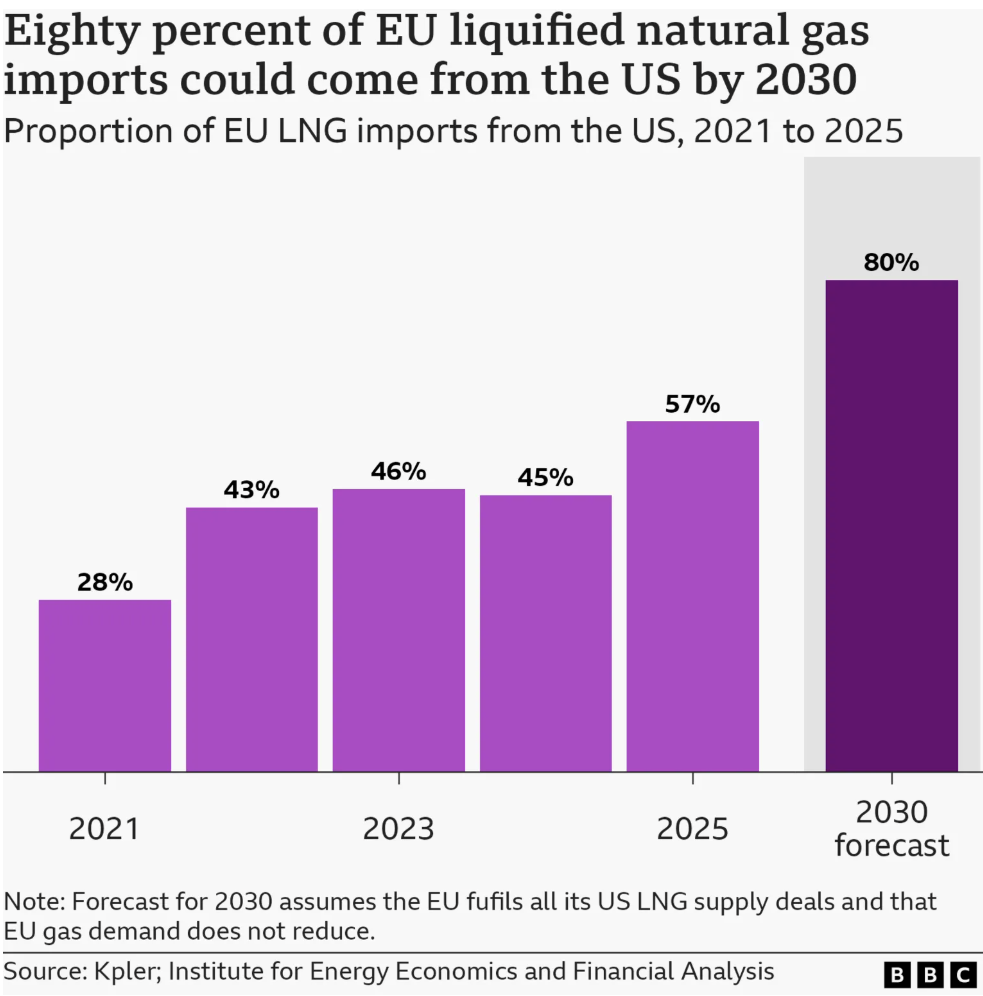
The United States supplies about two-thirds of Europe’s LNG imports, up from 28% in 2021 due to supply security and reliability issues. According to the BBC, the EU is expected to get as much as 80% of its LNG imports from the United States by 2030 based on two assumptions: the EU does not reduce its gas demand and that the EU fulfills all of its U.S. LNG deals. A 2025 U.S.-EU trade deal commits Europe to $750 billion of American energy over three years – including LNG, oil and nuclear fuel.

In the European Union, household electricity bills have risen 30% since 2021, according to official Eurostat figures. In the UK, electricity prices are about 38% higher than in mid-2021, while gas prices are 120% higher. In Germany, the average home pays 31% more for its electricity than before the Ukraine war, and gas prices for German households are up by over 74%. Natural gas accounts for 12% of German power generation, and half of German homes are fitted with gas boilers. Germany is the EU’s biggest manufacturer, producing more than a quarter of the bloc’s industrial output, although industrial production is down across Europe. At InfraLeuna, a vast chemicals and plastics industrial park in central Germany, the annual gas bill rose from €60 million ($68 million) before the war in Ukraine, to an expected €200 million ($230 million) this year due to the Iran crisis—an increase of 233%.
The answer for Europe, of course, is to produce its own natural gas, which is much cheaper than LNG shipped from abroad—gas that needs to be liquefied before shipping and then re-gasified before use. Norway supplies only about one-third of Europe’s gas imports. With some European countries banning fracking and restricting oil and gas leasing, Europe is creating its own energy crisis and will need to rely on imports as it transitions to wind and solar power, which require expensive batteries to back them up when the wind is not blowing and the sun is not shining.
Conclusion
To reassure its Asian customers that it is a reliable gas supplier, Qatar is purchasing LNG from the United States and delivering it to Asia. Qatar had to declare force majeure on its liquefied natural gas shipments due to the U.S. conflict with Iran and the effective closure of the Strait of Hormuz. With Qatar LNG in limbo, European and Asian countries are relying on U.S. LNG, which is more expensive than domestic natural gas because of the liquefaction and regasification processes and limited supply due to the wars in Ukraine and Iran. The United States supplies about two-thirds of the EU’s LNG now and is expected to supply 80% by 2030. Just 10 years ago, the United States began exporting LNG, and it has now surpassed Qatar and Australia in exports.
For media inquiries, please contact press@ierdc.org.

