

The European Union (EU) is planning to adopt guidelines to delay penalties on energy imports that do not comply with the bloc’s methane emissions regulations. The guidelines will urge member states not to apply penalties for a certain period, giving the market room to adjust. The United States, Qatar and other gas-producing nations urged the EU to revise the rules, warning that they could jeopardize critical energy shipments. The United States has become Europe’s largest LNG supplier due to conflicts in Iran and between Russia and Ukraine. The United States has warned the EU that its LNG supplies will be exported elsewhere if the bloc refuses to ease the regulations. EU members the Czech Republic, Slovakia, Belgium, Italy, Poland and Sweden called on the commission to consider options to ease barriers to oil and gas purchases, including a three-year delay to the importer requirements.
Beginning in 2027, the regulations require fossil-fuel imports into the EU to comply with monitoring, reporting and verification requirements to reduce methane emissions. By 2030, imports exceeding a methane-intensity threshold would face penalties, with the fine amounting to up to 20% of their annual turnover. Over the past few months, companies in the chemical, oil and gas, and energy trading sectors have called for a delay in the requirements, warning that importers risk being pushed into non-compliance. They cited verification as a major bottleneck, with too few recognized protocols and verification bodies. No EU country has established a verification body to enforce the legislation, so companies currently have no way to certify compliance.
The International Energy Agency (IEA) has warned that the EU’s methane emissions rules could limit the oil supplies available to the bloc. According to the IEA, around 22.5 million barrels per day of global oil production is expected to comply with the criteria in 2027, but not all of it would be available to the EU. Reuters reports that the EU imported 9.3 million barrels per day of oil in 2025. According to the IEA, the oil that EU refiners can import legally could decline by more than 50% because some grades of oil cannot easily be substituted and certain producers may prefer to sell into more profitable markets outside Europe. For example, heavy oil used in asphalt production is supplied largely by countries such as Mexico and Venezuela, which do not meet the EU methane standard.
The EU methane regulation could also be difficult for American LNG exporters to comply with. The EU requires importers to provide data “at the level of the producer,” which is likely to be particularly challenging for American LNG exporters. Unlike most of the world, U.S. LNG export facilities source natural gas from a vast pipeline network. Supplies are commingled, including volumes sourced from different production basins from many different companies with varied methane intensities.
According to the Energy Information Administration, in 2025, U.S. LNG exports to Europe reached a record 10.3 billion cubic feet per day, up from 6.3 billion cubic feet per day in 2024, and accounted for 68% of LNG export volumes. Exports to Italy and Poland rose the fastest in Europe.

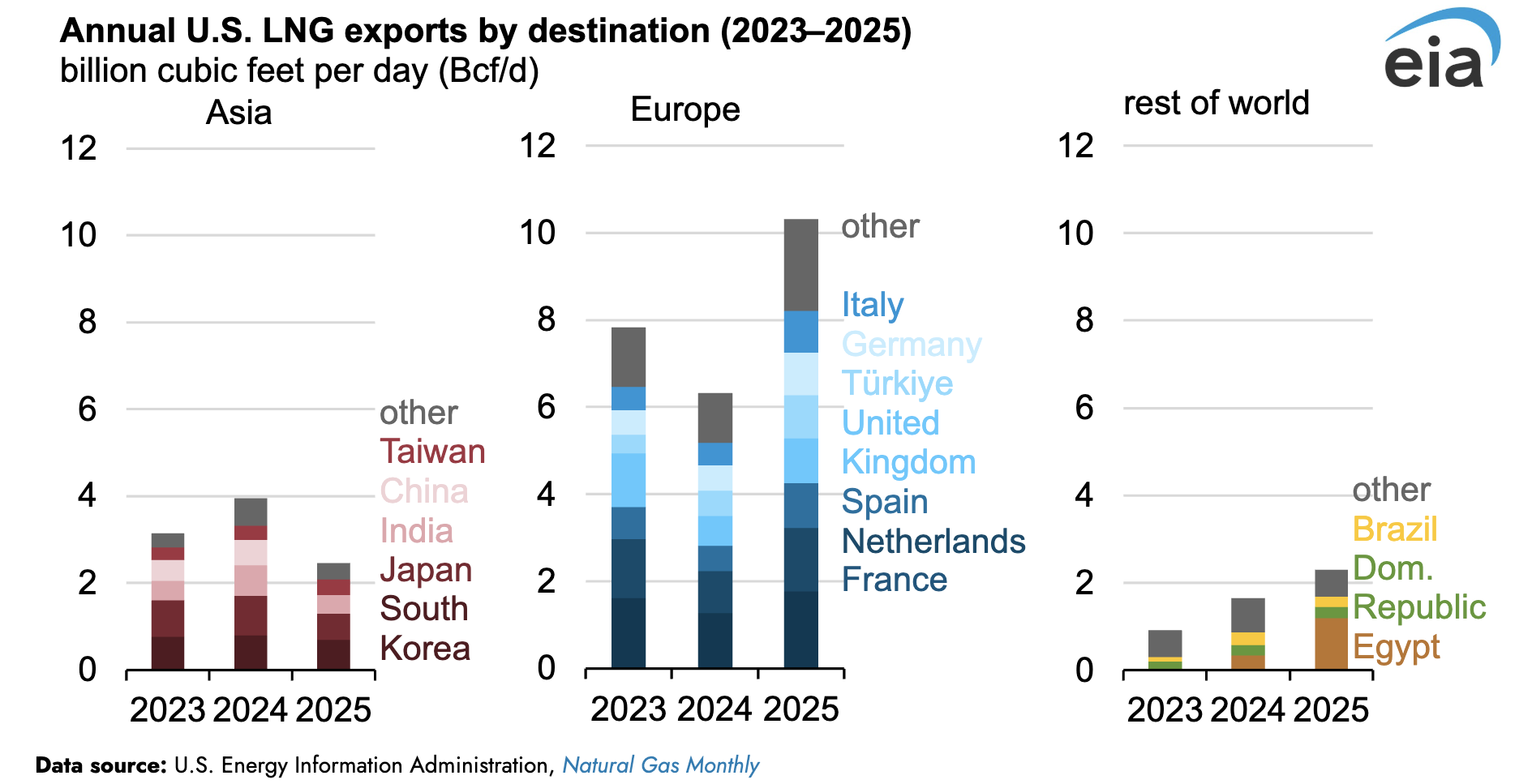
Halfway through 2026, the United States remains the EU’s dominant LNG supplier, shipping it about 31.6 million metric tons, or 59% of the EU’s imports of LNG so far this year. By the same point in 2025, the U.S. had met about 55% of the EU’s year-to-date LNG imports.
Conclusion
Although 17 of the 27 EU member states requested specific adjustments to the import-related clauses of the methane rule, the European Commission has refused to change the regulations and is instead offering non-binding recommendations. The regulations target methane emissions within the EU and impose new requirements on fossil fuel importers. It highlights the difficulties the EU encounters when applying more rigorous environmental regulations to products from non-EU nations. As Europe moves to be free of Russian gas imports by 2027, it will become more dependent on imports from the United States and other countries, and how the methane regulation gets implemented will determine the future of LNG flows to Europe and oil as well. These regulations could have a detrimental effect on Europe’s ability to supply natural gas and oil to its people in the future, threatening EU energy security. The EU’s continued adherence to its climate change and net-zero orthodoxy is creating significant problems as EU economies are confronted with policy-driven energy costs and limits to availability.
For media inquiries, please contact press@ierdc.org.

