

When Russia invaded Ukraine in 2022, oil prices shot up to $139 per barrel, but they were somewhat subdued in the war with Iran four years later. There were several reasons for the muted price response. They include a demand reduction from the world’s largest oil importer, China; U.S. energy dominance, with the United States upping oil production and exporting record amounts of oil and petroleum products; and the use of commercial inventories and strategic reserves. Also helping was an established oil oversupply at the beginning of the conflict and U.S. forces facilitating oil transit via the Strait of Hormuz.
With a tentative framework agreement in hand and negotiations to follow for 60 days on Iran’s nuclear program and uranium enrichment, the conflict may not yet be over, so prices could still escalate. For now, Brent crude is hovering around $80 per barrel. Some forecasters expect it to remain largely capped near $100 a barrel over the next year, as supply disruptions from the war are offset by demand destruction and gradual market rebalancing, with the range between $81 and $100 a barrel.
China
The world’s biggest oil importer is continuing to prioritize lower refinery use and fuel export limits to manage reduced oil imports from the Middle East, as it did at the onset of the Iranian conflict. State-owned refiners have cut processing rates to record lows, fuel exports have been constrained under wartime measures to preserve domestic supply, and the switch to electric vehicles in China has accelerated. According to Bloomberg, China has refrained from tapping international markets to make up for the lost barrels.
China has also filled up its oil inventories to unprecedented levels over the past year. Its commercial inventories and strategic reserves are estimated to total between 1.2 billion and 1.4 billion barrels, dwarfing the reserves of other countries. The country was able to obtain oil below market prices from Venezuela, Russia, and Iran due to sanctions on those countries. In May, China began tapping its reserves, drawing down almost 25 million barrels through June 7. Inventory draws are expected to average about 1 million barrels a day in the coming months — about a third of the oil China is no longer receiving since the conflict effectively closed the Strait of Hormuz.
U.S. Energy Dominance
The United States has increased its oil production and its exports since the start of the war. The Energy Information Administration (EIA) expects U.S. oil production in 2026 to total 13.72 million barrels per day—130,000 barrels more per day than in 2025. U.S. crude oil exports reached a record 5.6 million barrels per day in May—up from the previous record set in April of 5.2 million barrels per day–due to demand from Asian and European refiners. At least 283,000 barrels per day, or about 5% of U.S. crude oil exports in May, were from the U.S. Strategic Petroleum Reserve.
The EIA reported that U.S. net exports of crude oil and petroleum products reached an all-time high of 5.8 million barrels per day in April, with May levels estimated to remain similar. Growing international demand for U.S. diesel and jet fuel is expected to drive higher net exports of both products in the second quarter of 2026 than in the same period in 2025. Meanwhile, U.S. refineries are operating at nearly 95% utilization and are delaying their usual spring maintenance, which typically occurs during the shift to summer fuel blends. Overall, the EIA forecasts that U.S. net exports of crude oil and petroleum products will average 4.2 million barrels per day in 2026, up 1.4 million barrels per day from 2025.
Strategic Reserve Drawdown
Member nations of the International Energy Agency (IEA) agreed to collectively release 400 million barrels from strategic reserves based on the IEA’s recommendation. The United States agreed to release 172 million barrels over a four-month period. Oil was last released from the SPR in 2022 by President Biden to lower oil and gasoline prices for political purposes during Russia’s invasion of Ukraine, depleting the reserve of a net 240 million barrels without refilling much of it and causing structural damage to the facilities in the process. Before the conflict with Iran, President Trump was working on refilling it while it was undergoing necessary repairs and was at 415 million barrels, about 58% of its 714-million-barrel capacity, when the current release was announced.

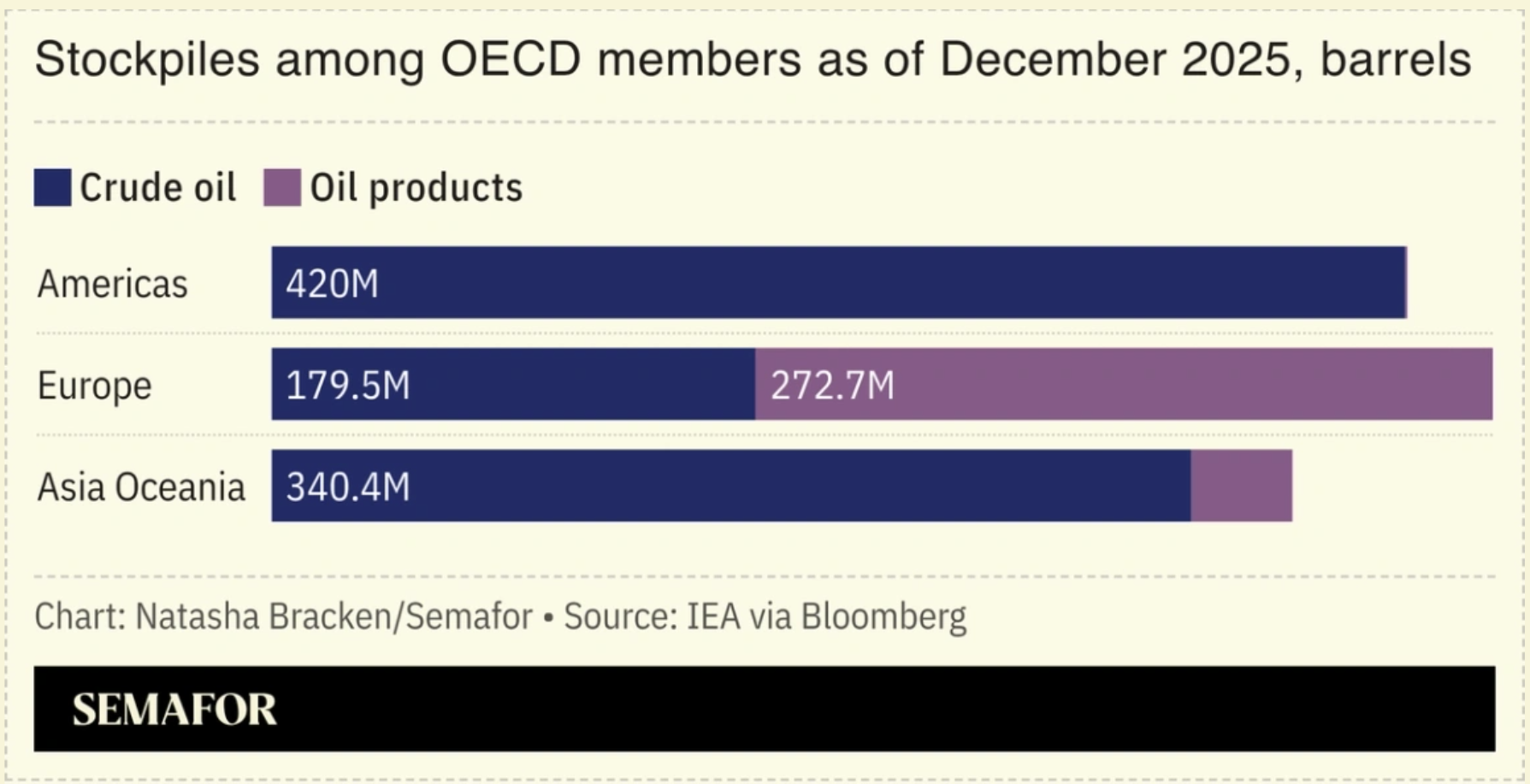
The U.S. emergency oil reserve is now at 340.3 million barrels — down 75 million barrels, or 18%, since the war with Iran began in late February. The last time the SPR had less oil was July 1983, when the Reagan administration was filling the reserve for the first time. It must be at least 20% full to be operational. Commercial inventories are also low. Supply at the crude oil hub in Cushing, Oklahoma, has dropped to less than 2 million barrels above its operational floor. Oil prices could increase due to these low inventories if a final agreement is not reached.
U.S. Military Escorts Ships through the Strait
The U.S. military secretly helped 200 ships and 100 million barrels of oil transit the Strait of Hormuz over the past month, which partially explains why oil prices have remained relatively stable recently. One hundred million barrels represents about 16% of the normal oil volume in a typical month. Recent reported transits through the strait remain around 5% of pre-conflict levels.
Conclusion
Oil prices during the U.S.-Iran conflict have remained relatively muted for several reasons, including demand destruction, primarily in China, the world’s largest oil importer; increased U.S. exports to Europe and Asian refiners; and the use of commercial stocks and strategic reserves. While demand destruction and higher U.S. oil production will likely continue until normal shipping has resumed, stocks and strategic reserves have been brought down to low levels, which could escalate oil prices if shipping through the strait does not return to more normal levels.

