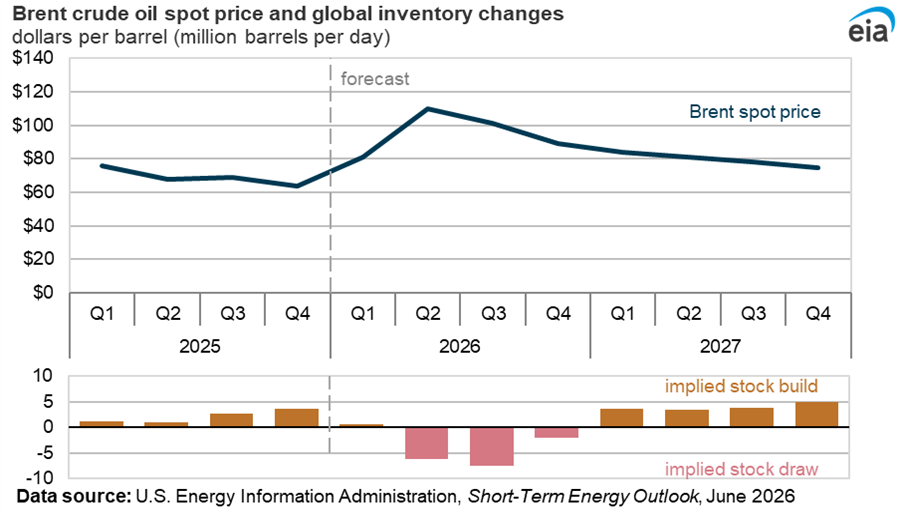
The Energy Information Administration’s (EIA) Short-Term Energy Outlook (June 9, 2026) assumes that the Strait of Hormuz marine traffic does not normalize to pre-conflict levels until early 2027, despite also assuming that the strait reopens in the third quarter of this year. With that assumption, the agency expects oil inventories in Organization for Economic Cooperation and Development economies to fall below 2.3 billion barrels by December–the lowest level in agency records dating to 2003. Global oil demand is projected to decline by 1.1 million barrels per day this year–the first decline since the pandemic-related drop of 2020. The decrease is due to high oil prices, a reduction in fuel availability, and governmental initiatives designed to conserve oil. Spot Brent oil prices are projected to average about $105 per barrel in June and July—higher than their current prices that are in the $90 dollar per barrel range. Because stocks are needed to make up for 11 million barrels a day of lost Middle Eastern oil output in May, oil prices are expected to increase in the coming months.
The EIA expects global oil demand to grow by 2.5 million barrels per day in 2027 to 105.3 million barrels per day. Brent oil prices in 2027 are expected to average $79 a barrel as flows through the Strait of Hormuz incrementally resume and producers gradually restore shut-in production. Gasoline prices are expected to average $3.90 a gallon in 2026, dropping to $3.64 a gallon in 2027–a 6.7% drop.
U.S. crude oil and petroleum product net exports in April hit a record 5.8 million barrels per day, and May net exports are assumed to be about the same. Demand for U.S. diesel and jet fuel has risen, with net exports for both expected to increase in the second quarter of 2026 compared with the same period in 2025. EIA expects U.S. crude oil and petroleum product net exports to average 4.2 million barrels per day this year, 1.4 million barrels per day higher than in 2025.
Since natural gas is priced domestically rather than on the global market like oil, the price forecast is different. EIA expects natural gas prices to remain relatively flat in 2026, as supply growth outpaces demand, despite a rise in gas-fired power demand in May due to warmer weather. The agency’s forecast for dry gas production in 2026 is 111 billion cubic feet per day, with consumption at 92.1 billion cubic feet per day. It expects natural gas demand next year to increase due to higher expected electricity generation and growth in U.S. natural gas exports. The agency is forecasting that average U.S. liquefied natural gas exports would rise from a record 15.1 billion cubic feet per day in 2025 to 17.2 billion cubic feet per day in 2026 and 18.6 billion cubic feet per day in 2027. It expects the Henry Hub spot price to average about $3.34 per million British thermal units in the second half of 2026 and $3.55 per million Btu in the second half of 2027—an increase of 6.3%.
EIA expects electric generation to be 3% higher this summer compared with last summer. It expects renewables to meet the increased generation, with solar up 19% and wind up 10%. Coal generation is expected to decline by 2% as coal units are assumed to retire, while natural gas is expected to generate about the same amount of electricity as last summer.
EIA’s forecast retires 16 gigawatts of coal capacity through 2027. Wind and solar both add capacity, with solar capacity growing by 70 gigawatts through 2027 and wind capacity growing by 20 gigawatts during the two-year period. Natural gas adds 13 gigawatts of capacity through 2027. While wind and solar together add 70 gigawatts, that compares to less generation than equivalent natural gas capacity due to much lower capacity factors for wind and solar power. According to EIA data, wind’s capacity factor in 2025 was about 34%, and solar power’s capacity factor was around 24%.
Residential electricity prices are expected to increase 5.4% in 2026 and 2% in 2027.
Conclusion
EIA does not expect traffic through the Strait of Hormuz to return to pre-conflict levels until early 2027, though it expects the strait to reopen in the third quarter of 2026. As such, Brent oil prices are expected to be $105 per barrel in June and July—higher than current prices. OECD stocks are expected to be drawn down to their lowest level since EIA began recording data in 2003, resulting in upward pressure on oil prices. EIA expects Brent oil to average $79 a barrel in 2027 once traffic through the strait resumes to pre-conflict conditions and for gasoline prices to drop from $3.90 a gallon in 2026 to $3.64 in 2027. Because natural gas is priced domestically, its price is expected to increase by only 6% in 2027 at the Henry Hub. Electricity generation is expected to be 3% higher this summer, with wind and solar providing increased power.
For media inquiries, please contact press@ierdc.org.