Summary
The Renewable Fuel Standard (RFS) requires refiners and fuel importers to obtain credits representing specified volumes of renewable fuel. These credits, known as Renewable Identification Numbers, or RINs, are retired annually to demonstrate compliance with percentage standards established by the Environmental Protection Agency (EPA).
EPA’s renewable-fuel requirements for 2026 establish a total obligation of 26.81 billion RINs, equivalent to 15.50 percent of projected obligated gasoline and diesel sales. The 2027 requirement rises to 27.02 billion RINs, or 15.78 percent.
RIN prices increased substantially as the new requirements were developed and finalized. In early June 2026, conventional ethanol RINs traded at approximately $2.37, while biomass-based diesel RINs traded at approximately $2.41, close to their all-time highs. The Energy Information Administration attributed most of the increase to higher federal biofuel requirements.
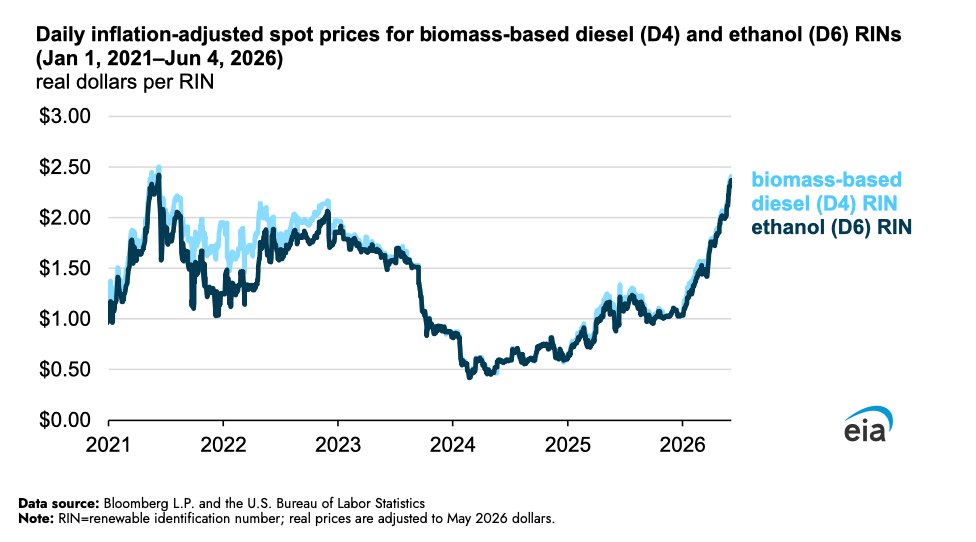
Applying an average RIN price of approximately $2.40 to EPA’s 15.50-percent standard produces a gross compliance obligation of approximately 37 cents for every gallon of obligated gasoline or diesel. Across the full 2026 requirement, the market value of the required credits is approximately $64 billion.
The RFS obligation is not legally an excise tax. However, research and the EPA’s own analysis indicate that RIN costs are generally incorporated into wholesale petroleum product prices. The program therefore affects the price of gasoline and diesel even though its costs do not appear as a separate charge at the pump.
How the RFS Works
Congress created the RFS in 2005 and expanded it through the Energy Independence and Security Act of 2007. The program requires increasing amounts of renewable fuel to be incorporated into the nation’s transportation fuel supply.
The RFS contains four nested categories:
- Total renewable fuel;
- Advanced biofuel;
- Biomass-based diesel; and
- Cellulosic biofuel.
Qualifying renewable fuels generate RINs when they are produced. Refiners and importers of gasoline and diesel are designated as obligated parties. Each obligated party calculates its annual Renewable Volume Obligation by multiplying EPA’s percentage standards by the volume of nonrenewable gasoline and diesel it produces or imports.
The obligated party must then acquire and retire the appropriate number and types of RINs. Companies can obtain credits by blending renewable fuel themselves or purchasing RINs from other market participants.
Because the categories are nested, some credits can satisfy multiple requirements. For example, advanced biofuel RINs (e.g., biodiesel or sugarcane ethanol) can be used to meet both the advanced biofuel and total renewable fuel standards, and cellulosic biofuel and biomass-based diesel RINs can both be used to meet the advanced biofuel standard.
EPA’s 2026 Requirements
EPA’s 2026 rule establishes the following volumes:
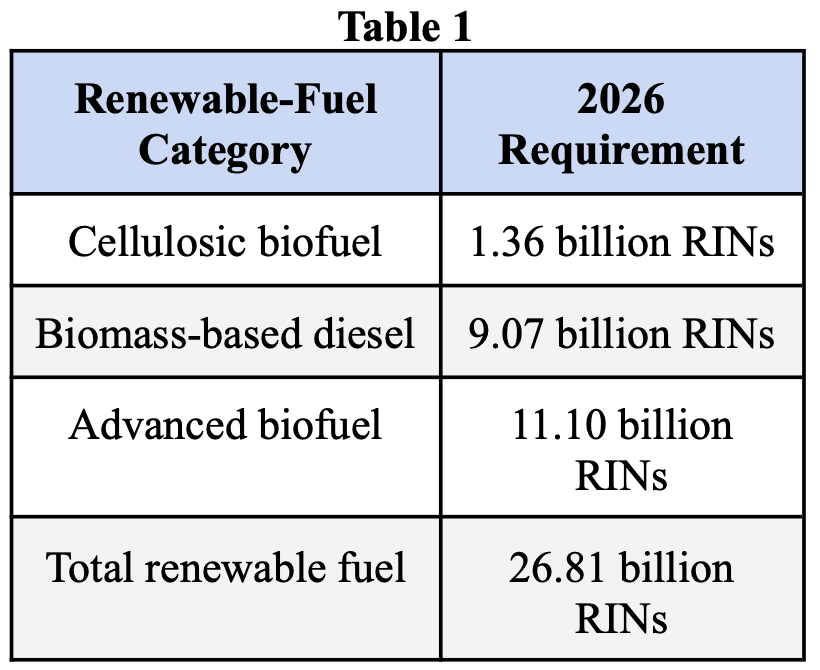
The total includes approximately 990 million additional RINs resulting from EPA’s partial reallocation of obligations associated with small-refinery exemptions granted for earlier compliance years.
EPA translated these volumes into percentage standards of 0.79 percent for cellulosic biofuel, 5.24 percent for biomass-based diesel, 6.42 percent for advanced biofuel, and 15.50 percent for total renewable fuel.
The 37-Cent Compliance Obligation
In June 2026, conventional ethanol RINs traded at approximately $2.37 and biomass-based diesel RINs at approximately $2.41. Both were roughly twice their values compared to the beginning of the year and near the record levels reached in 2021.
Using those prices, the approximate RIN obligation per gallon is:
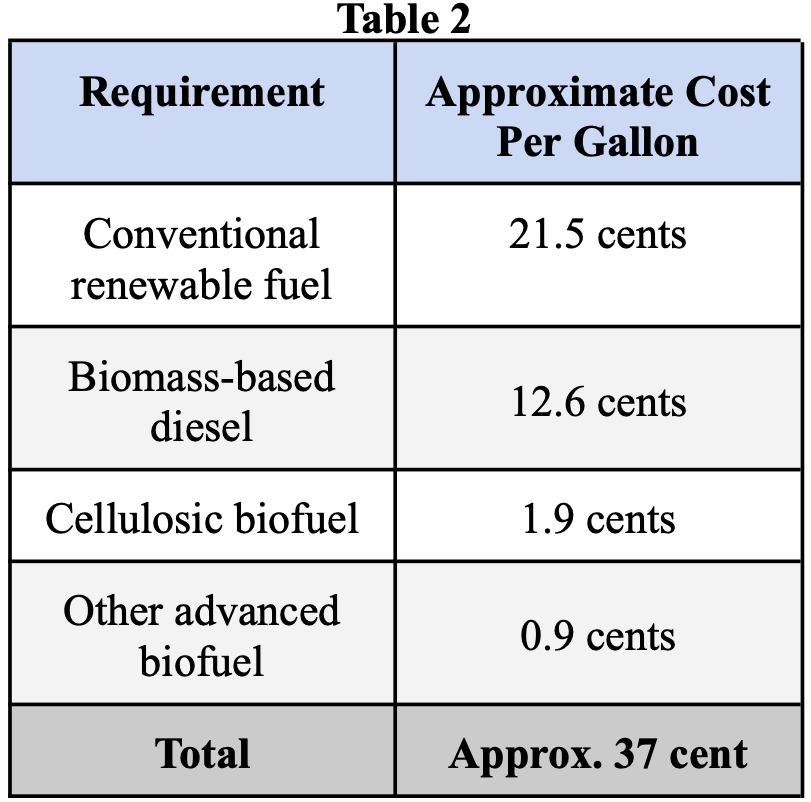
Applying the same approximate RIN value to the full 26.81-billion-RIN requirement produces a gross annual compliance value of approximately $64 billion.
For comparison, the federal gasoline excise tax is 18.4 cents per gallon, while the federal diesel tax is 24.4 cents per gallon. The RFS compliance obligation is therefore approximately twice the federal gasoline tax, although the two policies operate differently and the RFS cost is not explicitly displayed to consumers.
RIN purchases are a direct expense for obligated refiners and importers. Economic research indicates that these costs are generally passed through to wholesale petroleum product prices.
A study by Christopher Knittel, Ben Meiselman, and James Stock examined RIN-price pass-through in six wholesale fuel markets. The researchers estimated approximately complete long-run pass-through. About 73 percent of an unexpected change in RIN prices was reflected in wholesale prices on the same day, rising to approximately 98 percent within two business days.
EPA has reached a similar conclusion. The agency has stated that obligated parties generally recover RIN-acquisition costs through higher prices for the petroleum products they sell.
EPA’s Post-2022 Authority
Congress established annual statutory RFS volumes through 2022. The Clean Air Act has since directed the EPA to determine applicable volumes through rulemaking, after considering renewable fuel production, energy security, transportation fuel costs, environmental effects, infrastructure, agricultural markets, food prices, and rural economic development.
EPA therefore has substantial discretion over the post-2022 standards, although that authority is not unlimited. The only floor Congress left in place is a 1-billion-gallon minimum for biomass-based diesel; for conventional ethanol and advanced biofuel, the statute imposes no minimum volume at all.
Conclusion
EPA’s 2026 Renewable Fuel Standard creates a significant compliance obligation for refiners and fuel importers. At RIN prices observed in June 2026, the requirement amounts to approximately 37 cents per gallon of obligated gasoline and diesel, and approximately $64 billion for the full annual requirement.
Although the RFS is not a conventional fuel tax, its compliance costs are generally incorporated into wholesale petroleum-product prices. Because EPA now sets annual requirements under its post-2022 rulemaking authority, the size of the obligation remains an important administrative decision affecting refiners, fuel markets, and American motorists.