

Key Takeaways
After the U.S. midterm elections on November 3, average U.S. gasoline prices fell below $4 a gallon.
On November 12, U.S. gasoline prices averaged $3.91 a gallon, 45 cents less than a month ago, and average diesel prices dropped to $6.10 a gallon, 43 cents below their high on September 22.
On November 12, U.S. gasoline prices averaged $3.91 a gallon, 45 cents less than a month ago, and average diesel prices dropped to $6.10 a gallon, 43 cents below their high on September 22.
While oil exports from the Middle East are near pre-war levels, only 35% to 40% of petroleum product exports are available.
Because global refining capacity is tight, as many facilities were closed due to anti-fossil fuel policies, petroleum product prices remain high.
President Trump has asked Vice President JD Vance to cease negotiations with Iranian officials and concentrate on anti-fraud and corruption matters while keeping the blockade on Iranian ports and economic sanctions on Iran.
On November 12, average U.S. gasoline prices were $3.91 a gallon, 45 cents less than a month ago, and average diesel prices were $6.10 a gallon, 43 cents less than their high on September 22, 2026, according to AAA. California still skews the national average, with average gasoline prices at $5.63 per gallon, about $1.70 more than the U.S. average due to its climate and anti-oil and gas policies. Front-month Brent crude oil futures were $91.79 a barrel, and front-month West Texas Intermediate crude oil futures were $85.69 a barrel due to the possibility of renewed talks between the United States and Iran.
The U.S. blockade and shuttle service through the Strait of Hormuz, along with oil pipelines avoiding it, have resulted in oil exports around pre-war levels. Petroleum product prices, though coming down, reflect that only 35 to 40% of those exports can exit the Middle East, and anti-fossil fuel policies in many nations have led to refinery closures, so little excess refining capacity exists to make up the slack.
U.S. oil stocks rose by approximately 9 million barrels during the week ending November 6, according to the American Petroleum Institute. Distillate and gasoline stockpiles also rose by 1.5 million barrels and 4,000 barrels, respectively. The Strategic Petroleum Reserve (SPR) released 2.7 million barrels of crude oil to commercial inventories, bringing total SPR holdings to 279.5 million barrels—434 million barrels below maximum capacity and the lowest level since 1982. The operational minimum for oil in the SPR is between 250 and 300 million barrels, below which it may be difficult to pump and process oil efficiently. U.S. oil production for the week ending October 30 reached a new record of 14.003 million barrels per day, up from 13.992 million barrels per day the previous week and 352,000 barrels per day from a year ago.
Despite oil exports from the Middle East near pre-war levels, the Energy Information Administration (EIA) November Short-Term Energy Outlook forecasts shut-in production among Kuwait, United Arab Emirates, Iran, Iraq, Qatar, Bahrain, and Saudi Arabia to average around 2.52 million barrels per day during the last quarter of 2026, falling to 1.9 million barrels per day during the first half of 2027. Oil producers outside the Middle East have increased output, particularly in the United States, Brazil and Canada. Global crude oil production reached 85 million barrels per day in October, which is above the five-year average of 83 million barrels per day.
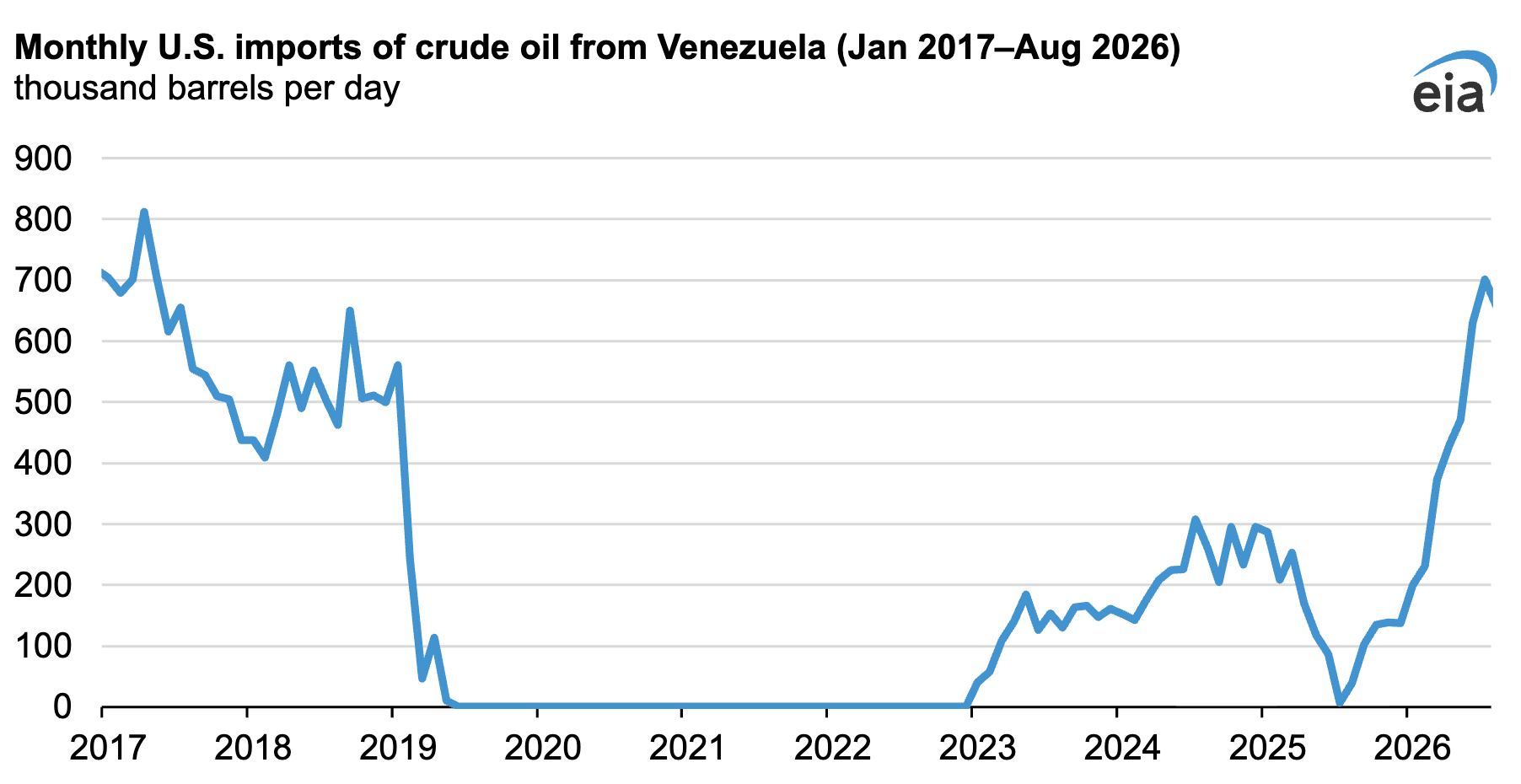
Venezuela has also picked up some of the slack, producing 1.23 million barrels of oil per day in October and is targeting 1.3 million barrels per day by the end of 2026 and 1.5 million barrels per day by the end of 2027. This year, the United States has been the largest single destination by volume for Venezuelan crude oil exports, as many refineries on the U.S. Gulf Coast are configured to process heavy sour crude oil grades, such as those from Venezuela. In July 2026, U.S. crude oil imports from Venezuela averaged 701,000 barrels per day, the most since May 2017 due to U.S. sanctions, before decreasing to 655,000 barrels per day in August, according to EIA’s Petroleum Supply Monthly.
Change in Storage Strategy
Middle East exporters are looking to build storage facilities near buyers to withstand at least the beginnings of a possible supply shock. Aramco is considering more storage near export terminals and possibly in depleted wells, alongside overseas facilities, particularly in Asia. In October, Saudi Aramco reached a preliminary agreement to store oil in Singapore’s Jurong Rock Caverns — five caverns with chambers nine stories high and longer than three football fields. Together, they can hold 9 million barrels of oil, but that is less than two days’ worth of Saudi crude oil exports. Aramco already maintains storage in Egypt, Japan, the Netherlands and South Korea. The United Arab Emirates’ Adnoc is exploring storage arrangements in India totaling 30 million barrels. More storage options would increase energy security and deliverability, helping meet contractual obligations.
Buying nations are also looking to set up storage facilities. The Wall Street Journal reports that Indonesia plans to build storage for 60 days of crude oil demand and the Philippines is pursuing its first state-owned oil-storage facilities. In Australia, which has only two remaining refineries that supply about 10% of the country’s total liquid fuel demand, the government pledged over $2.1 billion to stockpile a billion liters of diesel and jet fuel. Japan has set up a $10 billion regional financing framework supporting oil stockpiles and storage across Asia.
Conclusion
After the U.S. mid-term elections on November 3, U.S. average gasoline prices fell below $4 a gallon. On November 12, U.S. gasoline prices averaged $3.91 a gallon, 45 cents less than a month ago, and average diesel prices dropped to $6.10 a gallon, 43 cents below their high on September 22. While oil exports from the Middle East are near pre-war levels, only 35% to 40% of petroleum product exports are available. Because global refining capacity is tight, as many facilities were closed due to anti-fossil fuel policies, petroleum product prices remain high. President Trump has asked Vice President JD Vance to cease negotiations with Iranian officials and concentrate on anti-fraud and corruption matters, while keeping the blockade on Iranian ports and economic sanctions on Iran.

