

Key Takeaways
President Trump believes natural gas prices are too high for New Yorkers and New Englanders and wants to provide relief by increasing supply through pipeline construction where bottlenecks exist.
The Energy Department is allocating up to $42 million to the Williams Companies for permitting and pre-construction work on the proposed pipeline to expand energy infrastructure and lower regional energy costs in the Northeast.
The much-needed natural gas pipeline project connecting Pennsylvania’s Marcellus Shale with consumers in New York and the Northeast continues to face state and community obstacles.
Williams Companies applied to FERC to reissue its federal certificate last year, but New York is still withholding a key water-quality certification, which it has previously used to block the pipeline as part of its push to stop fossil fuel use in the state.
Natural gas and electricity prices spiked in New England last winter during Fern, and due to pipeline constraints, the Northeast often needs to rely on more expensive imported LNG.
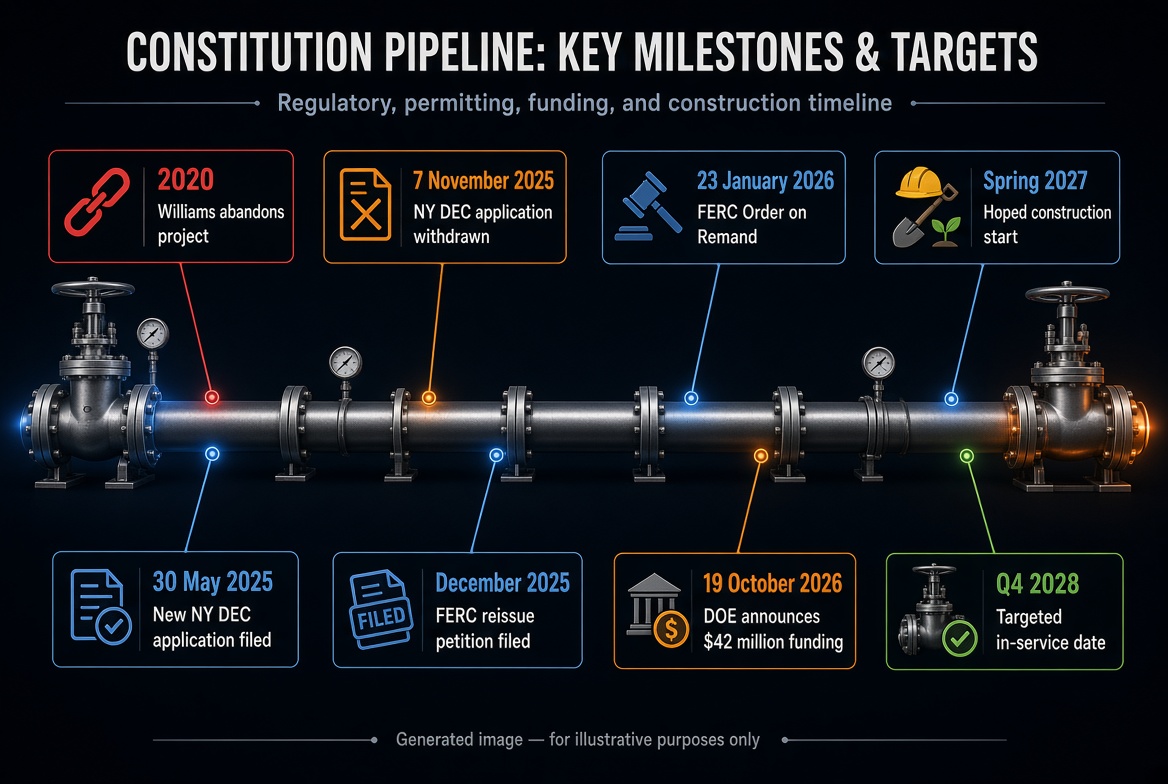
The Energy Department has committed up to $42 million to advance the Constitution Pipeline from Pennsylvania to New York as the Williams Companies seeks federal approvals to begin construction next spring for an in-service date in late 2028. The funding will support permitting and pre-construction work on the proposed Constitution Pipeline to expand energy infrastructure and lower regional energy costs. According to the Energy Department, activities may include environmental reviews and assessments, engineering and site-preparation work, and other costs associated with securing required regulatory approvals. The funding follows an April presidential determination invoking the Defense Production Act to support domestic natural gas infrastructure amid permitting delays, financing constraints, and pipeline bottlenecks.
Pipeline capacity constraints have contributed to energy supply issues in the Northeast, particularly during periods of high winter demand. The proposed 125-mile pipeline would transport up to 650,000 dekatherms of natural gas per day from the Marcellus shale fields in northeastern Pennsylvania into New York, connecting with existing interstate pipeline systems serving Northeast markets. The project was first proposed in 2012 and received federal approval in 2014. But New York regulators denied a water-quality certification in 2016, blocking construction and prompting years of legal and regulatory disputes; developers abandoned the project in 2020 amid concerns about economic viability and continued state opposition to expanding fossil fuel infrastructure. The issue is even more ironic because New York has huge Marcellus shale gas resources, which politicians have kept state residents from accessing.
The pipeline still faces federal and state regulatory hurdles before construction can proceed. The Constitution Pipeline filed a new application with the New York Department of Environmental Conservation (DEC) on May 30, 2025, and then withdrew it on November 7, 2025, after DEC found it incomplete. DEC maintains it never waived its Section 401 authority under the Clean Water Act that denied the water-quality certification. According to a N.Y. spokesperson for Governor Kathy Hochul, DEC returned the application as incomplete three times.
In May 2025, the Trump administration issued a stop-work order on Empire Wind, an offshore wind project being built off New York by the Norwegian company Equinor, after reports surfaced that the Biden administration may have rushed and approved it in 2024. The project is being built in federal waters 20 miles off Long Island and received a permit from the Biden administration. The Trump administration, however, allowed Empire Wind to move forward, despite its huge costs, after New York Governor Kathy Hochul made “comments about her willingness to move forward on critical pipeline capacity.”
In December 2025, the Constitution Pipeline Companies asked the Federal Energy Regulatory Commission to reissue its federal certificate. After the commission dismissed environmental groups’ requests for a rehearing, the groups sued FERC in the 2nd U.S. Circuit Court of Appeals in May. The court consolidated the cases with New York’s and put them on hold until FERC completes its review. New York is challenging the pipeline in federal court, arguing it needs another environmental review. In September, FERC issued an environmental assessment finding that approving the project would not significantly affect the environment.
During Winter Storm Fern on January 27, 2026, New England gas prices spiked near $122 per million British thermal units, and day-ahead power hit $634 per megawatt-hour. ISO New England, the region’s grid operator, reported significant pipeline constraints throughout last winter and heavy reliance on more expensive LNG imports. Because home heating gets priority on constrained pipelines, gas-fired power plants often compete for whatever supply remains and may turn to more expensive petroleum in dual-fired generators. According to the Energy Information Administration, the Northeast primarily uses natural gas for home heating.
Conclusion
President Trump believes natural gas prices are too high for New Yorkers and New Englanders and wants to provide relief by increasing supply through pipeline construction where bottlenecks exist. He wants to revive the Constitution Pipeline, which would carry natural gas from Pennsylvania’s shale gas fields to New York, and he says it would reduce energy prices in the Northeast. In that vein, the Energy Department is allocating up to $42 million to the Williams Companies for permitting and pre-construction work on the proposed pipeline to expand energy infrastructure and lower regional energy costs in the Northeast. However, the much-needed natural gas pipeline project connecting Pennsylvania’s Marcellus Shale to energy markets in New York and the Northeast continues to face state and community obstacles. Williams Companies applied to FERC to reissue its federal certificate last year, but New York is still withholding a key water-quality certification. Natural gas and electricity prices spiked in New England last winter during Fern, and due to pipeline constraints, the Northeast often needs to rely on more expensive imported LNG.
For media inquiries, please contact press@ierdc.org.

