

Key Takeaways
Saudi Arabia is working to reroute oil around a damaged pumping station on its East-West pipeline, restoring about half the export capacity within days and aiming for full restoration in about six weeks.
Three pumping stations were damaged on September 11 from drone attacks by Iran-backed militias in Iraq.
Saudi Aramco has just five to seven days of export inventory at the port in the Red Sea and a few additional days at its storage facilities in Egypt.
The Saudis are also planning to double exports via Oman using a shuttle service with help from the U.S. military.
The news lowered oil prices from their level when the September 11 attacks on the pipeline were announced.
According to JP Morgan, despite the scale of supply disruptions, oil prices have not risen as sharply as expected because governments and consumers have relied less on inventory drawdowns, and significant global inventories remain, providing a buffer against a prolonged disruption, which could limit the need for oil prices to rise substantially in the near term.
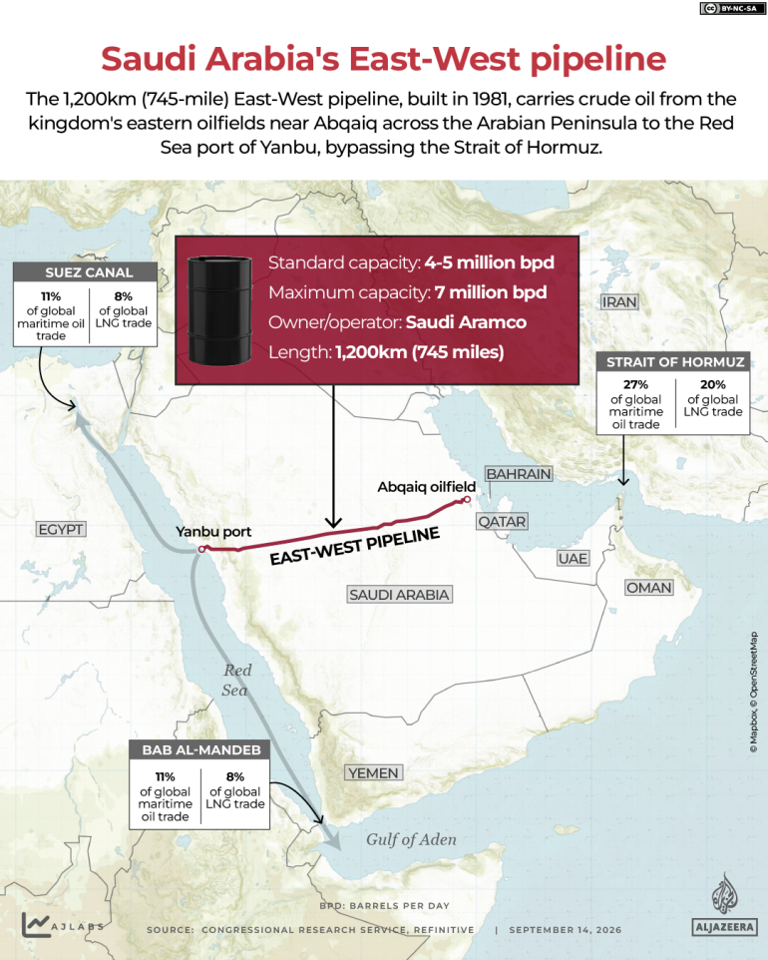
Saudi Aramco is fast-tracking a bypass of a damaged pumping station on its 1,200-kilometer (745-mile) East-West oil pipeline after last week’s drone strikes by Iran-backed militias in Iraq. Satellite imagery and industry sources confirmed three pumping stations were hit, with one of them a major facility southeast of Medina. The pipeline, which had been moving 4 to 5 million barrels per day (4 to 5% of global supply) over the past six months since the Strait of Hormuz was effectively closed, was shut down on September 11. According to Saudi Arabia’s Ministry of Energy, the shutdown was a “precautionary” measure after the attack caused damage and injuries in the Riyadh and Medina regions.
The pipeline is serviced by 11 pumping stations and two separate pressure relief stations. It could partially resume operations while other repairs are ongoing. According to Bloomberg, Aramco is aiming to restore about half capacity within days — roughly 2 to 2.5 million barrels per day — with full restoration targeted in approximately six weeks. The Wall Street Journal reports that Saudi Aramco’s extensive domestic supply chain could help speed up repairs to the damaged infrastructure. Around 70% of its operational inputs, including pipes, chemicals and wellheads, are sourced locally.
The East-West pipeline represented Saudi Arabia’s primary path to move oil to Red Sea terminals at Yanbu and onto global markets for export once the Strait of Hormuz was effectively closed. Oil traders estimated that the kingdom had five to seven days of export inventory at Yanbu and Egyptian facilities in Ain Sukhna and Sidi Kerir, which store Saudi oil, and that it had several days of additional supplies before Aramco’s ability to supply global markets would be critically curtailed. Also adding to Saudi Arabia’s oil problems is that Iran-backed Houthi forces in Yemen recently seized ports and an island in the Bab al-Mandeb Strait, interfering with Saudi Red Sea oil shipments.
Meanwhile, Aramco is planning to double its exports via Oman. A ship-to-ship shuttle service through the Strait of Hormuz is giving Saudi Arabia another option to get oil to buyers. The United Arab Emirates’ oil company has been using its own and hired vessels to carry oil through the strait in convoys under U.S. military protection, transferring the oil to other tankers waiting in the Gulf of Oman.
News of a partial quick repair and the Oman shuttle service pushed Brent oil futures down to $103.30 a barrel, while West Texas Intermediate fell to $101.36 a barrel, with both benchmarks paring some losses from earlier, when WTI dipped below the $100-a-barrel level. The pullback follows Brent and WTI settling at four-month highs earlier this week at $108.75 and $105.83 a barrel, respectively.
Reuters reports JP Morgan has no clear baseline view for oil markets for the first time since the start of the conflict with Iran. “We simply don’t know how to model the endgame,” analysts at the bank noted. According to JP Morgan, it had assumed the United States would not cross some economic thresholds, but six months into the conflict, many of those lines have been crossed, with oil prices above $100 a barrel and gasoline at $4.37 a gallon. And U.S. diesel prices have hit an all-time high of $6.31 a gallon heading into winter, the period of peak seasonal demand, while inventories are at all-time lows. JP Morgan estimated Brent’s fair value at around $90 a barrel for September, so anything above that is a geopolitical risk premium. Since the conflict began, Brent has averaged $94 a barrel.
According to JP Morgan, despite the scale of supply disruptions, oil prices have not risen as sharply as expected because governments and consumers have relied less on inventory drawdowns. Global inventories of crude and refined products have fallen by about 555 million barrels since the conflict began, only around one-third of the decline the bank had projected earlier this year, while global oil demand has run about 4.4 million barrels per day below year-ago levels, helping offset supply losses. According to the bank, significant inventories remain available, particularly in China, Europe, Japan and South Korea, providing a buffer against a prolonged disruption and limiting the need for crude prices to rise substantially in the near term.
Conclusion
Saudi Aramco plans to reroute oil around a damaged pumping station at its East-West pipeline, restoring about half the export capacity within days and aiming for full restoration in about six weeks. Three pumping stations were damaged on September 11 from drone attacks by Iran-backed militias in Iraq. Saudi Arabia has just five to seven days of export inventory at its Red Sea port and a few additional days at its storage facilities in Egypt. The Saudis are also planning to double exports via Oman using a shuttle service with help from the U.S. military. The news lowered oil prices from their level when the September 11 attacks on the pipeline were announced. According to JP Morgan, despite the scale of supply disruptions, oil prices have not risen as sharply as expected because governments and consumers have relied less on inventory drawdowns, and significant global inventories remain, providing a buffer against a prolonged disruption, which could limit the need for oil prices to rise substantially in the near term.

