

Key Takeaways
Massachusetts Governor Healey has declared an “energy emergency” because of high power and heating costs across the state, driven largely by state policies.
She has also asked the Trump administration to expedite approval for a natural gas pipeline expansion project, Project RARE, estimated to save consumers $40 million annually with an in-service date of 2028.
That project may be followed by another pipeline expansion project, Project Beacon, with a projected in-service date of 2030.
Governor Healey is pursuing natural gas pipeline projects despite blocking gas pipeline projects when she was Massachusetts Attorney General, indicating then that they were not needed.
Massachusetts residents pay very high energy costs because the state has limited energy production and is unwilling to site energy infrastructure.
Less than a month before Massachusetts Governor Maura Healey faces reelection, she has called for an energy emergency, issuing an executive order to temporarily reduce electric bills and expand home heating aid ahead of the winter season. She claims her slate of changes and payouts could save residents tens of millions of dollars in heating costs this winter. She has also asked the Trump administration to expedite approval of a gas pipeline expansion that would save $40 million in annual costs, but she has called for a thorough environmental review first. These actions are occurring despite her frequent statements against natural gas pipelines during her tenure as attorney general.
Healey’s Energy Emergency Actions
Healey’s current proposal follows her administration’s earlier efforts to overhaul utility buying practices and temporarily suspend the state gas tax. Yet Massachusetts residents pay about twice the national average for electricity and face a winter of high energy bills. The state’s initiatives, approved by Healey and noted below, are projected to cut aggregate heating costs for state residents by tens of millions of dollars.
- Middle-class relief will come from an assistance program that expands heating financial support to roughly 50,000 middle-income households. Eligible families that use heating oil can receive up to $680 in one-time financial support starting in December.
- The state will add $15 million in low-income support for heating assistance, explicitly targeted at low-income residents.
- An executive order will reduce electricity bills by temporarily removing a specific surcharge traditionally used to fund solar energy development across the state—a solar fee the state imposed on consumers’ bills in a northern climate.
This collaborative effort with Citizens Energy Corporation, known as the Emergency Winter Warmth Fund, will operate from November 1, 2026, through April 30, 2027.
Gas Pipeline Expansion
Governor Healey asked the Trump administration to expedite its review of a natural gas pipeline expansion project in New England. She sent a letter to U.S. Energy Secretary Chris Wright, urging federal regulators to move as quickly as possible to assess the Reliable Affordable Resilient Enhancement proposal — known as Project RARE. The project, proposed by Enbridge, involves installing wider pipes along sections of the Algonquin natural gas pipeline that brings natural gas from New Jersey through southern New York, Connecticut, Rhode Island, and into Massachusetts.
Haeley claims the project will lower costs for 600,000 customers, saving customers about $40 million annually by replacing LNG with pipeline gas. Earlier this year, the Massachusetts Department of Public Utilities approved Eversource’s plan to purchase gas from the Project RARE expansion for 10 years.
New England, and Massachusetts in particular, has some of the country’s most expensive energy prices because of constraints and policies the state government has imposed. The state has fought new natural gas pipelines, so it must rely on imported, higher-priced LNG during periods of high home heating demand. On cold winter days, pipeline constraints force many gas power plants to burn more expensive oil.
If federal regulators approve Project RARE, Enbridge would replace about eight miles of existing pipelines with larger-diameter pipes in parts of Massachusetts and Rhode Island and run a secondary pipeline along a segment in Rhode Island. The company would also upgrade a compressor station in Cromwell, Connecticut. The project is planned to be in service in 2028.
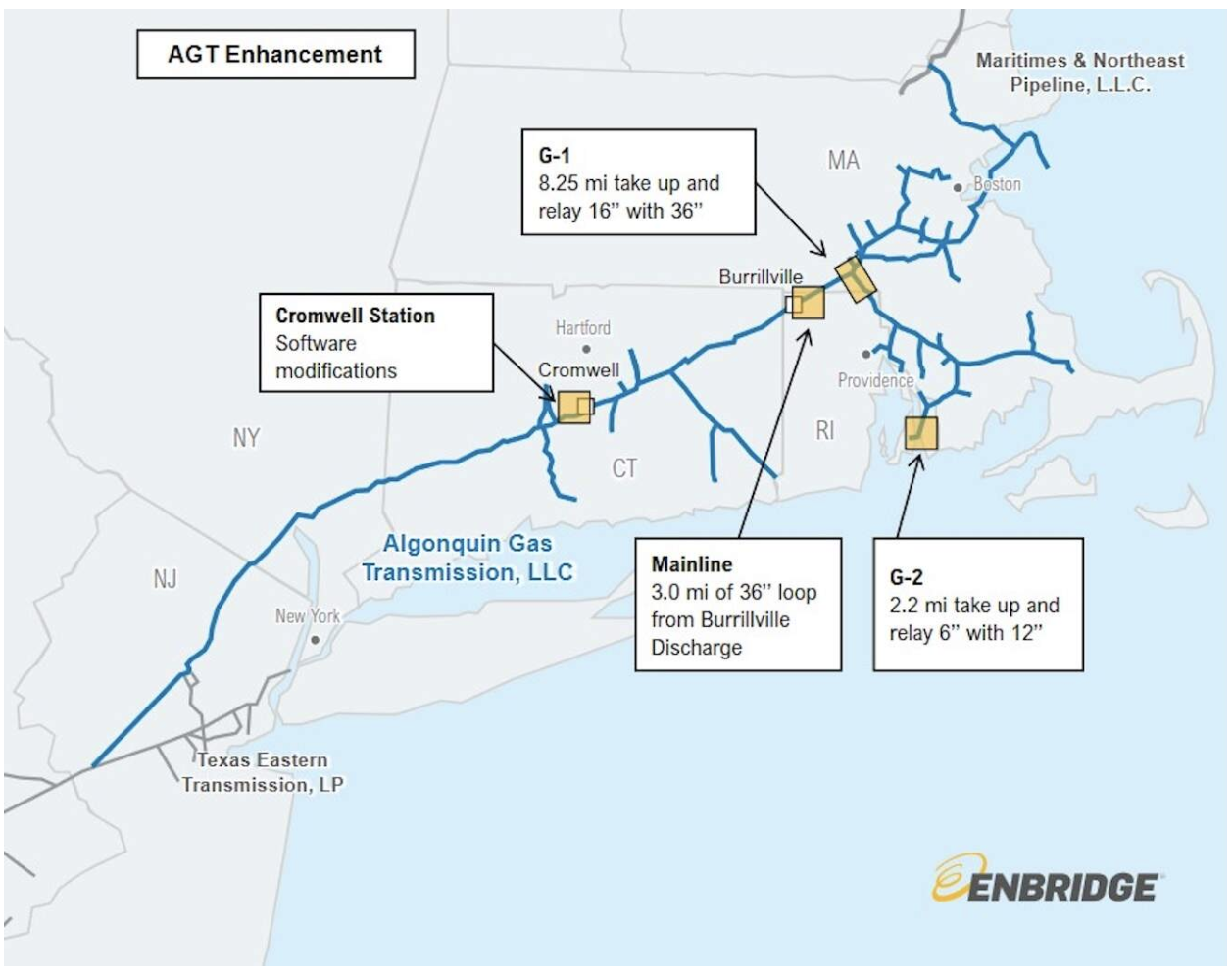
The 1,100-mile Algonquin pipeline is one of three large interstate pipelines that bring gas into Massachusetts, moving more than 3 billion cubic feet of gas per day. The expansion would increase that by about 75 million cubic feet per day, potentially bringing a substantial amount of natural gas into a part of Massachusetts where supply is very tight. The deal is not a cure-all; it cannot solve the region’s energy affordability issue on its own, but it will help meet winter demand from natural gas customers in southeastern Massachusetts and reduce reliance on higher-cost, foreign LNG. Reducing utilities’ reliance on LNG should save ratepayers money and reduce emissions since pipeline gas has a lower carbon footprint than LNG.
Healey’s actions, however, do not align with state policy, as Massachusetts has legally binding requirements to cut carbon dioxide emissions—targets that require reducing the use of natural gas. In 2015, Healey’s office released a study that she said showed the state did not need more gas pipeline capacity to keep its power grid reliable. As attorney general, Healey sued ExxonMobil in October 2019, accusing the company of deceiving Massachusetts consumers and investors about climate change.
Her dilemma is that high energy prices concern residents. About half of New England’s power comes from natural gas, and Massachusetts residents pay about twice the national average for electricity, despite being close to huge deposits in Pennsylvania. About a decade ago, when Healey was attorney general, she opposed two proposed pipeline expansion projects in the state. The state was more comfortable importing LNG from foreign sources, including Russia, than allowing pipelines. More recently, Healey is trying to justify her actions by saying her “all-of-the-above” approach to energy—which includes support for Project RARE—is not an about-face, but consistent with her position that she supports projects that save ratepayers money and opposes those that do not. Healey urged the federal government to move quickly. “Moving quickly does not mean cutting corners” on any environmental review or community engagement efforts, she said. “Thorough and timely review are not competing goals,” she wrote.
Project Beacon
Enbridge has proposed a second pipeline expansion project on the Algonquin pipeline. Like Project RARE, Project Beacon would involve building alongside existing pipelines and adding larger diameter pipes. Enbridge estimates it would increase pipeline capacity by about 10%, much more than RARE, with service possibly starting in 2030. Project Beacon is still early in development, and Enbridge has not submitted a proposal for federal review. A study recently released by the Fiscal Alliance Foundation, a nonprofit affiliated with the conservative Mass Fiscal Alliance, found that Project Beacon could save utility gas customers in the state about $76 each winter.
Healey has not yet said whether she supports this project. But in her letter to the energy secretary, she wrote that “on several occasions” the two have discussed their “mutual desire to get more U.S. gas into New England.” She went on to mention Project Beacon, noting, “there may be more opportunities ahead,” as she is looking to advance gas expansion projects when they can lower energy bills.
In an email, Maria Hardiman, a spokeswoman for the Executive Office of Energy and Environmental Affairs, said the administration has urged power plant owners in the state to explore contracts that could advance Project Beacon. “In order for Project Beacon to move forward, the utilities and power generators need to sign contracts with the pipeline developer,” Hardiman said.
Conclusion
Massachusetts Governor Healey issued an energy emergency due to high power and heating costs across the state—much of which is driven by state policies. Massachusetts residents pay very high energy costs because the state has limited energy production and is unwilling to site energy infrastructure. Healey issued an executive order that includes payouts and temporarily removes a surcharge on electric bills to support solar development across the state. She has also asked the Trump administration to expedite approval for a natural gas pipeline expansion project, Project RARE, while ensuring a thorough environmental review. Project RARE is estimated to save consumers $40 million annually and is expected to be in service by 2028. That project may be followed by another pipeline expansion project, Project Beacon, with a projected in-service date of 2030. Healey is pursuing natural gas pipeline projects despite blocking gas pipeline projects when she was Attorney General, indicating then that they were not needed.

