

Key Takeaways
Newly elected Democratic governors are looking to place moratoria on data center development until regulations or laws are in place to address union hiring, electricity infrastructure and prices, water use, and community impact, among other things.
Public opposition to AI-related data centers reached a crescendo ahead of the elections, with dozens of anti-data center initiatives passing nationwide.
The regime also resorts to stealing American tradecraft, smuggling chips through third countries, and leveraging supply chain dependencies to impede U.S. AI infrastructure growth.
On November 9, the U.S. Senate began discussion on a bill that requires builders of new data centers to pay for their own power and help invest in their local communities.
Data centers are demanding gas turbines, creating a bottleneck because manufacturing capacity cannot keep up.
Some developers are turning to used turbines and repurposed engines, which are cheaper but also raise questions about past maintenance and long-term reliability.
Newly elected Democratic governor of Texas, Gina Hinojosa, has vowed to impose a statewide moratorium on data centers until state legislators pass new guardrails that require data centers to hire union workers, protect water resources, and give communities the power to approve data center projects. “When I am governor, I will issue a moratorium, a ban, on all data center approvals until laws can be passed by the legislature to protect Texans,” she said in a video posted to her X in late October. Voters in Ohio elected Democrat Amy Acton as their new governor, who has also called for a moratorium on data centers. Georgia Democratic Governor-elect Keisha Lance Bottoms plans to sign an executive order pausing data center development. Public opposition to AI-related data centers reached a crescendo leading up to the elections, with dozens of anti-data center initiatives passing nationwide.
Texas ranks second only to Virginia in data centers because of its reliable energy supply, low taxes, and cheap land, especially compared to California. According to Bloom Energy’s 2026 Data Center Power report, Texas is projected to exceed 40 gigawatts of data center capacity by 2028, accounting for nearly 30% of projected U.S. demand of almost 150 gigawatts, nearly double its 2025 level. In September, Texas Governor Greg Abbott ordered the Texas Commission on Environmental Quality to pause data center permits until it audited all data center projects still in the interconnection process, to maintain power grid reliability and ensure water resources are not put at risk.
Evidence shows the Chinese regime, which is America’s chief competitor in AI, is using data centers to sow division in the United States that is apparently working with the populace. The Epoch Times reports that, using virtual private networks, Chinese operators tapped into the artificial intelligence chatbot ChatGPT, which is not accessible in China, and instructed it to create English-language comic strips and comments suggesting AI center construction was hiking up electricity costs for average American households. (See comic strips below). And X’s Global Government Affairs team posted on August 27 that an investigation into Chinese influence operations found a bot farm that includes 200 China-linked accounts “posting in a manner that could manipulate a legitimate debate about American AI and energy policy.”
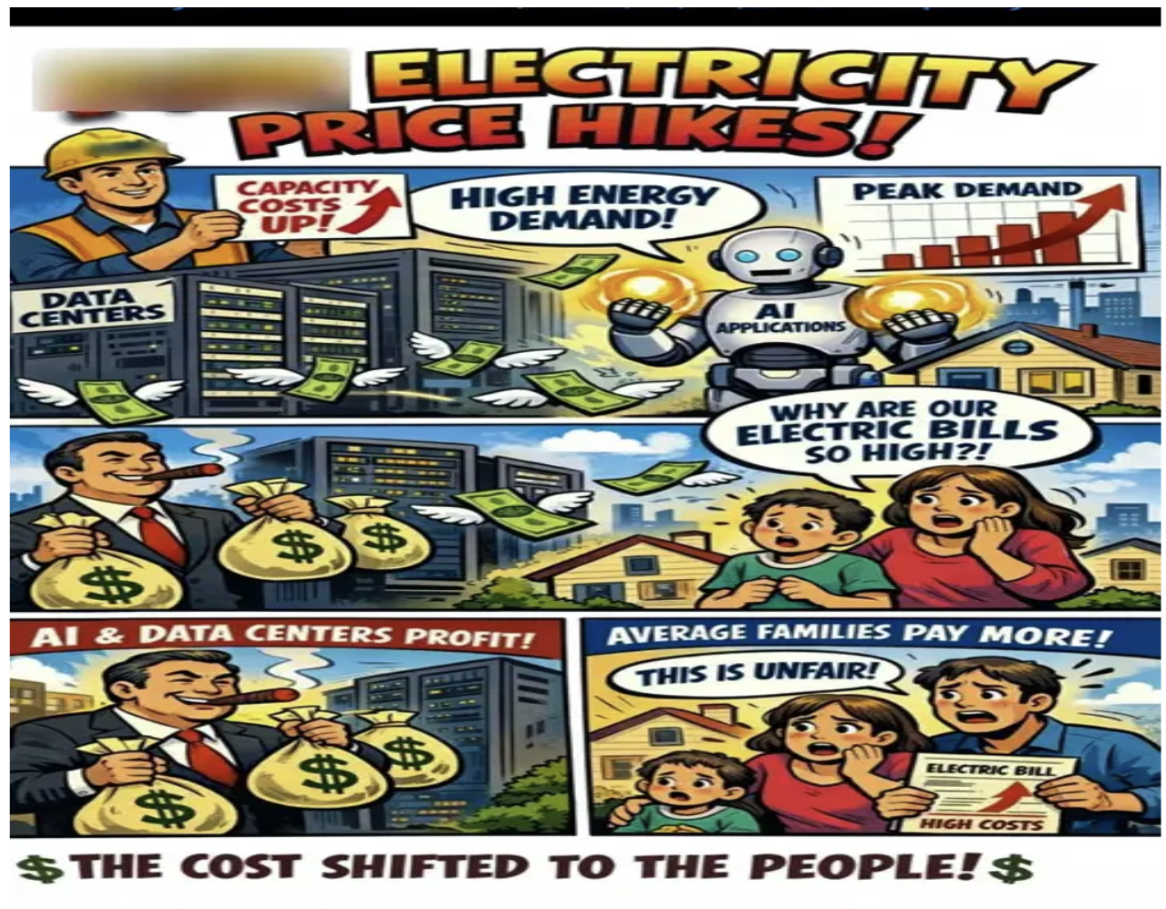
China’s 15th five-year plan, adopted in March, pushes to integrate AI in all sectors of the economy. In a speech on July 17, Chinese leader Xi Jinping laid out a global AI order in which China will lead training and collaboration on the technology for developing countries. Where its technology falls short, China makes up the difference by stealing American tradecraft, smuggling chips through third countries, and leveraging supply chain dependencies to impede U.S. AI infrastructure growth. Recent revelations about NVIDIA CEO Jensen Huang’s potential involvement in a Chinese spy ring reaffirm China’s abiding interest in winning the AI race.
Senate Bill with Data Center Provision
The Bipartisan American Affordability and Jobs Act of 2026 would make it easier to receive federal permitting for energy projects. The legislation provides relief to traditional energy sources and mines and promotes expansion of the U.S. power grid and renewable energy infrastructure. It also includes mechanisms to require builders of new data centers to pay for their own power and “help invest in their local communities.” For new data centers requiring 20 megawatts or more of power, the legislation prohibits utilities from passing the costs of additional power generation, grid enhancements, or transmission upgrades onto regular residential and commercial customers. Utilities must obtain financial guarantees from data center companies to ensure they can fully cover the incremental energy and infrastructure costs. However, a Manager’s Substitute Amendment eliminated the 20 MW minimum threshold, extending those rules to all new data centers regardless of size. Data center developers also remain legally obligated to pay for their dedicated power and grid investments even if they later stop buying power from the utility.
Gas Turbines in Demand
Data centers are big customers of gas turbines — a market that once almost solely served traditional utilities until a few years ago. Worldwide orders exceed 100 gigawatts, well above the estimated global production capacity of 60 to 70 gigawatts annually. U.S. data centers are estimated to account for nearly 17 gigawatts of demand this year, and they are expected to more than triple that figure by 2028. While global gas turbine manufacturing capacity is growing and is expected to reach around 87 gigawatts in 2028, it will still fall well short of the 129 gigawatts in expected turbine demand. According to Siemens Energy, GE Vernova, and Mitsubishi Heavy Industries, which dominate the gas turbine manufacturing market, the AI boom has driven orders beyond their production capacity. In the United States, delivery of a new gas turbine averages six years, and trade barriers have made procurement more costly and difficult.
Used, refurbished, or repurposed equipment is now in demand because it is more readily available, but it comes with issues. Overhauled turbines can have unclear maintenance histories, limited life, and weak long-term servicing; converted jet engines may not be suitable for continuous work as power generators. Well-maintained used units can sell for about $1.5 million to $1.7 million per megawatt, and refurbished units for about $1.3 million, which is less than new turbines, which cost about $2 million to $2.5 million per megawatt. The discount can be higher for smaller, cheaper units. Developers will turn to small turbines if the bigger ones are harder to come by, even though the bigger ones tend to be more efficient. They sometimes deploy more than 100 at a single site and mix models and brands.
Conclusion
Newly elected Democratic gubernatorial candidates are looking to place moratoria or pauses on data center development until regulations address hiring union workers, electricity infrastructure and prices, water usage, and community impact. The Chinese regime has used AI to sow dissent in the U.S. populace using comic strips and social media, suggesting AI center construction is hiking up electricity costs for average Americans. The regime also resorts to stealing American tradecraft, smuggling chips through third countries, and leveraging supply chain dependencies to impede U.S. AI infrastructure growth. On November 9, the U.S. Senate began discussing a bill that requires builders of new data centers to pay for their own power and invest in their local communities. Data centers are in demand for gas turbines, creating a bottleneck because manufacturing capacity cannot keep up. Some developers are turning to used turbines and repurposed engines, which are cheaper but can also raise questions about past maintenance and long-term reliability.

