

Key Takeaways
The Trump administration has cut much of the Biden administration’s funding for its climate program, known as the “Green New Deal.”
Most of this money came via the 2022 Inflation Reduction Act and the 2021 Infrastructure bill.
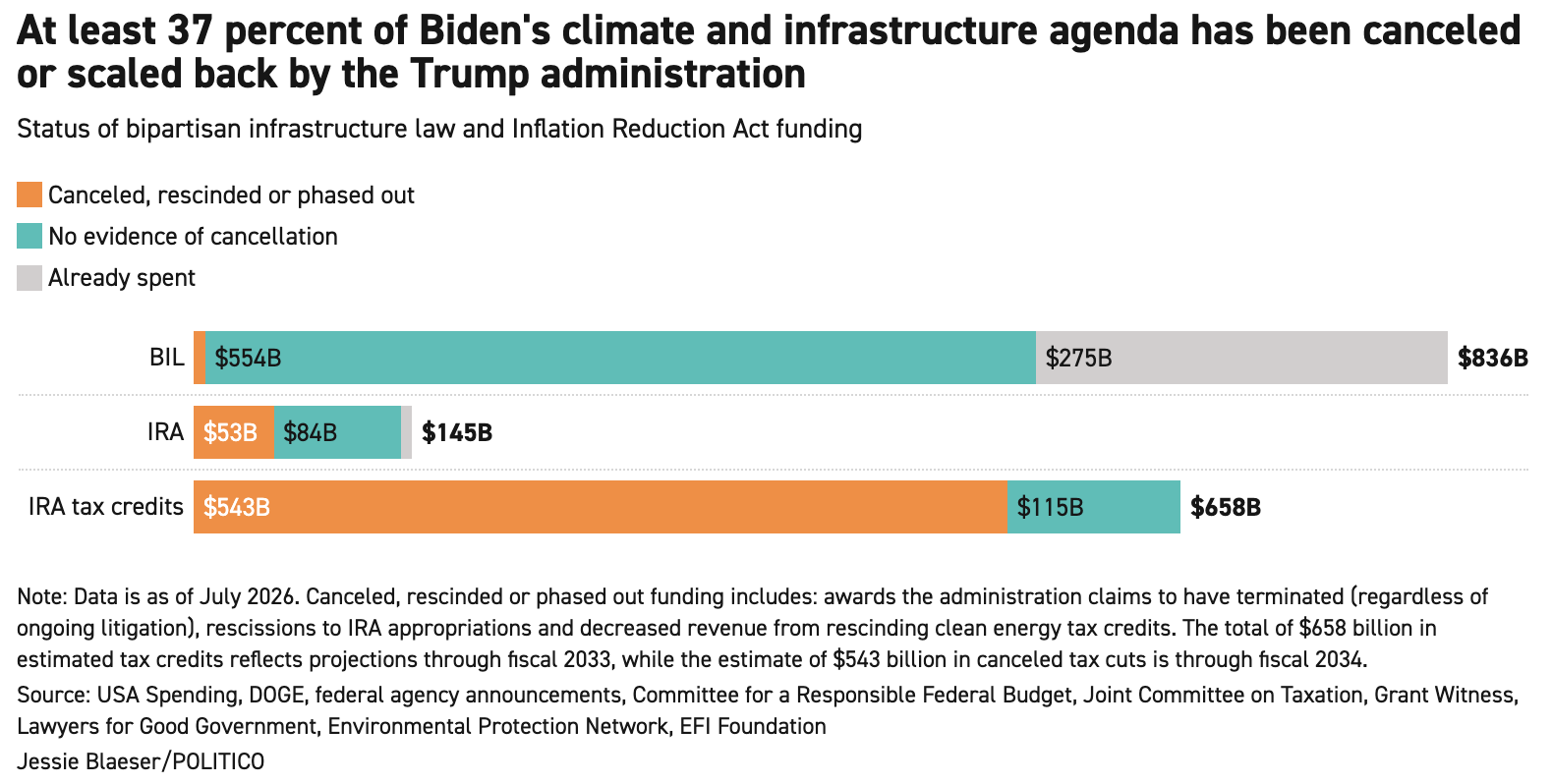
About one-third — $600 billion of the $1.6 trillion in Congressionally approved funds — is still available, according to Politico.
President Trump and Congress have eliminated more than $540 billion in Biden-era tax incentives/subsidies for electric cars, wind and solar power, and other “clean” technology.
Biden’s climate and infrastructure laws provided nearly $1 trillion in grants, contracts, and other direct federal outlays, and the Trump administration has tried to cut about 6%—about $60 billion—of them, but many have been stalled by court challenges.
The Administration has approved many of the grants it reviewed, with the Department of Energy paying special attention to ways to improve the grid.
President Trump has cut much of the Biden administration’s funding for its green new deal agenda, except for about $600 billion in Congressionally approved spending—about one-third of the $1.6 trillion set aside by the 2022 Inflation Reduction Act (IRA) and the 2021 Bipartisan Infrastructure Law for Biden’s pet projects. President Trump and Congress have eliminated more than $540 billion in Biden-era tax subsidies for electric cars, wind and solar power, and other “clean” technology. Politico says about another $275 billion has been spent. Out of nearly $1 trillion in grants, contracts, and other direct federal outlays provided by Biden’s climate and infrastructure laws, Politico found approximately $600 billion available to recipients or for federal agencies to award. Attempts by the Trump administration to cut around 6% of the $1 trillion — about $60 billion — have largely stalled in court challenges.
Impact of the Cuts
With the EV tax credit having expired at the end of September 2025 due to the One Big Beautiful Bill Act, EV sales in the United States fell 4% that year, despite spiking last summer before the credit went away. That compares to global EV sales, which increased more than 20% as other countries either reconstituted their EV subsidies or continued them. With less consumer interest, automakers have canceled plans for electric vehicle factories that the Biden administration supported. In 2024, for example, the Biden Administration gave over $1 billion to General Motors and Stellantis to build electric vehicles, with GM receiving $500 million to convert its Lansing Grand River Assembly Plant to manufacture electric vehicles. In 2026, GM laid off 350 employees at two Lansing plants as part of a previously announced $1.25 billion investment for gas-powered Cadillac CT5 production.
Power companies have traded wind projects for natural gas plants — in some cases, after the Trump administration agreed to repay offshore wind developers $1 billion or more for leases they had purchased to stop development of expensive offshore wind facilities. The Trump administration reached a nearly $1 billion agreement with French energy giant TotalEnergies to cancel its offshore wind leases off the coasts of New York and North Carolina. As part of the agreement, the Interior Department would terminate the leases for TotalEnergies’ Attentive Energy and Carolina Long Bay projects, worth $928 million — lease sales that occurred during the Biden administration. In return, TotalEnergies would invest the value of those leases into oil and natural gas production in the United States, after which the United States would reimburse the company dollar-for-dollar for the amount it paid for the offshore wind leases. TotalEnergies plans to redirect the funds toward the Rio Grande LNG plant in Texas and the development of upstream conventional oil in the Gulf of Mexico and shale gas production. The Trump administration made several similar deals, saving ratepayers from higher energy bills and reducing taxpayer expenditures on tax credits that operators would have received if the projects had gone forward.
In just one year, the number of natural gas plants planning to come online by 2030 nearly tripled to about 66 gigawatts, equivalent to adding the combined generating capacity of Pennsylvania and Maryland, according to U.S. Energy Information Administration data. Investments in clean energy manufacturing for factories making EV batteries, solar panels and other “clean” technologies fell 17% to $41 billion in 2025, according to tracking from the Rhodium Group and the Massachusetts Institute of Technology.
Other projects continued because of demand or state renewable power mandates. For example, a 400-megawatt solar project in Pennsylvania and a 578-mile transmission line connecting Kansas to Missouri are both moving forward, despite losing a $90 million DOE grant and a $4.9 billion loan guarantee, respectively.
EPA canceled a $1 million grant to create a community and cultural center in the Town of Bluff, Utah. The award was initially made under the IRA’s $3 billion environmental justice block grant initiative. Court documents show the Trump administration canceled it after announcing that redressing social and economic disparities in environmental policy was no longer a priority. The grant illustrates the wide latitude the government felt it had in distributing large sums of taxpayer money under the justification of the environment or climate.
The Trump administration, however, is keeping some Biden-era funding. In April, the Energy Department published a list of more than 1,900 projects it planned to keep after a year-plus review of Biden-era awards. The list included reinstating some awards the department previously terminated — mainly for grid-related projects. The Energy Department retained or modified 86% of the projects it reviewed.
On the cancellation side, the Energy Department terminated a $500 million grant for a California company looking for “cleaner” ways to make cement, and another $500 million grant for an Indiana cement plant looking to install technologies to capture and store carbon dioxide. It also canceled a $316 million grant for a company building a factory for manufacturing components for EV batteries in Kentucky—a company (Ascend Elements) that later declared bankruptcy. One company that was to make green hydrogen, which was awarded a $1.6 billion Energy Department loan guarantee days before Biden left office, subsequently suspended the work related to it.
Conclusion
The Trump administration has cut much of the Biden administration’s climate program funding. About one-third — $600 billion of the $1.6 trillion in Congressionally approved funds — is still available, according to Politico. President Trump and Congress have eliminated more than $540 billion in Biden-era tax incentives for electric cars, wind and solar power, and other “clean” technology. Biden’s climate and infrastructure laws provided nearly $1 trillion in grants, contracts, and other direct federal outlays, and the Trump administration has tried to cut about 6%—about $60 billion—of that, but court challenges have largely stalled those funds.

