

Key Takeaways
Texas Governor Greg Abbott has paused new data center construction in the state while ERCOT and the Public Utility Commission audit all current plans.
The audits seek ownership, financial, water, and community-impact information before granting grid access.
The action follows public concerns about the rapid growth of AI data centers in Texas, the nation’s 2nd-largest home to them behind Virginia.
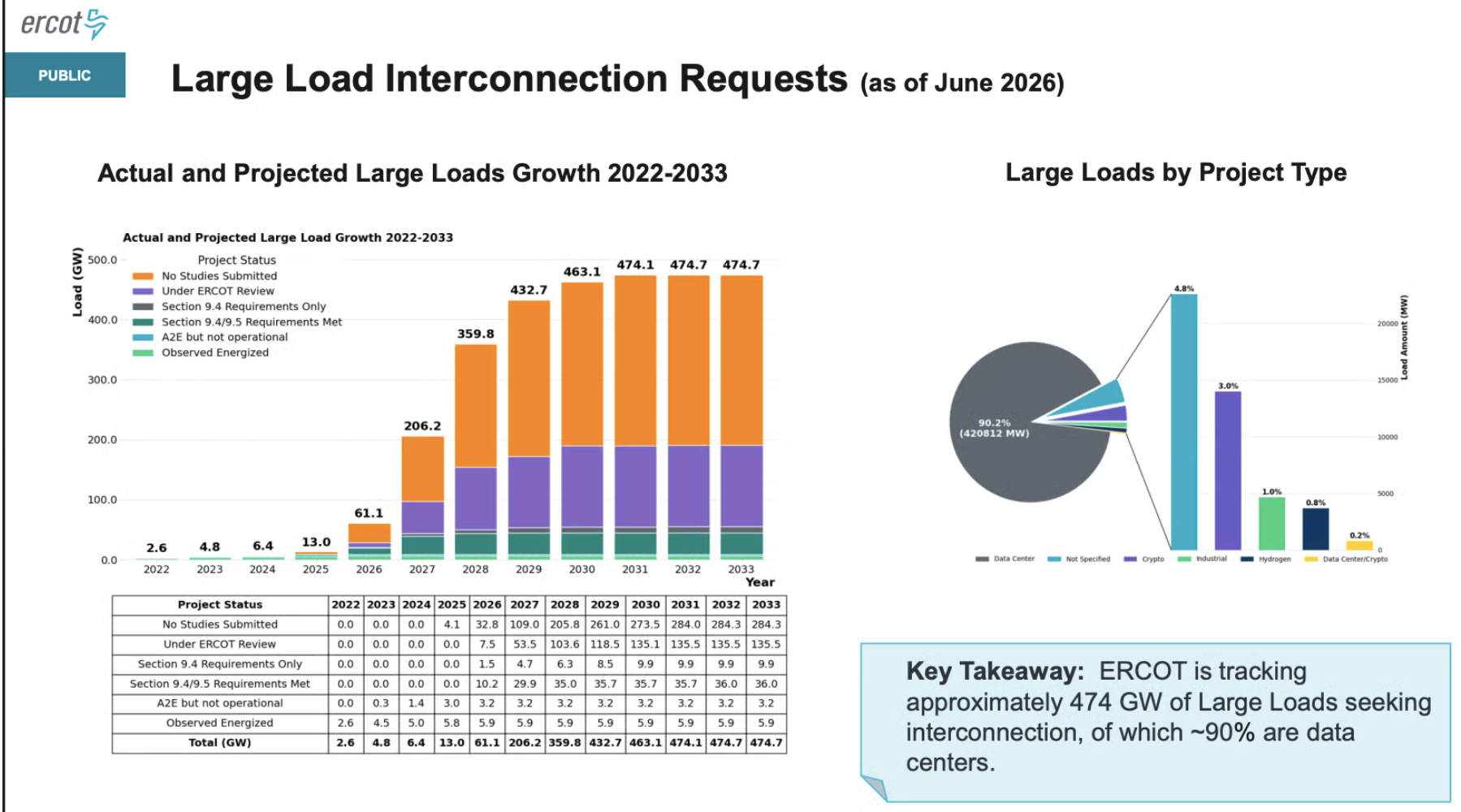
Interconnection requests for ERCOT have grown to more than 5 times peak demand.
AI supporters point to benefits such as job creation and tax revenues, as well as using less water than some traditional industries.
AI data centers can also help lower electricity rates because they can absorb the fixed costs of grid infrastructure built to power them.
Texas is poised to become one of the world’s largest AI data center hubs, with plenty of land, decent energy supplies, and a business-friendly atmosphere. But amid public concerns about energy and water use, Texas Governor Greg Abbott has paused all new data center construction while the state audits current plans. That pause puts 20% of the U.S. pipeline at risk of delay, affecting almost 49.8 gigawatts of projects.
Governor Abbott called for an audit of all data centers in the Electric Reliability Council of Texas (ERCOT) interconnection queue, which led the grid operator to delay its review of the first set of projects from the state’s new load interconnection process. According to Abbot, the ERCOT large load interconnection requests consist of about 474 gigawatts, of which about 90% are for data centers, which is more than five times ERCOT’s peak demand record. An all-time hourly peak of 91,089 megawatts was set on July 22, 2026. Abbott’s audit will examine whether data centers provide their own power or rely on the grid; their water use; and which data centers use state or federal assistance such as tax incentives, grants, or abatements.
According to ERCOT, 70% of generation capacity in the interconnection queue consists of solar and battery storage. Batteries are not an electricity-generating source, but a storage device that relies on generation sources to overproduce and store electricity. Natural gas facilities make up less than 17% of the interconnection queue, but their capacity is higher than three years ago, when fewer than 10 gigawatts of gas power plants wanted to connect. However, Texas legislators and grid operators indicate that the current level of planned gas facilities would not be enough to sustain reliability and resilience. They are contemplating requiring a minimum level of natural gas plants to increase dispatchability—plants that can be ramped up or down on demand by the system operator, unlike intermittent wind and solar power sources.
Through 2030, about 8.25 gigawatts of additional data center capacity will come online in ERCOT, bringing total capacity to more than 17 gigawatts, according to an analysis by Bloomberg NEF. Assuming 60% of the delayed capacity is AI-related, BNEF calculates that data center revenue losses could reach $8 billion by the first quarter of 2027. Delays could also put billions of dollars of data center leasing revenue at risk. Bloomberg NEF estimates AI computing capacity can earn around $1.76 billion per gigawatt per month.
Texas has followed N.Y. State in pausing data center development. In July, New York halted new data center approvals for up to a year while the state creates new development rules.
Benefits of Data Centers
According to the Data Center Map, there are currently 4,677 data centers in the United States. Virginia leads the states with 674 data centers across 25 markets. The majority of those data centers are located in Northern Virginia, around Data Center Alley in Ashburn. Texas follows Virginia with 537 data centers across 44 markets.
Some residents near data centers have raised concerns such as losing drinking water during construction, or continuous low-frequency “infrasound” from cooling fans and gas turbines — with claims linking the “sound” to negative health effects like headaches, insomnia, nausea, and anxiety. Infrasound is inaudible to humans but can be felt. These issues have resulted in local lawsuits, moratoriums, and pauses on construction, as in New York and Texas.
Data centers, however, often use less water than traditional industries like agriculture, rock quarries, and poultry processing. A data center will “evaporate into the air about as much water as a municipal golf course” over the course of a year. Data centers can cool heat by evaporating water, reducing electricity use by 20% to 25% annually. Data centers can also help lower electricity rates by absorbing the fixed costs of grid infrastructure built to power them, keeping prices stable or even reducing them over time. An IER study showed no meaningful relationship between data center concentration and higher electricity prices.
Data centers also bring economic benefits, such as tax revenues that can fund schools, road infrastructure, and sewer systems. The property tax paid by a data center “often exceeds the budget of a small rural county.” For instance, according to the Loudoun County, Virginia, website, “for every $1 in services that Loudoun County provides to data centers, the county receives $26 in tax revenue.”
Data centers also create jobs, particularly construction jobs. For example, the Trump administration announced a plan to develop a former nuclear enrichment site in Kentucky to build an AI data center, the most recent in a series of similar conversion plans. The initiative is expected to create around 8,000 construction jobs and 600 permanent jobs, according to the U.S. Department of Energy. Data centers have high-paying jobs, especially in construction, averaging around $81,000 a year.
A new peer-reviewed study published in a Nature journal finds AI could help produce more oil and natural gas by finding new resources and recovering more from existing fields. It can also help renewable energy by improving forecasting and operations. Furthermore, AI may improve water-use efficiency in many ways, helping address problems it currently faces.
Conclusion
Texas Governor Greg Abbott has directed the Public Utility Commission of Texas and ERCOT to conduct a comprehensive audit of every data center advancing through the state’s interconnection queue, warning that projects that fail to disclose ownership, financial, water, and community-impact information could be denied grid access. ERCOT’s large-load interconnection queue totals 474 gigawatts—about 90% of which are for data centers. Communities worry about electricity prices, water usage, and “infrasound” from data centers. But industry and lawmakers dispute those claims and indicate other benefits, including job creation, tax revenues, and productivity gains.
For media inquiries, please contact press@ierdc.org.

