

Issue Focus: Oil and Gas Leasing on Federal Lands
June 25, 2008· 20 Comments
Washington politicians are accusing oil companies of “stockpiling” federal energy leases to keep supplies low and prices high. They claim “Big Oil” holds leases for 68 million of acres of federal leases that are not currently producing energy. The following will help separate fact from fiction in the “68 million acres” sound bite.
The Claim: “Energy companies are not using 68 million acres of federal lands already open to energy development. If we extrapolate from today’s production rates on federal land and waters, this means that Big Oil is stockpiling an additional 4.8 million barrels of oil and 44.7 billion cubic feet of natural gas each day.” – The Truth About America’s Energy: Big Oil Stockpiles Supplies and Pockets Profits , page 2.
The Extrapolation: To arrive at the production numbers above, it appears as though the authors of the report “extrapolated” as follows:
• Roughly 23 million acres of onshore and offshore federal land are producing 1.6 million barrels per day today.
• Roughly 3 times as many onshore and offshore federal acres – or about 68 million – are leased to oil companies, but not currently producing oil or gas.
Therefore, the authors conclude, the United States could be producing 3 times as much oil – or an additional 4.8 million barrels per day – if the lease holders for the non-producing federal lands started producing oil today.
The Reality: America Cannot ‘Extrapolate Its Way Out of an Energy Crisis
Using the very same extrapolation, the Institute for Energy Research has calculated that the United States could produce an additional 160 million barrels of oil per day if the government leased all 2.46 billion onshore and offshore acres in the federal estate. That’s almost double the amount that is produced on a daily basis in the entire world.
Using the very same extrapolation, the Institute for Energy Research has calculated that 9.4 billion non-produing acres of the moon could produce an additional 654 million barrels of oil each day.
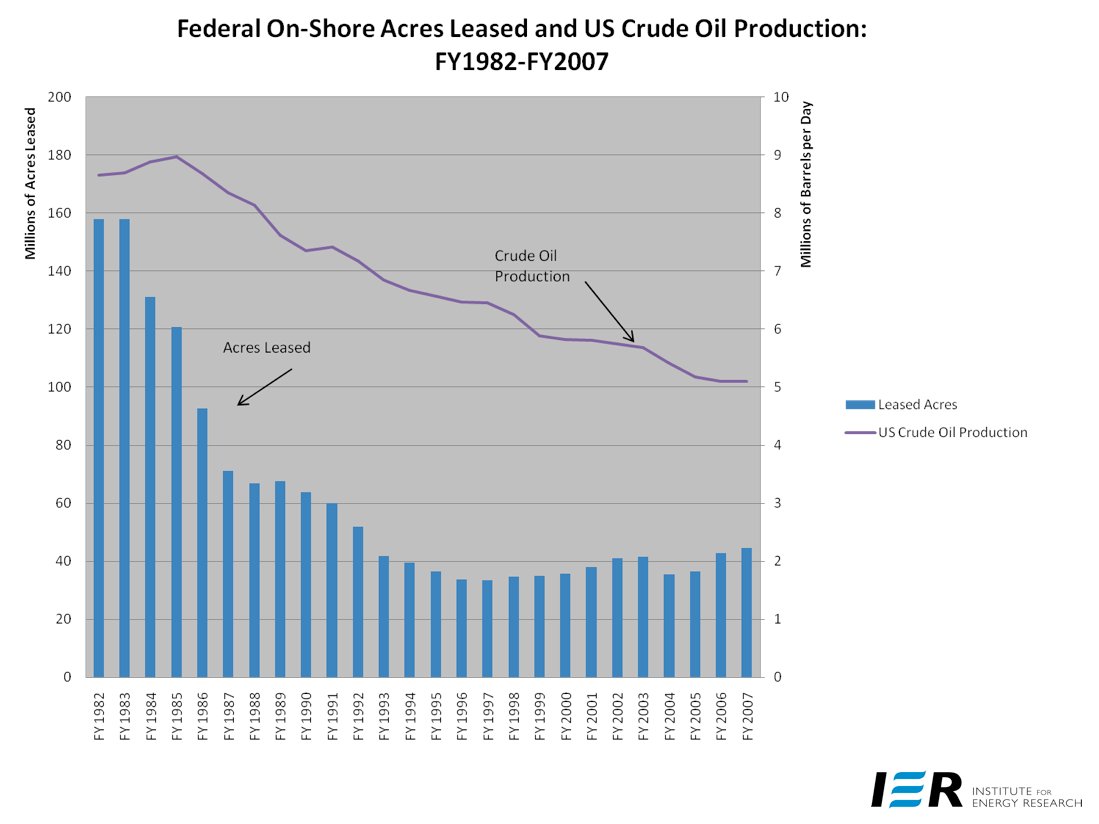
It seems the lawmakers would have us believe that obtaining a lease was a virtual guarantee that the lease holder would strike oil and gas, or both. In reality, not every acre of federal land contains oil and gas. If it were true, who wouldn’t be on line at the Department of Interior trying to buy an acre or two for themselves?
The chart to the right illustrates the correlation between the acreage of federal lands leased and the amount of crude produced over the past 25 years.
Unfortunately, there are no guarantees. Oil and gas might be found during the exploration phase of the lease, or it might not. This process, and those that involve satisfying all of the government requirements, defending against frivolous environmental lawsuits, and preparing to drill if energy is found can take a long as a decade.
The Truth & The Laws
Energy companies cannot “stockpile” leases (even the ones that are found to contain no oil or gas) in order to drive up prices:
- The Mineral Leasing Act (for onshore production): Section 17(e) stipulates that an oil company must have a producing well within 10 years or surrender the leases. Source: 30 U.S.C. 226(e)
- The Outer Continental Shelf Lands Act: (for offshore production): Stipulates that an oil company must produce energy between 5 to 10 years (in the government’s discretion) or surrender the lease. Source: 43 U.S.C. 1337(b)
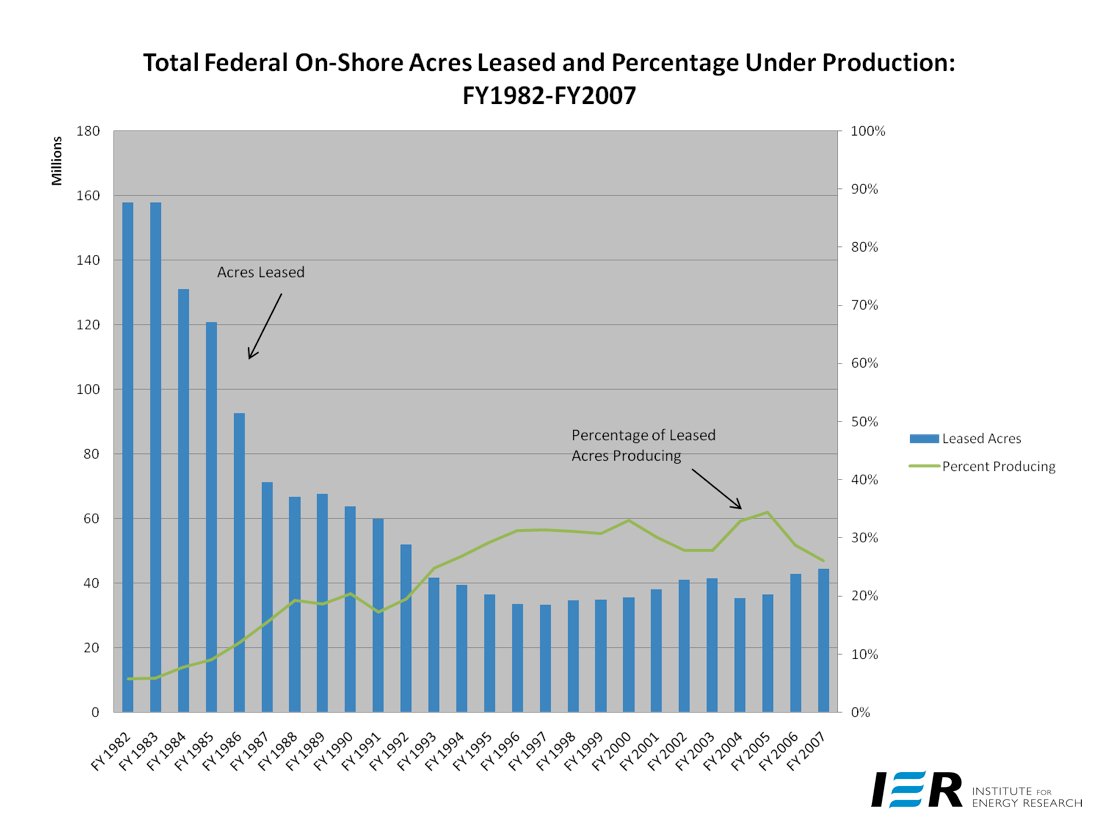
In fact technology has improved over time, allowing companies to increase their production on leased acreage. The chart at right demonstrates that oil companies are using more of their land, not stockpiling leases.
The Hard Facts:
- 97 percent of Federal offshore areas are not leased.
- 94 percent of Federal onshore areas are not leased.
Getting Blood From a Turnip
After the offshore drilling moratorium was implemented in 1982 the Department of Interior could only issue leases for areas that had already been offered/leased before, or those areas with little or no economic energy potential. The exception was when Congress provided incentives to invest in Ultra Deep Waters in 1995 to stimulate production in areas that were previously too deep for our technology to reach.
As the charts above illustrate, interest in American energy leasing declined after the moratorium. It remains low for the same reasons. If Congress were to open new areas to production, leasing would increase and so would domestic supplies of energy. Until then, the U.S. will simply be continuing its attempt to squeeze blood from a turnip.

Tags: energy policy


ShareThis
June 18th, 2008 at 2:47 pm
[...] problem is that those are places with low probability of turning up anything useful (so it would probably be wasted money to l…. Can anyone take seriously the notion that, with prices as they are now, a US oil company that [...]
June 18th, 2008 at 7:42 pm
[...] Until then, the U.S. will simply be continuing its attempt to squeeze blood from a turnip. Institute for Energy Research Blog Archive The Truth About Leasing on the Outer Continental Shelf __________________ CS:S admin- PM DennyCrane for [...]

June 18th, 2008 at 7:48 pm
[...] Unfortunately, there are no guarantees. Oil and gas might be found during the exploration phase of the lease, or it might not. This process, and those that involve satisfying all of the government requirements, defending against frivolous environmental lawsuits, and preparing to drill if energy is found can take a long as a decade. [...]
June 18th, 2008 at 9:17 pm
[...] that the congressional ban on offshore drilling has had much impact compare this chart from the Institute for Energy Research showing how the 1982 law impacted oil exploration with this table from the Energy Information [...]
June 19th, 2008 at 9:29 am
[...] The Truth About Leasing on the Outer Continental Shelf The Claim: “Energy companies are not using federal lands already open to energy development” [...]
June 20th, 2008 at 11:03 pm
[...] Link The Truth About Leasing on the Outer Continental Shelf Capitol Hill
July 1st, 2008 at 5:09 am
[...] Go read the rest so when you see someone borrowing the anti-energy and anti-growth Washington liberal’s rhetoric, you can smack then down. [...]
July 11th, 2008 at 7:36 am
[...] not to carry enough recoverable oil to justify drilling. This is in stark contrast to the other 97% of currently banned offshore resources and areas with shale oil, where enormous quantities are [...]
July 12th, 2008 at 3:08 pm
[...] Issue Focus: Oil and Gas Leasing on Federal Lands [...]
July 13th, 2008 at 11:07 pm
[...] not to carry enough recoverable oil to justify drilling. This is in stark contrast to the other 97% of currently banned offshore resources and areas with shale oil, where enormous quantities are [...]
July 16th, 2008 at 7:02 pm
[...] Originally Posted by jfuh To pretend that oil companies are ecstatic of high oil prices raking in record profits and sitting around not doing anything about various leases they already have and not doing anything about them IS dishonest. I
July 16th, 2008 at 8:59 pm
[...] fairly interesting as it deals with the claims about the oil companies
August 5th, 2008 at 7:27 am
[...] absurd situation where 94 percent of federal land, and 97 percent of federal offshore waters, are not being leased by energy companies. The US government itself estimates that its own prohibitions currently render 18 billion barrels [...]
August 15th, 2008 at 10:36 am
[...] DC – Today the Institute for Energy Research released a chart that debunks the myths surrounding the development of federal leases. As Russia threatens [...]
September 16th, 2008 at 4:42 pm
[...] Perpetuates—indeed legislates—the myth that oil companies sit on expensive oil leases instead of developing them. [...]
September 16th, 2008 at 4:47 pm
[...] This subtitle is a reference to the myth that there is 68 million acres with economical deposits that are leased by oil and gas production that oil companies are not using. More information on that myth is available here. [...]
September 17th, 2008 at 3:49 pm
[...] Perpetuates-indeed legislates-the myth that oil companies sit on expensive oil leases instead of developing them. [...]
November 14th, 2008 at 2:52 pm
[...] When energy prices hit record highs and began reaching further and further in people’s pockets to pay for those rising costs, Americans understood there was a need for increased domestic energy production. They learned that, contrary to the oft-repeated lie that America has little or no energy resources, the United States has huge resource potential that is being blocked by government actions that restrict affordable supplies to American consumers including ANWR, the OCS, and shale oil and natural gas. Huge potential energy resources remain off limits in the 96% of federal lands that remain unleased for energy exploration because of a host of government pol…. [...]
November 17th, 2008 at 8:43 pm
[...] not to carry enough recoverable oil to justify drilling. This is in stark contrast to the other 97% of currently banned offshore resources and areas with shale oil, where enormous quantities are [...]
February 11th, 2009 at 10:41 am
[...] Lease agreements already contain federal requirements that require oil companies to use leased land in a timely manner. The 1992 Comprehensive Energy [...]