

Key Takeaways
A number of states are looking at the affordability of electricity amid growing demand from increased electrification due to climate policies.
Connecticut’s residential electricity prices are the third highest in the nation, behind Hawaii and California.
Due to rising electricity prices, Connecticut Governor Lamont has lowered the 2030 goal of the state’s Renewable Portfolio Standard and is allowing more fuels to contribute to the goal.
The new renewable target for 2030 requires the state to get 29% of its electricity from renewable sources, down from 40%.
The state has a number of policies that add to the costs of generating and transmitting electricity, including forcing green mandates, joining the Regional Greenhouse Gas Initiative, limiting natural gas pipelines, and retiring its coal plants.
Connecticut is interested in getting supply from offshore wind, one of the most expensive generating technologies that operates less than half the time that fossil fuel and nuclear technologies operate, necessitating backup power.
Connecticut Governor Ned Lamont said, “electric bills are too damn high,” with his state having one of the highest residential electric bills in the nation — almost twice as high as neighboring Pennsylvania and the national average. As a result, on July 1, he signed Senate Bill 4, which reduces the state’s targets for its renewable portfolio standard (RPS) and allows for wood-burning and other biomass to count toward meeting the standard. The new renewable target for 2030 requires utilities to get 29% of their electricity from renewable sources, down from 40% before the change. Governor Lamont also said, “I want to be clear – this legislation is one step in the effort to make energy rates more affordable and we should not stop here.” He is recognizing that his state’s policies are affecting electricity prices.
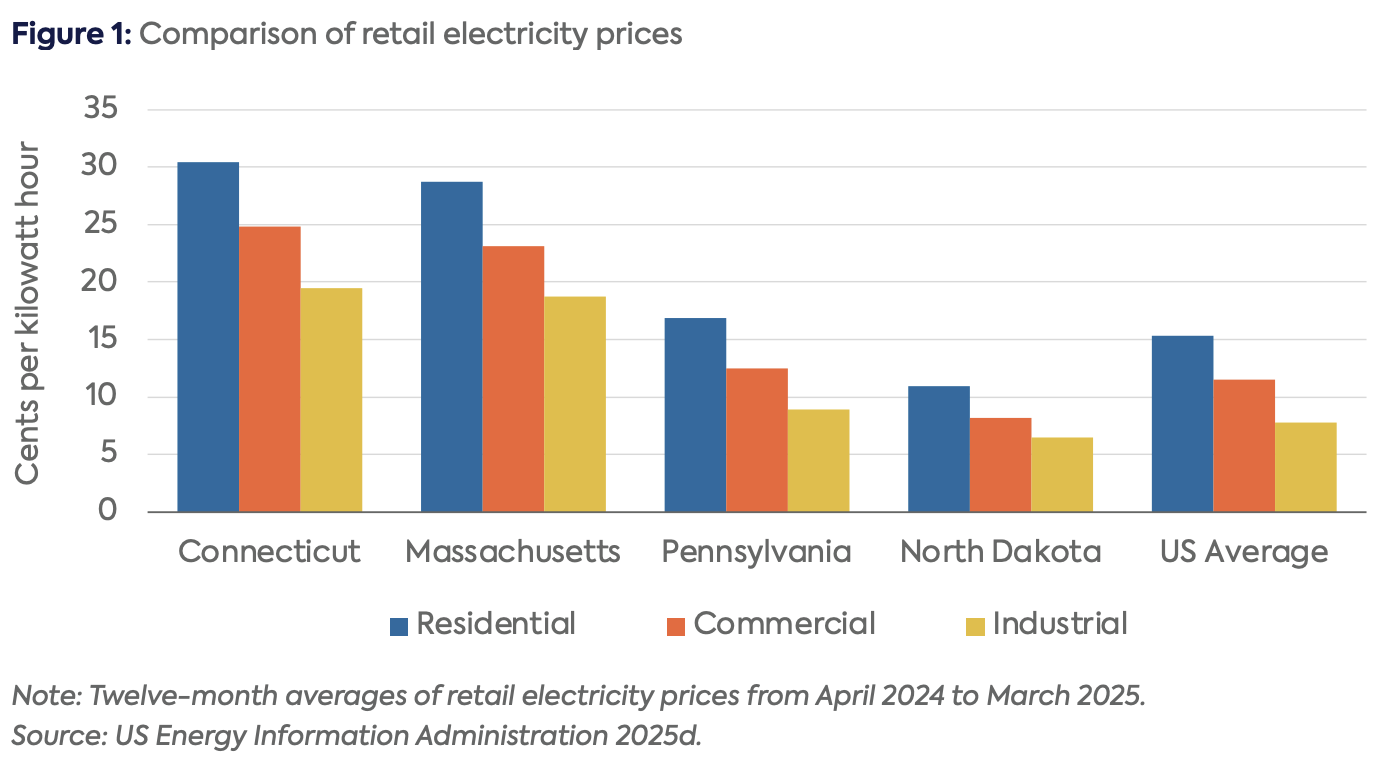
A study by the Center on Global Energy Policy, entitled “Climate Ambition and Electricity Affordability: Lessons from Connecticut,” delineated some of the costs that make Connecticut have one of the highest electricity prices in the nation. The state’s RPS costs a typical household about $6-$8 per month. Compliance with the RPS is met through Renewable Energy Credits that electricity suppliers purchase from renewable developers. The costs of the credits are ultimately paid by ratepayers. The study estimated that the RPS costs ratepayers about 0.8 to 1.1 cents per kilowatt hour, or $6 to $8 per month on a typical monthly bill. While recognizing that its RPS has an impact on prices, Connecticut still requires utilities to be carbon-free by 2040.
The study also discusses Connecticut’s membership in the Regional Greenhouse Gas Initiative (RGGI), which is a joint program among 11 states to reduce greenhouse gases through a “cap and tax program.” Fossil fuel generators are required to buy permits for each metric ton of carbon dioxide that they emit, with a 30% reduction target for 2020–30. Permits currently cost about $22.50 per metric ton, adding about 0.5 to 1 cent per kilowatt hour, or $4 to $7 on a typical monthly bill.
Furthermore, the state runs “clean energy” procurements to obtain “clean electricity generation,” and expensive energy battery storage to back up intermittent renewable technologies such as wind and solar power. Utilities typically purchase the electricity and associated renewable energy credits at fixed prices and pass those costs onto customers.
Other Reasons for Connecticut’s High Electricity Prices
According to the U.S. Energy Information Administration (EIA), Connecticut gets over half of its electricity from natural gas, but has limited access to low-cost gas from neighboring Pennsylvania’s Marcellus Shale Basin due to pipeline limitations. Most of the natural gas that enters Connecticut comes through the state of New York from the Appalachian region, Canada, the U.S. Gulf Coast, and the U.S. Mid-Continent region. Connecticut gets some gas delivered through Massachusetts, which imports liquefied natural gas from its Everett Marine Terminal, supplying about 20% of the gas used in New England annually.
The EIA explains that Connecticut no longer gets any generation from coal, having retired its last coal generating plant in 2021 — the 258-megawatt unit at Bridgeport Harbor Station — to help meet climate goals. In 2023, Connecticut was one of nine states that did not generate any electricity from burning coal. Connecticut has one nuclear power plant with two reactors — the 2,081-megawatt Millstone nuclear power station located in Waterford. Other generating sources include solar, hydroelectric, biomass, petroleum, and wind.
Connecticut is interested in offshore wind for new power generation to comply with its climate goals and, according to the EIA, the state’s strongest wind power resources are offshore along the Long Island Sound coastline. In 2019, Connecticut’s governor signed legislation requiring the state’s Department of Energy and Environmental Protection to solicit proposals to procure 2,000 megawatts of offshore wind by 2030. The state signed a contract to acquire up to 304 megawatts from Revolution Wind off Rhode Island at a guaranteed rate of $99 per megawatt-hour — a rate higher than its current generating sources. Under the agreement, if wholesale electricity prices fall below the contract rate, the shortfall is covered by ratepayers through a portion of the public benefits charge on their utility bills.
The cost of power from offshore wind is far more than the cost from onshore wind and other traditional generating technologies. Offshore wind costs are exorbitant, as developers must handle mounting the wind turbines in rough ocean waters, running extensive cables underground to bring the power to the coast, and maintaining the turbines in turbulent and corrosive ocean waters that make their operating and maintenance costs almost five times that of onshore wind. Offshore wind also operates less than half the time that fossil fuel and nuclear technologies operate, and needs backup power when the wind does not blow.
Connecticut needs new power as its demand is expected to grow about 12% over the next decade, according to the Center on Global Energy Policy, largely due to electrification, which is championed by the state’s policies. Connecticut’s electricity demand is expected to rise from the adoption of electric vehicles and heat pumps to meet climate goals, necessitating new generation and grid upgrades, which will continue to increase the state’s electricity prices.
Analysis
Connecticut is one of many blue states looking at the affordability of electricity, as residential electricity prices rose by 25% during the Biden years. As we discuss in Blue States, High Rates, “Electricity affordability is a function of state-level policy choices. States that have embraced aggressive renewable mandates, 100% ‘carbon-free’ targets, premature coal and nuclear retirements, rooftop-solar cost shifting, and restrictions on natural gas infrastructure routinely deliver the nation’s highest electricity prices.”
For inquiries, please contact wrampe@ierdc.org.

