

Key Takeaways
Virginia’s new governor, Abigail Spanberger, has announced that the state will rejoin the Regional Greenhouse Gas Initiative (RGGI) — a multistate compact that requires energy producers to pay for each metric ton of carbon dioxide they release by purchasing allowances for emissions above a predetermined cap.
She plans to use the funds raised to meet her goals of expanding energy storage, increasing home weatherization and insulation programs, and pursuing a mix of energy sources that includes solar, nuclear, and offshore wind — generally expensive technologies that will increase the state’s electricity prices.
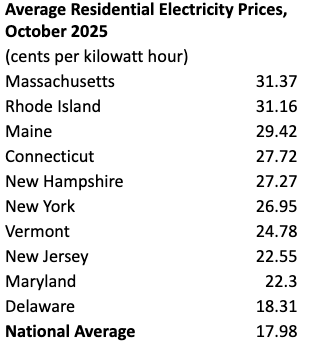
Virginia’s residential electricity prices are currently equal to the national average, and they are lower than the residential electricity prices of the ten states in the RGGI.
When Governor Youngkin dropped out of the RGGI, he indicated that the program added $2.39 a month to a typical residential customer’s bill and $1,554 a month to a typical industrial customer’s bill. In other RGGI states, the impact is higher.
Virginia’s new governor, Abigail Spanberger, announced that Virginia will rejoin the Regional Greenhouse Gas Initiative (RGGI), falsely claiming that the state’s withdrawal from the program increased costs. She said that rejoining RGGI is aimed at lowering monthly utility bills and restoring investments that support energy efficiency and flood mitigation across the Commonwealth, particularly for lower-income Virginians. RGGI is a group of ten Northeastern states that have capped power sector carbon dioxide emissions to reduce them by forcing companies to buy allowances for the emissions that they release from fossil fuels used to generate electricity. The participating states are Connecticut, Delaware, Maine, Maryland, Massachusetts, New Hampshire, New Jersey, New York, Rhode Island, and Vermont.
Virginia’s previous governor, Glenn Youngkin, withdrew the state from the program indicating that it functioned as a regressive tax and did not meaningfully reduce emissions. According to the Virginia Pilot, Youngkin, in a January 2022 executive order, indicated that RGGI increased typical residential customer bills by $2.39 a month and a typical industrial customer’s bill by $1,554 a month.
In contrast, Spanberger sees the RGGI as restoring a funding source that she can use to meet her goals of expanding energy storage, increasing home weatherization and insulation programs, and pursuing a mix of energy sources that includes solar, nuclear, and offshore wind, which she said are important to energy independence and economic growth. As reported by WVEC-TV, in 2021, Virginia raised nearly $600 million from the RGGI prior to Virginia’s withdrawal.
Spanberger’s favored technologies, offshore wind and energy storage, however, are very expensive. They are three to four times higher than the cost of onshore wind or solar. And battery storage can only release energy that it stores if there is excess power on the grid. One bill that Youngkin vetoed in 2025 would have increased energy storage capacity that could replace peak power during high demand periods. However, that would have meant one expensive technology replacing another and hoping that the excess power was there when needed.
The ten states that are currently members of the RGGI have average residential electricity rates that are all above the national average and many that are close to the highest in the nation as indicated below. Note that Pennsylvania withdrew from RGGI in 2025.
A study by the Center on Global Energy Policy, entitled “Climate Ambition and Electricity Affordability: Lessons from Connecticut,” delineated some of the costs that make Connecticut have one of the highest electricity prices in the nation. One of those costs is membership in the RGGI. Fossil fuel generators are required to buy permits for each metric ton of carbon dioxide that they emit, with a 30% reduction target for 2020 to 2030. Permits costing about $22.50 per metric ton added about 0.5 to 1 cent per kilowatt hour, or $4 to $7 on a typical monthly bill in Connecticut.
Currently, Virginia’s average residential electricity price is 17.98 cents per kilowatt hour, equal to the national average residential price and a lot less than Connecticut’s average residential electricity price. Virginia is currently the hottest state for artificial intelligence (AI) data centers, nicknamed “Data Center Alley”, because, according to the American Action Forum, of “its geographical location and robust fiber optic cable infrastructure.” Many see the rapid increase in demand from data centers as a reason for increasing electricity prices as the grid does not currently have the capacity for rapid expansion. Governor Youngkin, along with the governors of Maryland and Pennsylvania, want PJM, the grid operator, to hold a power auction for tech companies to bid on contracts to build new power plants so that data center operators, not regular consumers, pay for their power needs.
Virginia’s Clean Economy Act (VCEA), which established a Renewable Portfolio Standard and forces the state to generate 100% renewable electricity by 2045, works against the 24/7 reliable electricity needs of AI data centers. The rapid growth of AI data center demand makes meeting carbon-free targets extremely difficult, if not impossible, which will be an issue for Governor Sanberger’s goals. Climate goals are achievable only if demand is stifled, which would result in industry going abroad, as Europe is experiencing, leaving China to win the AI race.
Analysis
Governor Spanberger’s choice to rejoin RGGI is putting a short-term budgetary gain ahead of the long-term impact the compact has on electricity prices and Virginia’s economic competitiveness. The idea that RGGI-funded government subsidies for wind, solar, battery storage, and load-reducing programs will cover the costs of taxing fossil fuels doesn’t stand up to scrutiny. Data centers need 24/7 power, and it makes more sense for these companies to invest in reliable power sources, as they’ve already been doing, than to hope that intermittent sources, or batteries that only operate for four hours at a time, can have the same effect. To determine what sources meet demand best, Virginia should let the customers decide, not politicians.
For inquiries, please contact wrampe@ierdc.org.

