Key Takeaways
Massive storm “Fern” crossed almost half the nation’s states and raised havoc with the electricity system, leaving over a million without power initially and over 805,000 still without power as of Sunday night.
Reliable baseload power from natural gas, coal, and nuclear saved the day as limited sun resulted in little or no solar power, and limited wind resources and frozen equipment bogged down wind power.
Batteries helped little because they only discharged power for a few hours at a time and had no way to recharge.
The Energy Department released emergency guidance that waived emission rules so that fossil fuel plants could run at maximum capacity and allowed large consumers to use backup power.
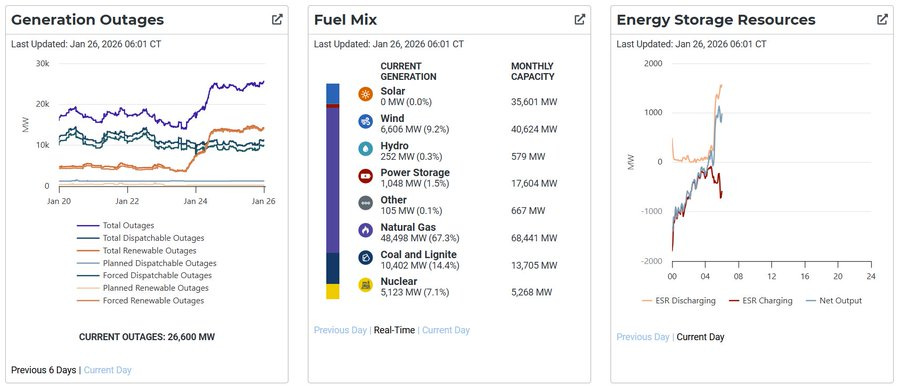
While Texas had some outages, it was able to rely on baseload power from natural gas, coal, and nuclear for 89% of its power early Monday morning, as there was no power from the sun and only 9% coming from wind.
When power was most needed, thermal, dispatchable sources provided it.
Electricity outages across the United States reached nearly a million customers early Sunday afternoon, but by 10:30 p.m. Sunday, utility crews had reduced the number of outages to fewer than 805,000, mostly in the South, according to poweroutage.com. Utility generators had to rely on natural gas, coal, and nuclear power to keep the lights on as the lack of sun wiped out solar power and limited wind and/or freezing equipment reduced wind power output. In the Northeast, oil and wood saved the day as the lack of sufficient pipeline infrastructure limited additional gas-generated power. In the Northeast and Midwest, where more people get heat from natural gas, less of the fuel is available for power plants. More outages would have been the result if President Trump and Energy Secretary Wright had not kept coal plants from retiring.
Record-breaking temperatures are expected to last for much of the week with more than 85 million people placed under an extreme cold warning. As the temperatures dip further, demand for power is expected to rise, raising the possibility that more outages could occur. It is estimated that storm damage could result in up to $115 billion in losses, according to AccuWeather. As natural gas is in high demand and freezing conditions restrict gas output, natural gas prices have risen to above $6.20 per million British thermal units as of Monday morning, the highest since December 2022. The fuel of choice for data centers, natural gas output dropped as icy conditions forced drillers in regions such as the Permian shale basin in Texas and New Mexico to curb output due to “freeze-offs,” when water and other liquids in the gas stream freeze.
The Department of Energy ordered the manager of the Texas power grid to begin using backup generation resources at data centers and other facilities that consume large amounts of energy to help prevent blackouts. According to the agency, the order would aid the Electric Reliability Council of Texas, ERCOT, in maintaining grid operations through the “extreme temperatures and storm destruction” left by the weekend’s powerful weather event. In its 2025–2026 Winter Reliability Assessment, the North American Electric Reliability Corporation (NERC) found that the ERCOT assessment area was at elevated risk. According to NERC, above-normal winter peak and outage conditions could result in the need for operating mitigations and Energy Emergency Alerts.
According to the Wall Street Journal, the Energy Department also waived emissions rules so fossil-fuel plants could run at maximum capacity. Early Sunday morning, coal accounted for some 40% of power in the Midwest’s MISO grid, 24% in the eastern PJM Interconnection, and 18% in Texas, with most of the rest coming from natural gas and nuclear. Power plants in New England burned oil, which accounted for 40% of electricity at peak demand, and the region generated more power from burning wood and trash than from wind power. Back-up batteries for wind and solar did little as they can discharge power only for a few hours at a time and had no excess sun or wind power to recharge them.
While Texas did have some outages, the results were far better than during Winter Storm Uri in February 2021 due to changes the state made post-Uri. As of early Monday morning, the state was generating 89% of its power from reliable baseload fuels — 67% from natural gas, 14% from coal, and 7% from nuclear, with just 9% coming from wind, none from solar, and 1.5% coming from batteries.
Analysis
Winter Storm Fern has further revealed the importance of connecting reliable generation resources to the grid, without which numerous lives and dollars would be lost. State-level policies forcing the retirement of coal plants and preventing the construction of natural gas and nuclear plants have led to the current situation facing the grid, where power plants are burning oil, wood, and trash, as the Wall Street Journal reports. Reducing carbon emissions by increasing renewable generation may sound good in theory, but the fact that solar and wind can’t provide the same capacity during poor conditions makes their inclusion on the grid duplicative and expensive. As the Journal’s Editorial Board asks, “Is the goal to reduce carbon emissions by making Americans freeze?”
For inquiries, please contact wrampe@ierdc.org.