

Key Takeaways
The Environmental Protection Agency (EPA) announced “Phase 1” of its rollback of the Biden administration’s “Good Neighbor” rule.
The rule was part of a suite of actions undertaken by the Biden administration in pursuit of his promise to shut down all coal plants in the United States.
Phase 1 would approve the plans of eight states to address the interstate transport rules for the 2015 eight-hour ozone standards that the Biden administration rejected as insufficient.
The “Good Neighbor” rule is intended to prevent criteria pollutants in one state from blowing downwind, which prevents other neighboring states from meeting federal air quality standards.
The roll-back of the rule could help keep existing coal plants slated for retirement online, many of which were used extensively during winter storm Fern, while reducing utility costs and increasing grid reliability.
The Environmental Protection Agency (EPA) announced “Phase 1” of its rollback of Biden’s “Good Neighbor” rule, which would approve the plans of eight states to address the interstate transport rules for the 2015 eight-hour ozone standards that the Biden administration rejected as insufficient. The eight states whose plans would now be accepted are Alabama, Arizona, Kentucky, Minnesota, Mississippi, Nevada, New Mexico, and Tennessee. The concept of the “Good Neighbor” rule is to prevent criteria pollutants in one state from blowing downwind, which would hinder neighboring states’ ability to meet federal air quality standards under the Clean Air Act. According to EPA Administrator Lee Zeldin, the EPA is committed to advancing “cooperative federalism” that allows states to decide for themselves how to attain air pollution goals. The roll-back of the rule could help keep existing coal plants slated for retirement online, many of which were used extensively during winter storm Fern. EPA will accept public comment for at least 30 days after the rule is published in the Federal Register.
The Clean Air Act requires each state in its State Implementation Plan to prohibit criteria emissions that would significantly contribute to non-attainment of the standards, or interfere with their maintenance in a downwind state. The criteria pollutants are carbon monoxide, lead, sulfur dioxide (SO2), nitrogen oxides (NOx), ground-level ozone, and particulate matter (PM). They are called “criteria” pollutants because the EPA sets the criteria for permissible levels.
The Biden administration imposed strict limits on nitrogen oxide (which contributes to ozone) and other emissions from power plants, pipelines, cement makers, steel mills, chemical companies, and other industries in 23 states. The standards required coal and gas-burning power plants to spend money upgrading their pollution control equipment, making it more expensive for them to operate, increasing electricity prices for consumers, and reducing the reliability of the grid. The rule was part of a suite of actions undertaken by the Biden administration in pursuit of his promise to shut down all coal plants in the United States.
In June 2024, the Supreme Court halted the Biden plan in a five to four decision while challenges to it worked through the lower courts. According to the challengers, consisting of states, industry, and trade organizations, the rule would impose unreasonable costs, destabilize power grids, put an undue burden on utility operators, and force the early retirement of crucial coal-fired plants. Those coal-fired plants performed admirably during winter storm Fern, providing 21% of electricity generation in the Lower 48 states during the storm week, up from 17% the previous week, according to the Energy Information Administration.
According to the Associated Press, along with this action, it is likely that the EPA will also withdraw proposed error corrections for state plans submitted by Iowa and Kansas. EPA also plans to address “interstate transport” obligations for the remaining states covered in the Biden administration’s “Good Neighbor” plan.
The United States Has Already Successfully Reduced Criteria Pollutants
Between 1970 and 2023, the combined emissions of the six common pollutants (PM2.5 and PM10, SO2, NOx, VOCs, CO, and Pb) dropped by 78%. This progress occurred while U.S. economic indicators remained strong; the economy improved by 321%, Americans drove more miles (194%), the population increased by 63%, and energy use increased by 42%, all while the environment became cleaner. The graph below also shows that carbon dioxide emissions, after having risen gradually for decades, have decreased since 2007. Zeldin’s actions at EPA are designed to build on this record of success while working with states to keep a reliable and affordable grid.
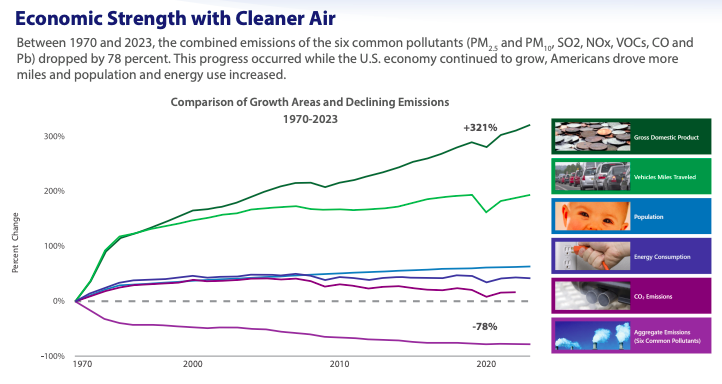
One factor in improving air quality has been the pollution-control technologies used by coal-fired power plants. Today’s coal-fired electricity generating plants produce more power with fewer emissions of criteria pollutants than ever before. According to the National Energy Technology Laboratory (NETL), a new pulverized coal plant (operating at lower, “subcritical” temperatures and pressures) reduces the emission of NOx by 83%, SO2 by 98%, and PM by 99.8%, as compared with a similar plant having no pollution controls. Air quality will continue to improve in the future due to improved technology.
Analysis
As history has shown, air quality standards improve with innovation even as economic output increases. The Biden administration’s approach would have hindered this improvement by forcing coal plants to close, raising electricity prices, and threatening the reliability of the grid. Instead of a top-down approach to controlling pollution, cooperative federalism, alongside common law protections against the harms of pollution, would be a better way forward. This strategy would give producers and states more flexibility in mitigating pollution while allowing for continued economic growth.
For inquiries, please contact wrampe@ierdc.org.

