

Key Takeaways
The conflict with Iran in the Middle East will affect energy prices, but the extent of price hikes will depend on its duration and outcome.
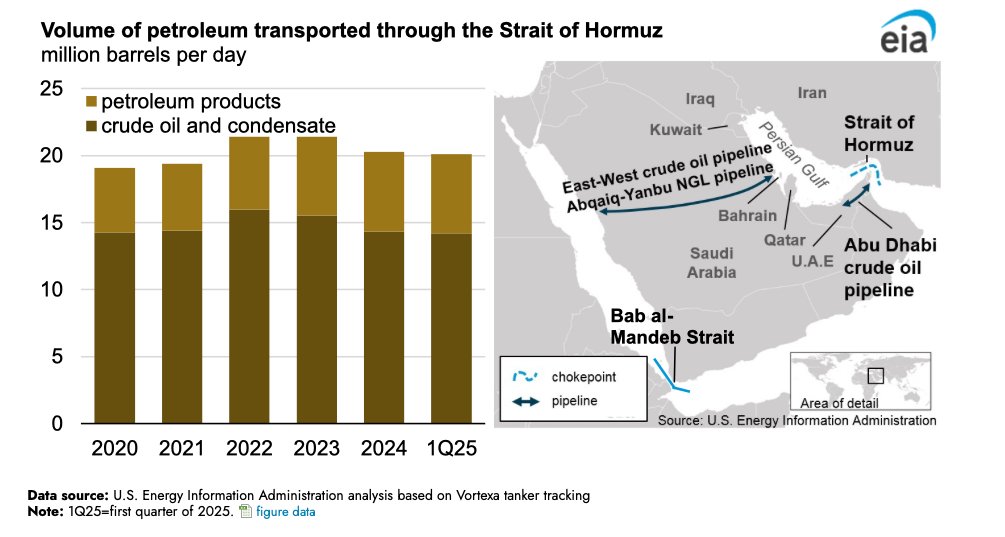
The most important chokepoint is the Strait of Hormuz, through which about 20% of the world’s supply typically transits.
Between two and four million barrels per day of the 20 million that normally flow through the Strait may find markets via underutilized pipeline capacity.
President Trump is offering “political risk insurance and guarantees” for energy tankers and other ships in the Gulf region, with the Navy escorting tankers through the Strait of Hormuz, if necessary.
The Trump administration is working through options to minimize price volatility. However, the Strategic Petroleum Reserve as a buffer has been undermined by the politicized release of large volumes during Biden’s Presidency.
China receives much more of its oil via the Middle East than does the United States, and it has been stocking its strategic reserves by buying sanctioned oil from Russia, Venezuela, and Iran.
Tuesday morning, Brent crude, the global benchmark, almost hit $85 at its peak. How high oil prices will go is dependent on the length of the war. While there is currently a surplus of oil in the system, mainly due to the shale oil renaissance in the United States and the resources of other non-OPEC producers, the surplus will not last under a prolonged siege. The Strait of Hormuz, through which 20% of global petroleum consumption flows (about 20 million barrels per day), is controlled by Iran and is effectively blocked. The turmoil has raised shipping rates as war risk premiums were added and war insurance coverage on ships was cancelled. While Middle East producers have other pipeline outlets that do not operate at full capacity, the closure of Hormuz will reduce supplies. A month-long closure could affect as many as 600 million barrels if the conflict lasts that long.
The Energy Information Administration (EIA) estimates that about 2.6 million barrels per day of capacity from the Saudi and UAE pipelines could be available to bypass the Strait of Hormuz in the event of a supply disruption. The International Energy Agency estimates that about 4.2 million barrels a day of regional pipeline capacity is available. That means between 16 million and 18 million barrels of oil per day could be disrupted if Iran were to completely close the Strait. OPEC+ agreed to increase production by an additional 206,000 barrels per day starting in April.
To deal with the risk premiums and insurance coverage issues, President Trump posted on Truth Social that the United States will offer, through the U.S. Development Finance Corporation, at a very reasonable price, “political risk insurance and guarantees” for energy tankers and other ships in the Gulf region, and that the Navy will escort tankers through the Strait of Hormuz if necessary.
According to Secretary of State Marco Rubio, the United States has planned for the possibility of higher oil prices, which would affect gasoline prices, even as President Trump has been working to reduce them. Energy Secretary Wright and Treasury Secretary Bessent are planning to announce plans to contain them that do not immediately include using the Strategic Petroleum Reserve (SPR), as President Biden did when the Russian invasion of Ukraine produced oil prices above $100 per barrel. While SPR can hold over 700 million barrels of oil, as of the end of last week, it contained 415.4 million barrels, as President Trump has been refilling it after the lows it reached under the Biden Presidency. The Biden Administration’s use of the SPR to reduce prices ahead of the 2022 midterm elections is limiting the United States’ options during actual supply disruptions. Other policies available include temporarily removing the federal gas tax of 18.4 cents per gallon and easing restrictions on Russia’s oil.
Iran’s Oil Production
Iran, the fourth-largest oil producer in OPEC, produced about 4 million barrels per day in 2023, accounting for about 4 percent of the world’s total oil production—less than its proven reserves due to underinvestment and international sanctions. Iran exports its oil largely to China, which imports 1.4 million barrels per day on “shadow ships”—tankers that conceal their activities to avoid sanctions.
Strait of Hormuz
Iran controls the Strait of Hormuz, connecting the Persian Gulf, the Gulf of Oman, and the Arabian Sea, where 20% of the world’s oil moves through on large oil tankers. Saudi Arabia accounted for 38% of total oil flows through the strait at 5.5 million barrels per day, leading all other countries. About 20% of the world’s LNG trade goes through the strait, most of which comes from Qatar (about 9.3 million cubic feet per day in 2024).
EIA estimates that in 2024, 84% of the crude oil and condensate and 83% of the liquefied natural gas that moved through the Strait of Hormuz went to Asian markets, with China, India, Japan, and South Korea as the top destinations, accounting for a combined 69% of the oil and condensate flows moving through the Strait in 2024. While China’s oil imports are largely affected by the conflict in the Middle East, it has been filling its reserve with lower-cost oil from Russia, Iran, and Venezuela, whose oil exports were all under sanctions. In 2025, 17% of China’s oil imports came from Iran and Venezuela. China now has a reserve holding 1.3 billion barrels of oil, which will somewhat buffer a supply shock.
Pipelines
Saudi Aramco’s East-West oil pipeline was temporarily expanded in 2019 from 5 million barrels per day to 7.0 million barrels per day by converting some natural gas liquids pipelines to accept crude oil. The UAE operates a 1.8 million-barrel-per-day pipeline that bypasses the Strait.
Source: https://www.eia.gov/todayinenergy/detail.php?id=65504
Iran’s Attacks
Iran is not only attacking military bases but also energy facilities in the Middle East. An Iranian drone hit a storage facility at Saudi Arabia’s biggest oil refinery (550,000 barrels per day), which halted operations as a precautionary measure. QatarEnergy is halting all LNG production following a drone strike at its Ras Laffan facility. Israeli gas production is shut-in. If Iran were to hit export terminals that are difficult to repair and are within striking distance of its weapons systems, the energy situation could become problematic, especially if it affected spare capacity in Saudi Arabia and the United Arab Emirates.
Analysis
It is unclear how long the conflict will last, but President Trump has said it will take weeks, and possibly longer, to accomplish the objectives. Currently, there is sufficient spare capacity in the system to keep prices within an additional $5 to $10 per barrel. A lasting conflict could, however, result in higher prices, particularly if Iran attacks energy facilities in the Middle East, where most of the spare oil capacity exists.
The Strait of Hormuz, where 20% of oil transits, is essentially closed due to high-risk premiums added to shipping rates and the cancellation of war insurance. There are a few pipelines that bypass the Strait—the East-West and the Abu Dhabi oil pipelines —but the additional capacity they can provide is between 2.6 and 4.2 million barrels per day, which does not cover the 20 million barrels per day flowing through the Strait of Hormuz. President Trump is offering “political risk insurance and guarantees” for energy tankers and other ships in the Gulf region, with the Navy escorting tankers through the Strait of Hormuz, if necessary. Energy Secretary Wright and Treasury Secretary Bessent will be laying out a mitigation strategy that could include the temporary removal of the federal gas tax and easing sanctions on Russian oil.
For inquiries, please contact astevens@ierdc.org.

