

Key Takeaways
The North American Electric Reliability Council (NERC) released its long-term assessment and projects a grim outlook based on current utility plans that are focused on retiring firm capacity and adding weather-dependent renewable capacity.
Huge projected demand increases, combined with the increasing reliance on variable generation inherent in wind and solar, promise challenges for the grid and consumers.
Over the past year, fossil fuel capacity dropped by 21 gigawatts, while wind and solar capacity, along with expensive storage batteries, increased by 23 gigawatts.
NERC identifies five areas at high reliability risk across a wide region of the United States in its ten-year assessment.
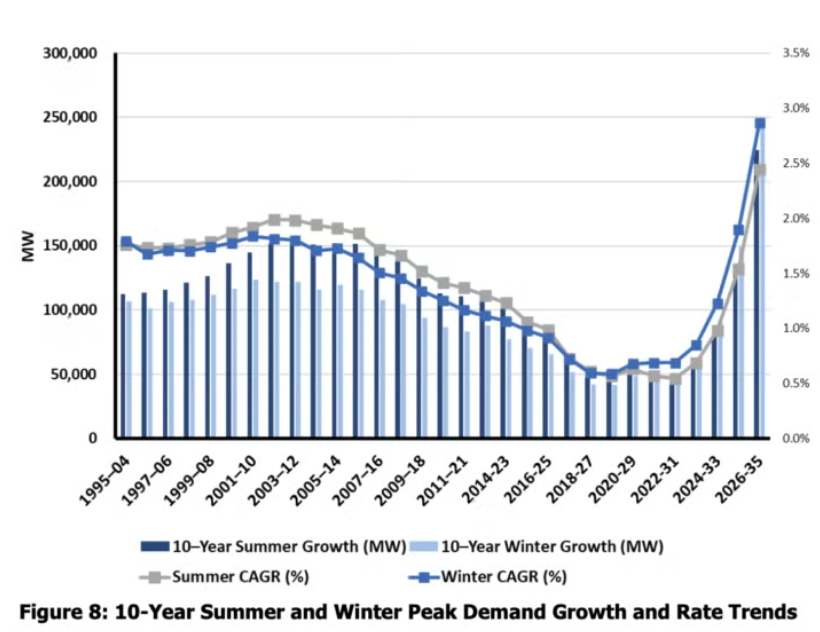
The North American Electric Reliability Corporation released its Long-Term Reliability Assessment in late January and projects a grim outlook, worse than its previous assessment. Its 10-year outlook for 2026 to 2035, based on industry projections compiled in mid-2025, indicates that summer peak demand could increase by 224 gigawatts — almost 70% more than the 132 gigawatts projected in last year’s assessment. Winter demand could increase by 245 gigawatts, about a 65% increase from last year’s 149-gigawatt projection.
Because supply growth is not keeping up with demand, NERC cautions that by 2030, at least five regions could face “high risk” — the Midcontinent Independent System Operator (MISO), PJM Interconnection (PJM), the Electric Reliability Council of Texas (ERCOT), and the Western Electricity Coordinating Council’s (WECC’s) Basin and Northwest subregions. There are three areas of risk: normal, elevated, and high. High-risk areas are either falling short of a reserve margin target or exceeding the criteria for unserved energy and load loss. High-risk areas are denoted in red below.
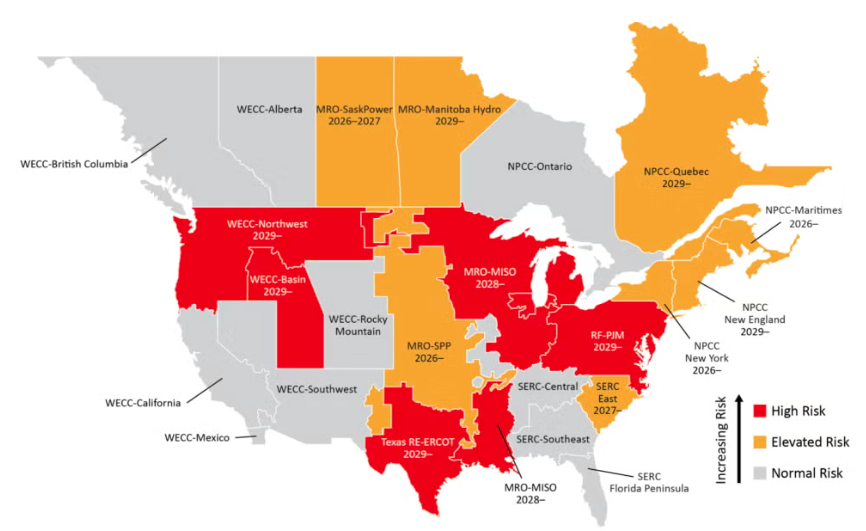
The orange areas are elevated-risk areas — areas that meet their adequacy targets and generally meet the load-loss criteria, but NERC’s studies show that some unserved energy and load loss begin to emerge, particularly under extreme conditions such as extreme cold or above-normal temperatures. The gray areas are normal risk areas that meet their resource adequacy targets, and NERC’s analysis generally indicates little or no unserved energy or load loss, even under a variety of conditions. NERC notes that many vulnerable regions move into elevated- or high-risk status later in the decade as demand rises and planned generation fails to keep pace.
The high-risk regions contend with steep load growth that consistently outpaces planned resource additions, particularly as fossil fuel retirements increase and solar additions introduce variability that requires back-up power. The Department of Energy (DOE) used emergency powers to keep coal plants that were heavily used during Winter Storm Fern online, but many blue states still want them gone. Two utilities in Colorado are suing the Energy Department because they want to retire their coal plant in favor of a solar plant that needs the same transmission lines, calling the DOE’s emergency action unconstitutional.
Many states, mostly blue states, are shifting the mix of generating technologies to weather-dependent technologies. Over the past year alone, fossil capacity dropped by 21 gigawatts, while wind and solar capacity, along with expensive storage batteries, increased by 23 gigawatts, according to NERC. The share of variable energy resources during peak hours grew from 9.5% to 10.2%. NERC notes that solar PV and batteries account for two-thirds of the capacity under development. It warns that while they provide good capacity to meet summer peak demand, they are vulnerable in winter. Solar cannot provide power during winter peak, and four-hour batteries cannot charge enough to cover a dark spell.
While intermittent solar and wind are the capacity additions of choice for much of the high-risk areas, they often require additional transmission lines to deliver their output to demand centers, as wind and solar generating units need to be located where wind and sun are strongest. Transmission development is accelerating, but is not keeping pace with demand. While a record 41,000 miles of new transmission projects above 100 kV are under construction or in planning stages for the next decade, only a fraction have begun construction, and nearly 400 of the roughly 900 identified projects have already been delayed from their originally expected in-service dates. Permitting issues, supply chain constraints, and planning challenges continue to hinder transmission development.
Many blue states have a renewable portfolio standard (RPS) that requires a specified amount of generation from renewable technologies, which is mostly wind and solar projects. Texas, a red state that has an RPS, exceeded its 2025 goal in 2009. The state has more wind capacity than any other state, often generating a bulk of its energy from wind. This capacity led to massive problems during Winter Storm Uri in 2021, with blackouts lasting days, but the state avoided similar issues during Winter Storm Fern. However, NERC has designated it as a high-risk area. In the five years since Winter Storm Uri, the ERCOT region has added mostly intermittent power: 31 gigawatts of solar, nine gigawatts of wind, and only three gigawatts of natural gas. Texas has less gas, coal, and nuclear capacity than it did 10 years ago, while peak winter demand has grown by over 30%. It is a state that is attracting artificial intelligence data centers because of its currently low electricity prices relative to many other states.
Despite wind and solar capacity accounting for nearly 30% of nameplate capacity across the United States, on January 25, during Fern, they provided only 10% of actual generation. In the Northeast, where natural gas pipelines are having trouble getting built, oil generated 40% of the region’s electricity. Coal performed well during Fern in states that had not already retired them.
Analysis
Utilities need to heed NERC’s warning and change course, keeping firm, baseload capacity online and adding more firm capacity, or the future landscape for electricity in the United States could be very dire. Moreover, state legislators may need to revisit existing laws against the backdrop of NERC’s increasingly strident warnings as well as the experience of other countries that are pushing intermittent renewable energy, including the European Union. Similar policies in Europe have led to rapidly escalating electricity prices and whole industries abandoning the continent for other venues.
For inquiries, please contact wrampe@ierdc.org.

