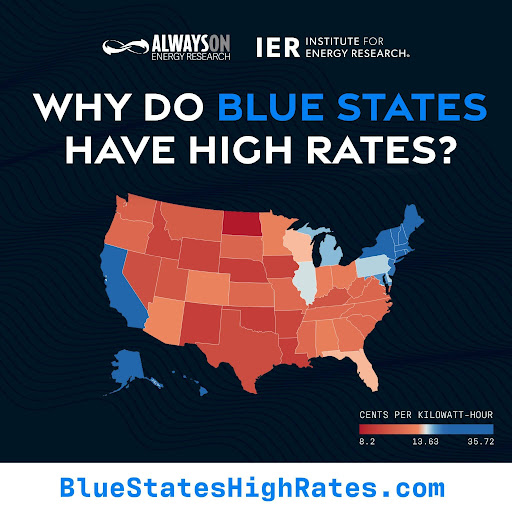
During the July 6, 2026 episode of The Glenn Beck Program, Glenn Beck used a segment of the show to highlight the findings of Blue States, High Rates, a report produced by Always On Energy Research and the Institute for Energy Research. IER and Always On Energy Research have released a new website, BlueStatesHighRates.com. The website contains profiles showcasing what’s driving electricity prices in individual states which users can explore.
Why Do Blue States Have High Rates?
Energy affordability has become a top concern for American families and businesses. A recent poll conducted by Ipsos found that 73% of U.S. residents were concerned about their electricity and gas bills rising this year, and 80% of Americans admitted they feel powerless over how much they are charged for these utilities.
These affordability concerns are well-founded. Federal data show U.S. electricity prices increased by 27% from January 2021 through January 2025 and by an additional 11% from January through September 2025, placing additional strain on Americans’ finances.
Electricity prices are especially high in traditionally liberal areas of the country. In total, 86% of states with electricity prices above the national average in the continental U.S. are reliably blue, having voted for the Democratic nominee for president in the 2020 and 2024 elections. In contrast, 80% of the 10 states with the lowest electricity prices are reliably red, defined as having voted for the Republican candidate in these contests.
These price discrepancies exist because, more than almost any other product, electricity prices are a direct result of state energy policies, because states have exclusive authority to determine which resources supply their grids under the Federal Power Act (FPA).
These powers allow states to determine their generation portfolios, site and permit power generation facilities outside nuclear and hydroelectric plants, regulate retail prices, and exercise authority over resource adequacy and reliability, meaning states are charged with ensuring that utilities, and electric cooperatives, often referred to as load serving entities (LSEs), maintain adequate power plant capacity to keep the lights on.
This report highlights six key criteria that impact electricity prices for families and businesses, including:
- Renewable portfolio/carbon-free electricity mandates,
- Net-metering programs,
- Carbon prices or participation in cap-and-trade programs,
- Whether the state has adopted data center consumer protections,
- Natural gas access,
- And whether utilities are pursuing their own net-zero goals independent of legislative mandates.
Learn more by visiting BlueStatesHighRates.com.