

Key Takeaways
New York Governor Hochul imposed the first state moratorium on data center construction, which will supposedly last up to a year while standards are developed for their construction and their environmental impact is assessed.
New York lags far behind Virginia and Texas in data centers, as it has higher electricity rates.
Evidence is accumulating that China is directly fueling public opposition to AI as part of a race for number-one status.
Although some argue electricity prices are increasing because of data centers, other studies show just the opposite, pointing instead to state policies on energy and climate.
Studies also show that states with growing electricity demand saw smaller increases in electricity rates.
The Trump administration is working to resolve electricity issues by cooperating with states and companies and by increasing supplies both on- and off-grid.
On July 14, New York Governor Kathy Hochul issued the nation’s first statewide moratorium on large data centers, those of 50 megawatts or more, imposing up to a one-year moratorium over concerns that the data facilities are raising power costs, straining water supplies and burdening local communities. Hochul also plans to pursue legislation to repeal sales tax exemptions for large data centers. During the moratorium, the state’s Department of Environmental Conservation will not issue any discretionary permits that are not already complete. In her executive order, Hochul directed state officials to develop a Generic Environmental Impact Statement to ensure that new data centers coming online are held to “consistent standards” and to examine the potential environmental impacts of the construction and operation of data centers in the state. The ban in New York will reportedly be lifted once the state finalizes the standards.
Last month, New York’s legislature passed a bill to impose guardrails on data centers that consume more than 20 megawatts of power, a wider scope than Hochul’s executive order, but the bill has not yet been sent to Hochul’s desk for signing. With these actions, New York is sending a message about its concern for the jobs, tax revenues, and economic development that data center construction brings, which other states are benefiting from, with much more data center development than New York has. It is also reminiscent of N.Y.’s ban on hydraulic fracturing, even though the Marcellus natural gas play that has lifted incomes and the quality of life in Pennsylvania continues next door to New York.
New York has the eighth-highest retail price for residential electricity in the country, which did not deter the Governor from advocating for electric vehicles and even pushing for their mandatory adoption. While the state’s expensive land, tight power supplies, and high electric rates have largely limited data center interest compared to states such as Texas and Ohio, there is interest from server warehouses in the state. New York currently has more than 130 data centers, according to Data Center Map, compared with more than 600 in Virginia and about 500 in Texas.
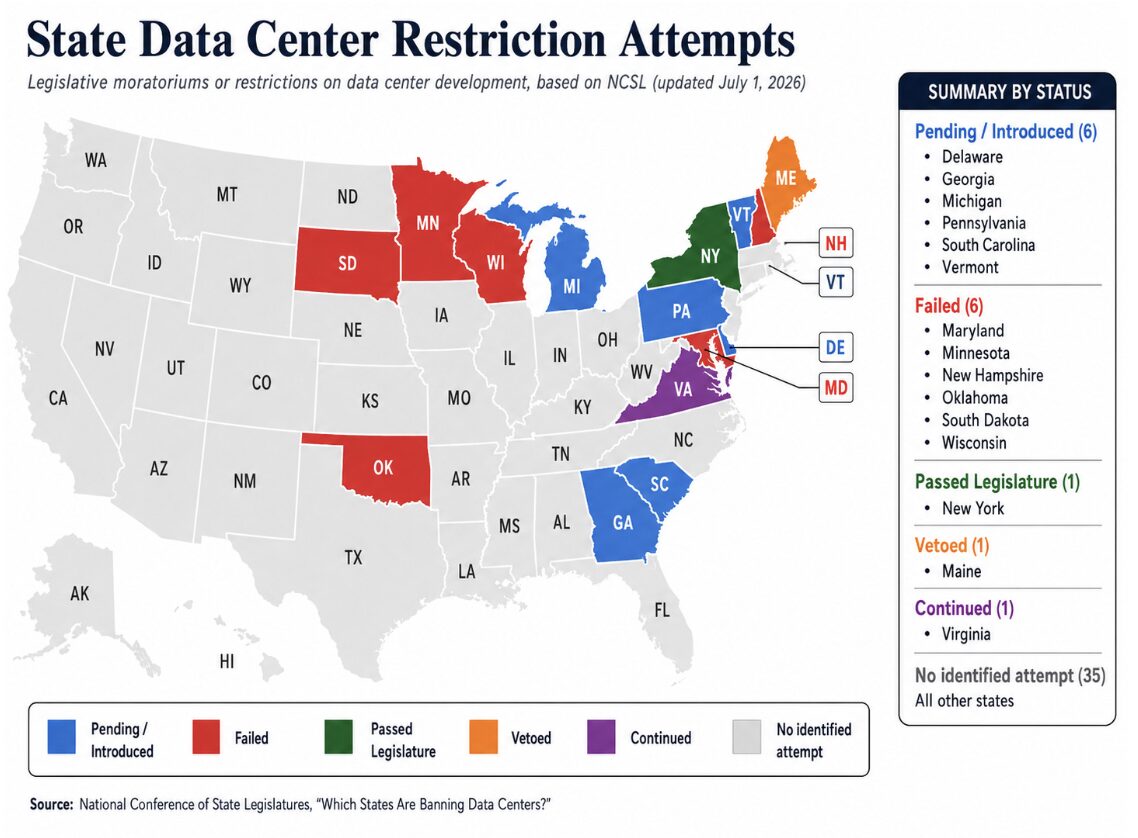
While New York is the only state currently with a moratorium on data centers, 14 states have considered bans, of which 13 failed, as depicted in the map below. Many more states are considering tax and energy cost measures, and more than 100 local moratoriums have passed.
Most of the restrictions, prohibitions, and regulations on data centers have come in the East Coast blue and purple states, but opposition is now rising in red states. Texas Governor Greg Abbott called for blocking new data center development in rural parts of the state during a campaign stop recently in East Texas.
Pennsylvania Governor Josh Shapiro recently signed a budget that will require data centers to report their exact water and power usage to the state annually. Data centers will be required to compile an annual report containing information such as their “estimated average amount of energy usage per hour during the data center’s peak load.” The budget provision also requires data centers to submit total energy consumption for the previous calendar year, an estimate of the projected total energy demand for the following year, and “any measures undertaken to generate electricity on site or off site to reduce carbon emissions or impacts on the electric grid, including the specific energy source, and any potential future measures to generate electricity or other form of energy on site or off site.” Data centers that do not comply with the new reporting requirements are to be fined $10,000 per day until their report is submitted. Pennsylvania is also requiring the PJM Interconnection to give state regulators additional information regarding the grid operator’s demand forecasting methodology.
Competition with China
The United States is in a race with China over AI and data centers to support its advancement, a race that is well underway. The stakes are high because the winner would gain the spoils of advanced medicine, technologies, industrial breakthroughs, and even energy game-changers, such as nuclear fusion, which would bear on economic and national security and defense. But polls show that public sentiment in the United States is generally against data center construction due to rising electricity rates and water usage. President Trump is trying to alleviate those fears by convening utility companies and data center developers to make a voluntary pledge to ensure that rapid growth in electricity demand from artificial intelligence does not increase power bills for households and businesses. Companies such as OpenAI have published accounts of PRC-backed attacks on AI expansion in the United States, with electricity rate hikes as a central focus of discussion.
Earlier this year, a number of data center developers (Amazon, Google, Meta, Microsoft, OpenAI, Oracle and xAI) signed a voluntary “Ratepayer Protection Pledge,” committing to finance the electricity infrastructure needed for their AI projects. The companies agreed to help pay for new power generation, grid upgrades, and other costs related to their data centers, including unused reserved capacity. Now President Trump wants to convene electric utilities, companies that build and operate data centers, and governors of states leading the expansion of the power infrastructure needed to accommodate the increase in electricity demand to make a similar pledge.
Controversy over Electricity Price Increases
A recent Reuters article implies that Big Tech data centers are driving up power bills at America’s Rust Belt factories. Capacity prices are up more than 1,000% in the last two years in the 13-state region covered by grid operator PJM Interconnection due to stagnant supply and demand from data centers. Capacity charges compensate power generators for ensuring the grid has enough electricity for peak usage and to spur development of new supply. They generally account for about 10% of residential bills but can represent up to three times that for manufacturers.
However, recent reports from Columbia University’s Center on Global Energy Policy and the Electric Power Research Institute (EPRI) indicate that data centers are not the primary drivers of rising electricity rates, with data center growth correlating with lower retail electricity rates due to economies of scale and cheaper infrastructure. They do, however, indicate that challenges such as supply chain constraints and the potential for an AI bubble could alter this result. And IER’s own study shows that the 10 states with the most data centers, including Virginia, Texas, California, Illinois, and Ohio, averaged 14.46 cents per kilowatt-hour in 2025 while all other states averaged 14.39 cents, and that states that have growing electricity demand saw lower increases in electricity rates.
Conclusion
New York Governor Hochul imposed the first state moratorium on data center construction, which is to last up to a year while standards are developed for their construction and their environmental impact is assessed. New York has far fewer data centers than Virginia and Texas, which lead all states in their construction and operation. The United States is in a race with China in AI, and data centers are needed. So as not to lose the race, President Trump is convening electric utilities, companies that build and operate data centers, and governors of states leading the expansion of the power infrastructure to make a voluntary pledge to ensure that rapid growth in electricity demand from artificial intelligence does not increase power bills for households and businesses. There is much controversy over the role of data centers in electricity price increases. IER has shown that they are not correlated, and other studies indicate similar results.
For media inquiries, please contact press@ierdc.org.

