

Key Takeaways
Oil prices are over $100 a barrel because strikes on oil tankers in the Gulf have disrupted supply, but flows are near or above pre-conflict levels as the U.S. Navy shuttles oil through the Strait of Hormuz along the Oman side.
The United States continues sanctions against Iran, with new measures targeting most of the remaining tankers in Iran’s so-called shadow fleet, following sanctions imposed on its rail and automotive industries on October 1.
Saudi Arabia’s East-West Pipeline has been partially restored, and Saudi-backed militias in Yemen have taken back some of the ports in the Red Sea from the Houthis, helping ships to move through the Bab al-Mandab Strait.
Alternate routes to the Strait of Hormuz are being expanded or are being planned to be available in 2027 and 2028.
President Trump said he does not intend to strike Iran prior to the November 3 elections because talks with Iran are so far from productive.
Brent crude oil, the international benchmark, traded around $103 on October 9 after oil tankers were struck near Qatar and the United Arab Emirates. In Saudi Arabia, Iranian-backed Houthi rebels in Yemen are claiming credit for deadly attacks on Riyadh’s airport, which caused flights to be canceled. Despite the U.S. military designing attack plans, President Trump says he does not plan to attack Iran again before the mid-term elections on November 3 due to what he says are productive talks continuing. Instead, the U.S. Navy is using its shuttle service to secure oil through the Strait of Hormuz, with oil flows now near or above pre-conflict levels, and the U.S. Treasury is continuing with sanctions, crippling the Iranian economy. Most recently, the United States imposed sanctions targeting most of the remaining tankers in Iran’s so-called shadow fleet. This fleet is a covert network of aging oil tankers, shell companies, and fraudulent maritime operations used by the Islamic Republic to illegally export crude oil, petroleum, and petrochemicals in defiance of sanctions.
The Treasury Department designated 17 shadow fleet ships responsible for transporting Iranian oil, petroleum, and petrochemical products to markets in South Asia and East Asia. The Treasury sanctioned 17 vessels, including tankers registered in the Bahamas, Cameroon, Comoros, Gambia, Hong Kong, Mongolia, Palau, Panama, San Marino, Sierra Leone, Vanuatu, and Zanzibar. According to the Treasury, a network of international front companies operated the sanctioned vessels, demonstrating the global scale of Iran’s illegal shipping and sanctions-evasion efforts. In addition to the sanctioned vessels, the Treasury designated 18 associated companies for operating in Iran’s petroleum and petrochemical sectors. Under the sanctions, any entities owned 50% or more by blocked persons will also be blocked.
In addition, the State Department announced sanctions on 10 entities based in Turkey, the United Arab Emirates, India, Iran, and the United Kingdom; six individuals; and five vessels linked to the trade of Iranian petroleum, petroleum products, and petrochemical products. The individuals were linked to some of the sanctioned companies. These sanctions add to other recent sanctions. On October 1, the United States imposed sanctions against Iran’s automotive and rail industries, following previously announced sanctions against individuals and entities operating in Iran’s shipping, aviation, technology, gold, and digital asset sectors.
The U.S. military has continued to enforce a blockade of Iranian ports. As of October 5, U.S. forces had redirected 130 ships to ensure compliance with the naval blockade of Iranian ports. U.S. forces have supported the shipment of more than 1.25 billion barrels of crude oil from Gulf partners through the Strait of Hormuz. The U.S. Central Command (CENTCOM) said Iran has had zero oil exports shipped due to its “ironclad blockade.” The U.S. blockade has deprived Iran of foreign-currency earnings and compounded an economic crisis.
Gulf producers have increasingly relied on the U.S.-protected tanker movements, ship-to-ship transfers outside Hormuz and pipelines that bypass the strait. Saudi Arabia has resumed exports from both its Gulf and Red Sea coasts after repairing part of the damage to its East-West Pipeline after a September attack. The alternative routes have helped keep regional oil exports near, and at times above, prewar levels. Iranian officials have warned that they intend to challenge these shipping arrangements, including by closing routes near Oman’s coast.
The internationally recognized government of Yemen, backed by Saudi warplanes, began a counteroffensive this week to retake territory along the Red Sea that the Houthis recently captured. The militia seized parts of the coast in September that gave it greater control over the Bab al-Mandab Strait, a critical global trade route that the Saudis use to transport oil from the Red Sea. While President Trump has not directly aided Saudi Arabia in its fight against the Houthis, U.S. intelligence and military analysts are assisting the Saudi government in command centers, helping to analyze and select targets in support of Yemeni allies. The United States is also providing aerial refueling for Saudi warplanes conducting defensive air patrols. Britain and France also indicated that they would help with aerial refueling and military assets.
Middle Eastern oil producers are either expanding or planning alternative pipelines and shipping corridors to bypass the Strait of Hormuz. At least seven major pipeline and infrastructure projects are under construction or active development, projected to add nearly 4 million barrels per day of export capacity by late 2027 and over 7 million barrels per day by late 2028.
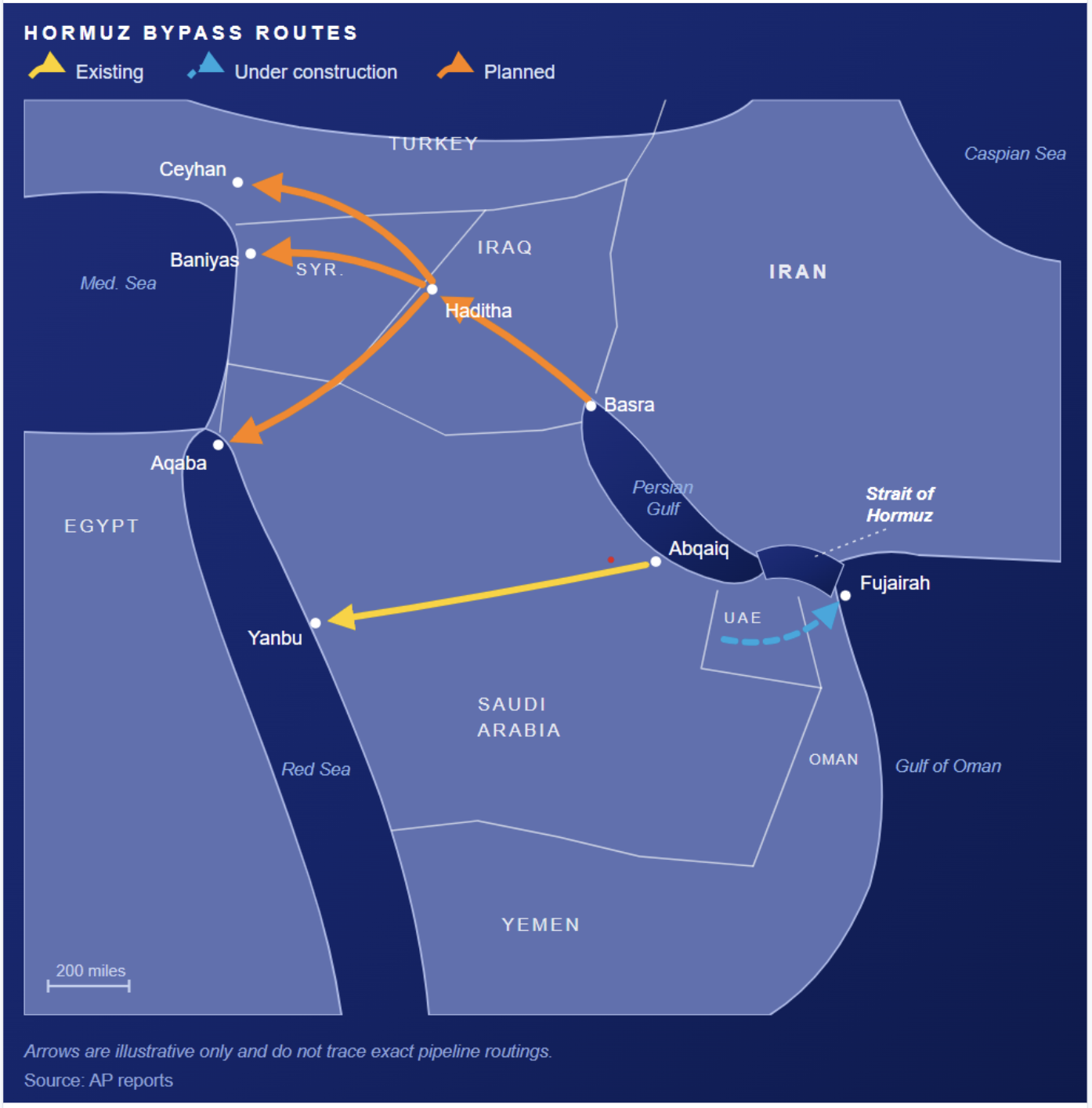
Saudi Arabia’s East-West Pipeline from Abqaiq to the Red Sea port of Yanbu can move up to 5 million to 7 million barrels per day, serving as the largest active bypass route. It has been partially repaired after being hit by strikes coming from Iraq by Iran-backed militia. The United Arab Emirates’ pipeline runs from the Habshan fields to the Gulf of Oman port of Fujairah, bypassing the strait with a capacity of roughly 1.5 to 1.8 million barrels per day and the UAE is actively constructing parallel expansion lines to push capacity past 3 million barrels per day.
Iraq’s main northern export route runs from Kirkuk to Turkey’s Mediterranean port of Ceyhan via the Kurdistan region. The pipeline restarted last September after a 2-1/2-year shutdown following an interim deal between Baghdad and the Kurdistan Regional Government. On March 17, Iraq began pumping 170,000 barrels per day, with plans to reach 250,000 barrels per day, after Iraq’s national oil company signed export contracts via Turkey, Jordan and Syria. Others are in conceptual planning stages to ports in the Mediterranean Sea and the Red Sea.
The United States has proposed a $5 billion funding framework to help rebuild Middle East energy infrastructure and construct alternative pipelines that bypass the Strait of Hormuz.
Conclusion
Oil prices are over $100 a barrel due to strikes on oil tankers in the Gulf. Despite that, oil flows are near or above pre-conflict levels as the U.S. Navy shuttles oil through the Strait of Hormuz along the Oman side of the strait. The United States continues its sanctions against Iran with new sanctions targeting most of the remaining tankers in Iran’s so-called shadow fleet, following sanctions on its rail and automotive industries imposed on October 1. Saudi Arabia’s East-West Pipeline has been partially restored, and Saudi-backed militias in Yemen have taken back some of the ports in the Red Sea from the Houthis, helping ships to move through the Bab al-Mandab Strait. Alternate routes to the Strait of Hormuz are being expanded or are in the planning stages for availability in 2027 and 2028.

