

Key Takeaways
California’s unique gasoline blend places it on an “energy island,” and its refinery closures due to onerous state policies could result in even higher petroleum prices and fuel shortages.
Phillips 66 and Kinder Morgan have proposed a 1,300-mile pipeline that will carry petroleum products from Illinois to California and adjacent markets.
The proposed Western Gateway pipeline project combines new and existing infrastructure to address growing petroleum demand and future supply constraints from California’s policies and refinery closures.
It is an example of how the industry can collaborate to strengthen energy reliability, meet growing demand across the West, and set the foundation for future growth.
California’s gasoline prices are the highest in the nation — about $1.50 above the national average — due to its unique blend required by the state, numerous state taxes and policies, and refinery closures. California’s unique gasoline blend, known as CARBOB, places it on an “energy island,” and the state’s gas taxes are more per gallon than refineries make on producing gasoline. To help with some of these issues, a pipeline is being proposed to carry gasoline and other petroleum products from Illinois to California, much like the Colonial Pipeline provides petroleum products from Gulf Coast refineries to the Northeast. It will be capable of delivering gasoline, as well as important distillate products.
As explained by the California Globe, because CARBOB specifications differ from those used elsewhere, many refineries across the United States and abroad do not make it, which removes competition and leaves California dependent on in-state refineries and specialty imports. Those in-state refineries are slowly closing due to onerous state regulations and policies. One of the 13 remaining refineries will close by the end of the year, and another next year, removing 17% of the state’s capacity, adding to the 350,000 barrel-per-day capacity the state already lost since 2015, via the California Globe. Since California is not connected to the major refining hubs east of the Rockies, any shortage needs to be supplied by expensive tankers to bring in specialty barrels at high prices that meet California’s unique standards.
The proposed Western Gateway Pipeline, which would be the world’s largest fuel conduit, would not only transport gasoline, but also jet fuel and diesel. According to Bloomberg, the pipeline network would cross from Illinois through Oklahoma, Texas, New Mexico, Arizona, and Nevada to California and adjacent markets, with connectivity to Las Vegas, Nevada. Much of the pipeline would be built along or utilize existing Kinder Morgan conduits, with a new section across New Mexico. The section of the pipeline that would cross near Mescalero Apache land in New Mexico has received buy-in from local tribes, but past endeavors at building pipelines have often been caught up in lawsuits and protests.
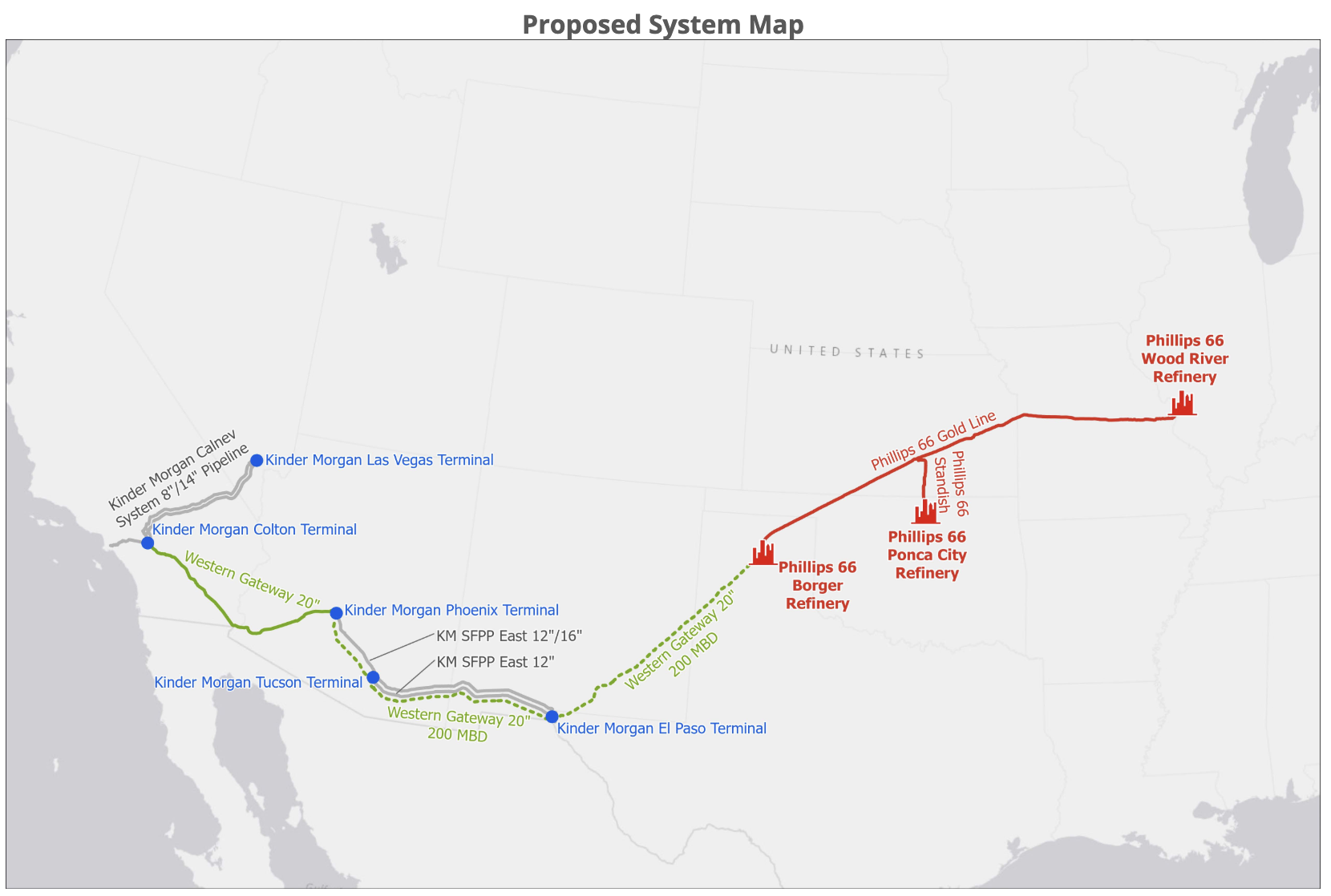
The pipeline is a joint venture between Phillips 66 and Kinder Morgan Inc. According to the El Paso Times, Phillips 66 will lead construction of the new pipeline, and Kinder Morgan will have primary operating responsibility, which is expected to be completed by 2029, pending the receipt of all permits and regulatory approvals. A binding open season to determine contracts for the Western Gateway Pipeline ends on December 19, at which point Phillips 66 and Kinder Morgan will evaluate the results to determine how big the pipeline would be.
Via Kinder Morgan, the project would combine a new-build pipeline from Borger, Texas, to Phoenix, Arizona, with a reversal of Kinder Morgan’s existing Santa Fe Pacific Products. The West Line (which currently flows from Colton, California, to Phoenix) will enable east-to-west flows into California. The plans also include the Phillips 66 Gold Pipeline, which currently flows from Borger to St. Louis, to also be reversed to move gasoline, diesel, and jet fuel from the Midcontinent toward Borger and into the Western Gateway system. The Western Gateway Pipeline is designed to be approximately 1,300 miles long.
The Arizona Republic reports that, besides helping California, the Western Gateway Pipeline will fill a gap in Arizona, as the state has no oil refineries of its own, and much of the state relies on gasoline imported from California, which makes the state vulnerable to outages as refineries there are shutting down. Earlier this year, wildfires in California caused widespread power outages, shutting down two pipelines that send fuel east. The Western Gateway pipeline is expected to deliver up to 200,000 barrels of gas a day to Arizona, nearly double the amount Phoenix gets from an existing pipeline. Kinder Morgan has been operating in the state and across the West Coast for decades and owns several pipelines in Arizona. The West Line runs from California to Phoenix, and the East Line runs from Texas to Phoenix.
Analysis
Due to onerous regulations and specific, unique blend requirements, California has become an energy island. With major refineries leaving the state by the end of this year and next year, the state is at risk of losing a substantial portion of its refining capacity and, therefore, its supply of gasoline, jet fuel, and diesel. The proposed pipeline is necessary to carry gasoline and other petroleum products to California.
For inquiries, please contact [email protected].

