

Diesel prices are high because two of the world’s three largest oil producers (Russia and Saudi Arabia) and three of the world’s eight largest oil refiners (Russia, Saudi Arabia, and Iran) are impacted by war. Oil and diesel exports from all these countries are down, creating a global diesel shortfall.
The Shock: Two Wars Took Diesel off the World Market
Why is the price of diesel higher than it “should be” given the price of oil? Oil prices are high, but diesel prices are sky-high. The difference between the price of diesel and the price of the crude oil it is made from, known as the crack spread, was $107.90 a barrel in New York Harbor the week of September 11, up from $36.12 a year earlier. This has everything to do with lost refining capacity. The wars have knocked out refineries and blocked the routes diesel travels.
According to the International Energy Agency (IEA), net diesel exports from Russia and the Persian Gulf in August were 1.6 million barrels a day lower than in February. In February, those two regions accounted for almost 45 percent of the diesel traded by sea.
Russia
- Ukraine hit a Russian refinery once every three days, on average, during the first eight months of 2026, according to the IEA.
- Half of Russia’s six largest diesel refineries cut or halted production in September after drone strikes (Reuters, via Kyiv Post).
- Russia’s diesel exports fell below 1 million metric tons in June, against about 2.5 million tons a month a year earlier (Reuters, via OilPrice).
- On July 9, Russia banned diesel exports.
The Gulf
- Refineries in Saudi Arabia, Kuwait, the United Arab Emirates and Bahrain have been hit, including Ras Tanura, Saudi Arabia’s largest, and the 460,000-barrel-a-day SATORP refinery (Bloomberg, via gCaptain).
- The consultancy IIR estimated that the war had shut 1.9 million barrels a day of Gulf refining capacity by early March and as much as 3.52 million barrels a day by May 7. Those figures measure how much crude oil the idled refineries could process, not how much diesel was lost.
- Net diesel exports from the Gulf averaged 390,000 barrels a day in August, just over a quarter of pre-war levels (IEA).
- Saudi crude oil production fell to 6 million barrels a day in August, its lowest in more than three decades (IEA, via Reuters).
The crude oil lost from both regions matters for diesel in particular. As FreightWaves put it, Middle East and Russian crudes “are heavier and tend to produce more diesel than, for example, a crude produced out of West Africa or from the Permian Basin in the U.S.”
But Why do These Wars Affect Diesel Prices in the United States, Especially Prices in the Midwest?
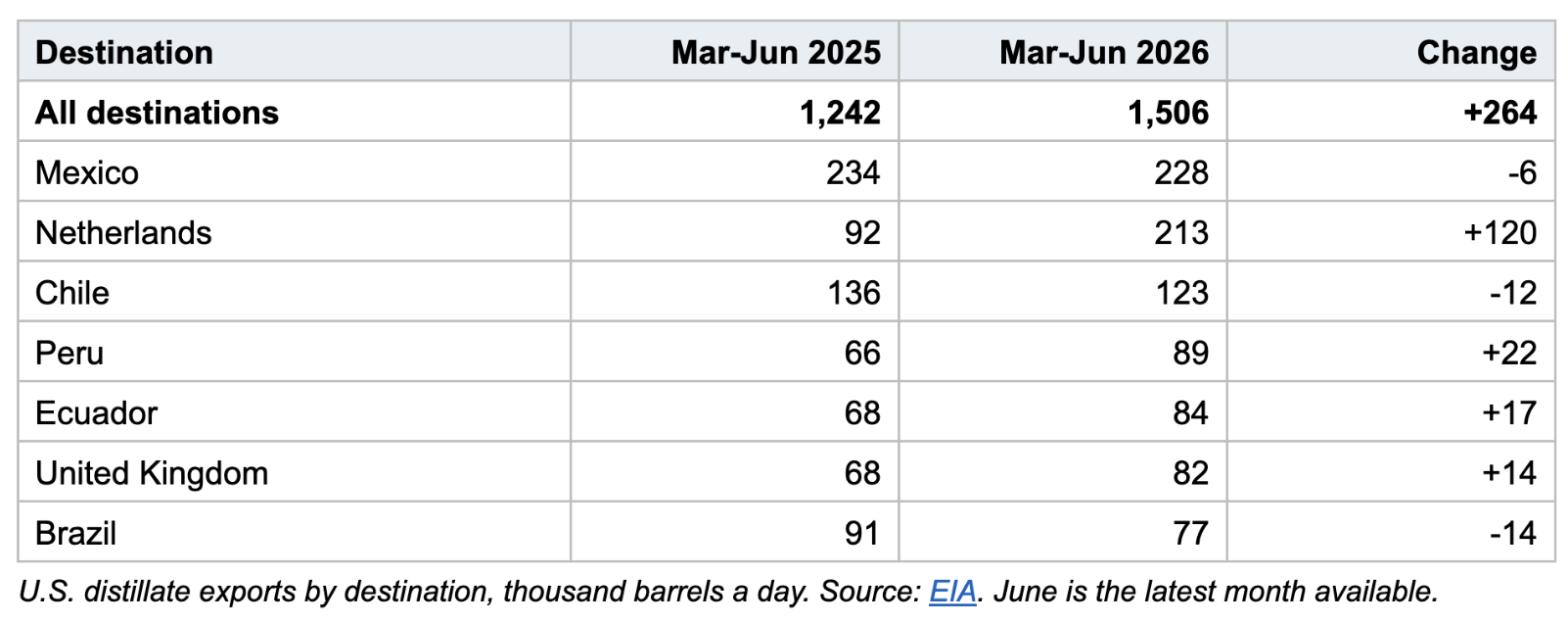
A similar question is: if the United States is the world’s largest producer of oil and we are currently a petroleum exporter, why are we seeing these high prices, especially high diesel prices? The answer is that oil markets are global. The diesel market is global, and with the loss of a substantial amount of diesel from Russia and the Middle East, global diesel prices are very high. As a result, the United States has exported diesel to other countries such as Mexico, the Netherlands, Chile, Peru, and the United Kingdom.
From March through June, the latest months with data by destination, U.S. distillate exports averaged 1.5 million barrels a day, up 21 percent from the same months in 2025. Most U.S. diesel exports go to Latin America, and those shipments held roughly steady. The growth went to Europe. Exports to the Netherlands, home to the Rotterdam trading hub, more than doubled, from 92,000 to 213,000 barrels a day.
In recent weeks, the Midwest has been hit hardest. In the six months before the Iran war, Midwest diesel ran a few cents below the national average. On September 21, it was $6.68 a gallon, 15 cents above the national average, after rising $1.11 in three weeks (EIA). The jump followed the September 13 outage at Exxon Mobil’s 275,000-barrel-a-day refinery in Joliet, Illinois, a key Midwest supplier.
But Why Now? Why are These Wars Increasing Prices Now and Not a Few Months Ago?
The blunt answer is that the world is running out of excess capacity and shock absorbers in the oil system.
Diesel prices jumped when the Iran war began, from $3.90 a gallon on March 2 to $5.64 on April 6, then eased to $4.58 by July 6 (EIA). Since then, they have climbed nearly $2. Several shocks hit a market that was already getting low on slack in the system:
- Russia banned diesel exports in July,
- The Houthis declared a blockade of Saudi shipping in the Red Sea, and struck a Saudi tanker off Yanbu in August
- Saudi crude output fell to a three-decade low
- The Joliet refinery went down in September
The Shock Absorbers are Worn Down:
- U.S. diesel stocks. Distillate stocks were 107.4 million barrels in the week of September 18, 12 percent below the 2021–2025 average and the lowest for this time of year in EIA records going back to 1982.
- The summer build never happened. Stocks normally rise about 6.8 million barrels from late June to mid-September. This year they fell 0.7 million barrels, because exports averaged 1.7 million barrels a day over those weeks, against 1.3 million normally, the most for that stretch since EIA’s weekly export data began in 2010. That is about 29 million extra barrels shipped abroad.
- U.S. refineries. Refineries ran at 95 percent of capacity or more for 15 straight weeks through September 11, the longest run since 1998. Little idle capacity remains to bring online.
- Europe’s stocks. Diesel stocks at the Amsterdam-Rotterdam-Antwerp hub fell in August to their lowest point in over four years. Middle distillate stocks in 16 European countries hit an 18-year low in April. In early September, higher U.S. shipments lifted Rotterdam-area stocks 4 percent.
- World stocks. Global oil inventories fell 507 million barrels from February through August (IEA).
- The Strategic Petroleum Reserve. The SPR held 285 million barrels of crude oil in mid-September, down 130 million barrels since the war began and the lowest since November 1982.
- U.S. refining capacity. Two U.S. refineries with about 400,000 barrels a day of capacity, LyondellBasell’s in Houston and Phillips 66’s in Los Angeles, stopped processing crude oil in 2025.
If U.S. Diesel is Being Exported to Other Countries, Should We Ban Diesel Exports?
The idea of banning diesel exports and the exports of other refined products like gasoline is not new. In 2021, the Biden administration floated a ban on crude oil exports but ultimately decided against it after weighing the potential harmful impacts.
In 2022, two analyses looked at the impact of a ban on exports of refined products, including diesel. The American Council for Capital Formation’s July 2022 study estimated that a ban without Jones Act waivers would shutter approximately 1.3 million barrels per day of refining capacity, raise East Coast, West Coast, and Rocky Mountain distillate prices by 45 to 51 cents per gallon during the second half of 2022, and reduce 2023 GDP by $44 billion. McKinsey’s December 2022 analysis projected that a refined-product export ban could lower Gulf Coast and Midwest prices by approximately 20–25 cents per gallon, while raising international prices by roughly 60 cents per gallon. But a ban would further increase prices in import-dependent U.S. regions because of transportation constraints. The National Petroleum Council’s December 2022 report, requested by Energy Secretary Jennifer Granholm, recommended maintaining exports (“U.S. exports should not be restricted”) and cited ACCF’s economic findings.
Both the ACCF and McKinsey studies found that a ban would lower prices on the Gulf Coast and in the Midwest, at least at first, which helps explain its appeal in the Midwest. The relief, however, would not last. In the ACCF study, the Gulf Coast’s surplus fuel forces refineries to cut runs and close, and U.S. oil production falls by about 620,000 barrels a day. A ban would also cut off Mexico, Chile, Peru, and other countries that rely on U.S. diesel and push world diesel prices even higher.
Another problem with a diesel ban is that it would incentivize U.S. refineries to close for deferred maintenance. American oil refineries have been running flat out for months. In fact, they haven’t run at this level of utilization since 1998. If diesel cannot be exported, numerous oil refineries will shut down to do the maintenance they have been postponing, pushing prices higher than otherwise.
If You Want Sustainably Lower Diesel Prices, We Need Peace in Ukraine and the Middle East
Diesel prices will come down for good when the diesel the wars took off the market comes back: when Russia’s refineries are repaired and its exports resume, when tankers can move freely through the Strait of Hormuz and the Red Sea, and when Gulf refineries are running again.
An export ban does not add a single barrel of diesel to the world market. It moves barrels from Rotterdam and Lima to Chicago, and it raises the world price that sets what Americans pay on the East and West Coasts.
Until peace comes, policymakers should focus on adding supply and moving it to where it is needed: keeping U.S. refineries running, and waiving the Jones Act so Gulf Coast diesel can reach the East Coast by ship. This crisis also shows the cost of letting the shock absorbers run down. The United States entered it with thin diesel stocks, a depleted Strategic Petroleum Reserve, and about 400,000 barrels a day less refining capacity than it had at the start of 2025.

