

This story is baffling. Bloomberg reports that California is starting to import gasoline from the Bahamas, while the state sits on enormous oil resources it refuses to develop. Bloomberg reports:
US supplies of gasoline are being shipped out of the country to travel thousands of miles via the Bahamas before finally ending up in California, a state battling shrinking fuelmaking capacity and high pump prices. Shipments on the circuitous route are increasing. California imported more gasoline in November than ever before, with more than 40% coming from the Bahamas… After Phillips 66 shuttered its Los Angeles refinery in October, gasoline imports climbed in 2025 to the highest level since at least 2016. With Valero Energy Corp. set to close a Northern California refinery this spring, and no fuel pipelines connecting the US Gulf’s oil-producing powerhouse to the West Coast, the nation’s most populous state will likely depend on imports to bridge the gap.
Only in Governor Newsom’s California does this make sense. The same governor who tried to ban the sale of new gasoline-powered cars by 2035 and has made it nearly impossible to develop new oil fields is now presiding over a state that needs gasoline shipped from the Bahamas because California can’t refine enough of its own fuel.
California Was Once an Oil Giant
With Governor Newsom as governor, it’s easy to forget that California is an oil state. But California was one of the birthplaces of the American oil industry. The state has been producing commercial oil since the 1860s, and by the mid-20th century, it was a cornerstone of the nation’s energy supply. That history is being deliberately erased by Governor Newsom’s war on fossil fuels.
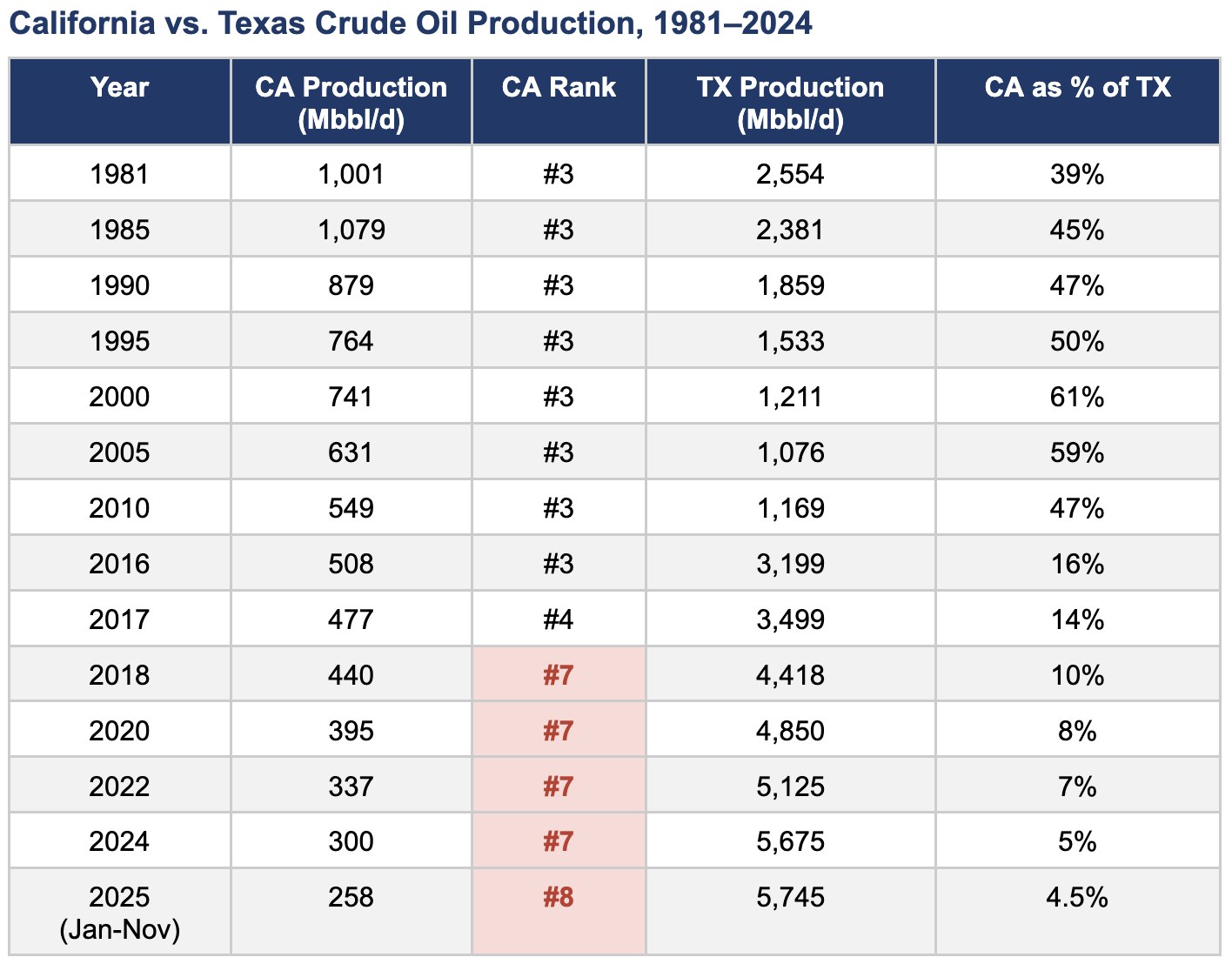
The data from the U.S. Energy Information Administration (EIA) tells the full story. From 1981 all the way through 2016 — 36 consecutive years — California was the #3 oil-producing state in the country, trailing only Texas and Alaska. But California’s oil production has only fallen since the 1980’s while other states, including Texas, have greatly increased oil production.
A Stunning Collapse: From #3 to #7
What has happened since the 1980s is a policy-driven catastrophe. California’s oil production has almost fallen every single year for nearly four decades, dropping from 1,079 Mbbl/d in 1985 to just 300 Mbbl/d in 2024 — a decline of 70%. The state slipped from #3 to #4 in 2017 when North Dakota overtook it. Then the shale revolution transformed the rankings, and New Mexico, Colorado, and Oklahoma all surpassed California. By 2018, California had fallen to #7, where it remained until last year, when Wyoming also surprised California.
The comparison to Texas is staggering. In 2000, California produced 61% as much oil as Texas. By 2024, California produced only 5% as much, and for the first 11 months of 2025, California only produced 4.5% as much oil as Texas. In the span of just 24 years, California went from a respectable energy producer to a rounding error next to the Lone Star State. Great work, Gavin.
The Shale Revolution California Missed — By Choice
While California sat on its hands, other states seized the energy opportunity of a generation. North Dakota went from a minor oil producer to pumping over 1,194 Mbbl/d in 2024 thanks to the Bakken shale play. New Mexico has become a powerhouse, producing 2,023 Mbbl/d in 2024 from the Permian Basin — nearly seven times California’s output.
California sits atop significant hydrocarbon resources, but California’s regulatory environment — a labyrinth of permitting requirements, environmental reviews, setback mandates, and outright moratoria on new drilling permits — has made development effectively impossible. Governor Newsom’s administration imposed a moratorium on new fracking permits in 2021 and has proposed to phase out all oil extraction in the state by 2045.
The consequence is not a California free of fossil fuels. It is a California that imports the fossil fuels it refuses to produce — from Iraq, Brazil, Saudi Arabia, the United Arab Emirates, and now even the Bahamas.
The Refinery Death Spiral
California’s production collapse is compounded by a simultaneous refinery crisis. When Phillips 66 shuttered its Los Angeles refinery in October 2024, it removed a critical piece of the state’s fuel supply chain. Valero Energy is set to close its Northern California refinery this year. With no pipelines connecting California to Gulf Coast refineries, the state is increasingly dependent on marine imports and will continue to pay more for gasoline than virtually anyone else in the country.
California’s unique boutique fuel requirements mean that when California refinery capacity goes offline, it cannot easily be replaced by supplies from other U.S. states. The result is a market structure perfectly engineered to produce high prices, supply disruptions, and gasoline imported from Caribbean islands.
Who Pays the Price?
Governor Newsom likes to talk about fighting for working families. But his policies are designed to make life harder for working families. Here are the current highest-priced gasoline states according to Gasbuddy:
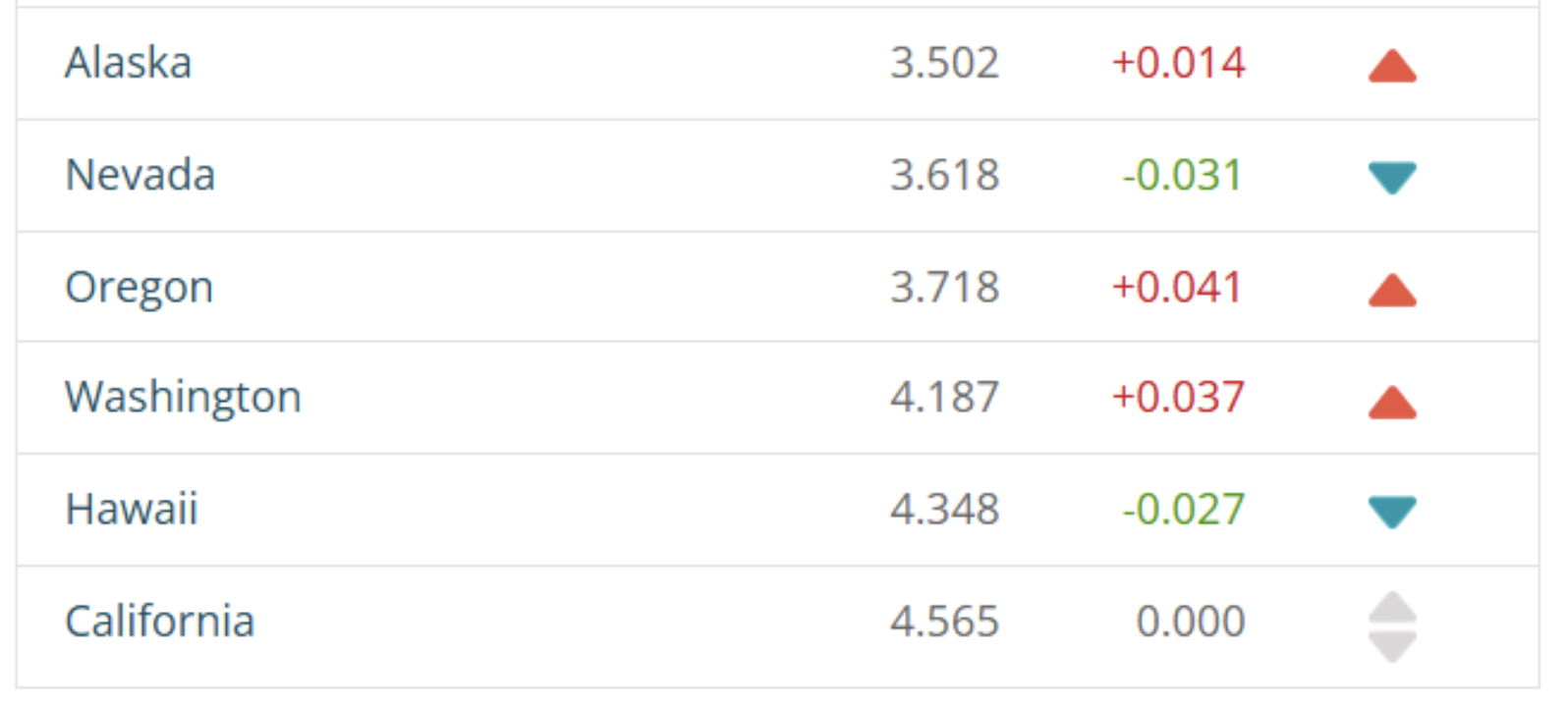
There is no reason that California, an oil-producing state with several oil refineries, should have higher gasoline prices than Hawaii, thousands of miles from any oil production or substantial oil refineries. But this is the outcome of Newsom’s policies.
The Bottom Line
California was the #3 oil-producing state in America for 36 consecutive years. (It was likely the #3 oil producing state for longer, but the data from EIA only goes back to 1981). Today it is #8 and falling. Its production is down over 75% since 1985. It produces less than 5% as much oil as Texas. Its refineries are closing. And it is importing gasoline from the Bahamas.
This is what it looks like when ideology overrides energy reality. Governor Newsom has made California a case study in how to destroy a state’s energy sector — and make its residents pay more for the privilege. The rest of America should take note.

